
The challenge of securing nearly $47 billion for a 12% growth target.
The target of achieving an average GRDP growth rate of approximately 12% per year during the 2026-2030 period places Nghe An province before the requirement to create a strong shift in economic structure, production capacity, and especially the ability to mobilize investment resources.
According to the growth scenario developed by the Department of Finance and the consulting unit during the adjustment of the Nghe An Provincial Planning for the period 2021-2030, with a vision to 2050, the total social investment capital in the next five years needs to reach approximately 1,150 trillion VND, equivalent to nearly 47 billion USD, more than 2.4 times higher than the 2021-2025 period.
Looking back at its development over the past period, Nghe An has achieved many positive results. The size of its economy increased from approximately 44,000 billion VND in 2010 to 145,000 billion VND in 2020 and is projected to reach approximately 237,000 billion VND in 2025, more than five times higher in 15 years.
However, when considered in relation to the province's potential, population size, and geostrategic location, the results achieved have not yet created a sufficiently significant leap in its economic standing.
By 2025, Nghe An's share of the national GDP will only reach approximately 1.84%. The gap with leading localities in terms of economic scale and competitiveness remains quite large.
This reality demands that Nghe An choose a new development trajectory that is faster, more decisive, and more effective. The growth target of approximately 12% per year is set in the context of the whole country aiming for high growth, while also placing expectations on localities with the potential to become new growth poles for the region and the nation.
To achieve this goal, the province's economy must undergo a profound structural transformation. According to the growth scenario, by 2030, the proportion of the agriculture, forestry, and fisheries sector will decrease to approximately 13.5%; the industry and construction sector will increase to approximately 41.5%; and the service sector will reach approximately 40.5%.
To achieve this, the industrial and construction sectors need to continue playing a leading role with a projected growth rate of approximately 16% per year. The processing and manufacturing industries, in particular, need to achieve a growth rate of nearly 20% per year to create momentum for the entire economy. This is because this sector has the potential to generate significant added value, boost exports, increase labor productivity, and enhance the competitiveness of the locality.
The service sector is expected to grow by approximately 11.7% per year, focusing on high value-added industries such as logistics, trade, finance, tourism, education, and training.
As logistics centers, transportation infrastructure, and urban networks continue to improve, the service sector will have more room to develop, contributing to the formation of new growth drivers.
For agriculture, forestry, and fisheries, the goal is to reduce their share in the economic structure while maintaining a growth rate of approximately 4.5% per year through the application of high technology, the development of ecological agriculture, the construction of production-processing-consumption linkages, and the enhancement of value per unit area.
While economic restructuring is a necessary condition, investment resources are the decisive factor in realizing growth targets.
During the period 2021-2025, Nghe An's total social investment capital is projected to reach approximately 471.7 trillion VND. The province's share of total national investment capital has also continuously increased, from about 2.2% in 2010 to nearly 2.8% in 2025.
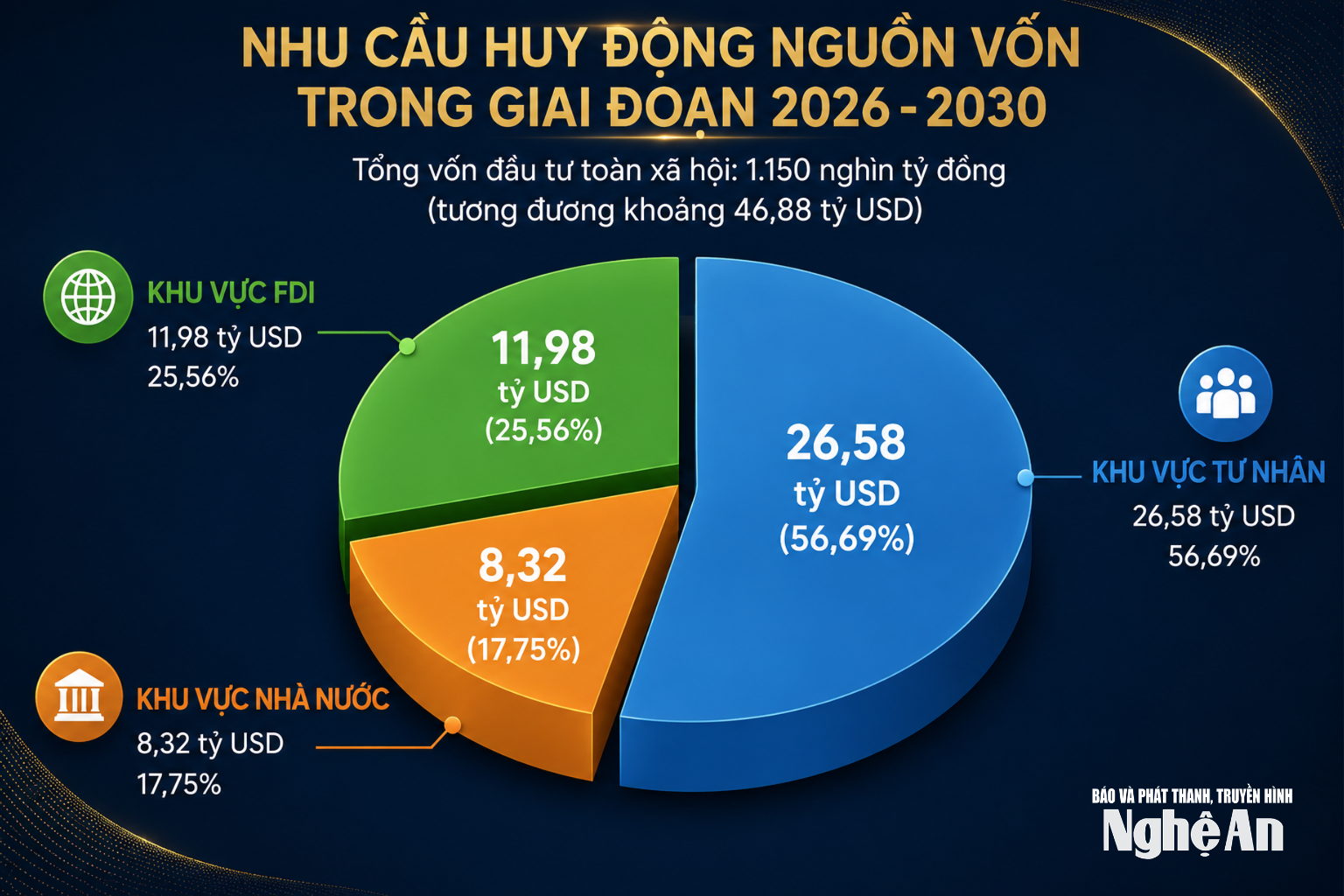
These results lay an important foundation for the next phase of development, but the scale of resources needed to be mobilized in the next five years is much larger. According to calculations, total social investment capital for the period 2026-2030 needs to reach approximately 1,150 trillion VND, equivalent to about 46.88 billion USD.
.png)
According to the scenario, the private sector will continue to play a leading role in the capital structure, with an expected scale of approximately $26.58 billion, accounting for nearly 57% of total investment.
State funding is expected to reach approximately US$8.32 billion, accounting for nearly 18%, focusing on strategic infrastructure projects, regional connectivity, digital infrastructure, education, healthcare, and projects with high spillover effects.
In particular, the foreign direct investment (FDI) sector is expected to grow strongly, reaching $11.98 billion, accounting for more than 25% of total social investment.
Mobilizing nearly $47 billion within five years is an unprecedented challenge for Nghe An province. Success will depend on its ability to create an attractive investment environment, improve capital efficiency, enhance labor productivity, and maximize new growth drivers.
When those conditions are met, the target of approximately 12% annual growth will have a solid foundation to become a reality, opening up opportunities for Nghe An to make a breakthrough in economic scale, enhance its position in the North Central region, and contribute more to the country's growth in the 2026-2030 period.


