
Discussions about relocating Saigon Railway Station following the Ghenh Bridge incident.
Following the collapse of the Ghenh Bridge, many suggested that Saigon Railway Station should be moved to the outskirts of the city to alleviate traffic congestion.
"Any opinion suggesting that the station should be moved entirely to the outskirts of the city certainly comes from people without expertise in urban planning and transportation," said lecturer Ha Ngoc Truong, a standing member of the Union of Science and Technology Associations of Ho Chi Minh City, when addressing the current sentiment of wanting to relocate Saigon Station.
The train stations are all located in the city center.
Beginning the story, Mr. Truong, a senior visiting lecturer in the Railway and Metro engineering field at the Ho Chi Minh City University of Transport, affirmed that Saigon Station cannot be moved to Bien Hoa or even to the outskirts of the city. According to him, the planning of the station is a major issue that has been decided and approved by the Ministry of Transport and the Government since 2013.
The train station must be located in the city center; this is a universal planning principle worldwide. The demand for train travel in the city center is very high. Moving the station to the suburbs would be very difficult, and the number of passengers would certainly decrease significantly. As evidence, when the Ghenh Bridge collapsed, passengers had to be transferred by car to Bien Hoa, and the number of passengers immediately dropped sharply.
Some residents want to move Saigon Railway Station to the suburbs to alleviate traffic congestion. However, transporting 1,000 people to the suburbs to catch a train from the city center would require approximately 30 buses. With an average of 10 train trips per day, this would necessitate over 300 bus trips. "Doing so might actually worsen traffic congestion at the city's gateways," Mr. Truong explained.
Furthermore, the national urban railway system must be interconnected to ensure adequate service for passengers, as it serves not only people from the northern and central provinces but also those from the eastern and western regions. Trains should bring passengers as close to the city center as possible.
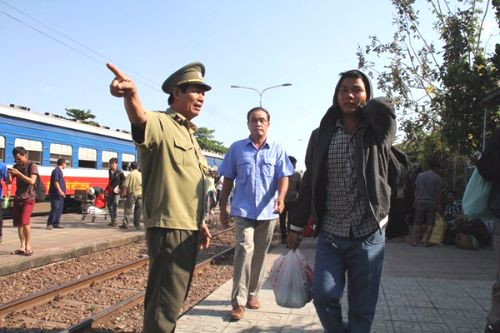 |
| The staff at Bien Hoa train station worked tirelessly as they were "unwillingly" forced to receive a very large number of passengers due to the collapse of the Ghenh bridge. |
Concurring, Dr. Pham Sanh, a transportation expert, stated that urban planning is a difficult problem. Experts, the Ministry of Transport, and the Government have analyzed the pros and cons before deciding to keep Saigon Station in the city center.
The train station in the city center not only solves the problem of large-scale passenger transportation but also impacts the economy, society, and national defense of Ho Chi Minh City, Vietnam's largest city.
"We shouldn't use traffic congestion as an excuse to relocate Saigon Railway Station to the suburbs. The traffic jam will worsen when a large number of buses transport passengers from the city center to the suburbs to board trains," Dr. Sanh warned.
According to him, the important thing here is to find ways to improve and modernize railway transport, and to arrange train schedules more rationally. As for the traffic congestion problem, a more comprehensive solution is needed, such as reducing private vehicles and developing a public transport system with high carrying capacity, safety, and speed.
Completing the metro lines is an urgent task.
Mr. Lam Thieu Quan (a representative of the Ho Chi Minh City People's Council) suggested that the most convenient option is to relocate Saigon Railway Station to the Binh Trieu area (Thu Duc District) to take advantage of the newly constructed Pham Van Dong road. At the same time, he proposed expanding the Xo Viet Nghe Tinh road and National Highway 13 from the Hang Xanh intersection to Binh Trieu, and building an additional bridge on the Thanh Da peninsula.
Saigon Station will remain the central passenger transport hub once the elevated railway from Binh Trieu is completed, utilizing the existing railway line. Thus, Saigon Station will also connect with Metro Line 2 (Ben Thanh – Tham Luong) to the northwestern gateway of the city.
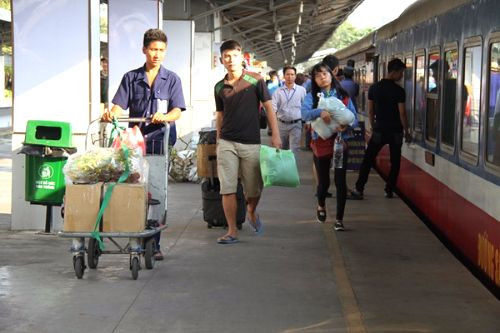 |
| Passengers board the train at Saigon station. |
Lecturer Ha Ngoc Truong believes that the density of traffic in the city is increasing, especially private cars. He argues that an elevated railway should be built immediately between Binh Trieu station and the existing Saigon station. Currently, the Prime Minister has approved the elevated railway project from Binh Trieu to Hoa Hung, while retaining Saigon station as the connection point for the national railway line.
“The goal of the national railway and the urban railway is to connect them to serve people's travel needs most conveniently. Therefore, keeping Saigon Station intact will certainly help these two railway lines connect smoothly,” said Professor Truong. Sharing his views on this issue, Associate Professor Dr. Nguyen Minh Hoa, an urban studies expert, commented that the core issue is finding solutions to reduce traffic congestion. Dr. Hoa said: “The city must focus all its efforts on building the Metro lines as quickly as possible, especially lines 1 and 2. Only then will the traffic congestion problem be reduced, and the Saigon Station issue will be easier to solve. If the elevated railway line from Binh Trieu and Saigon stations is built, it will reduce 14 level crossings caused by the railway.”
Lecturers from the Ho Chi Minh City University of Technology, Vietnam National University, believe that relocating Saigon Railway Station to Binh Duong and Bien Hoa is definitely not feasible. For a large city like Ho Chi Minh City, having a railway station in the city center is essential.
However, with the current sharp increase in traffic density, relocating Saigon Station to Binh Trieu, right at the intersection of National Highway 13 and the Tan Son Nhat – Binh Loi ring road, is also a good solution if investment is made in bus routes and connecting infrastructure. This is a major intersection, accessible to people from Binh Phuoc, Binh Duong, and Dong Nai provinces.
According to Zing.vn


