
Issuing a resolution on reforming Vietnam's development model.
On behalf of the Central Committee of the Party, General Secretary and President To Lam signed and promulgated the Resolution of the Third Plenum of the 14th Central Committee of the Party on reforming Vietnam's development model (Resolution No. 19-NQ/TW, dated July 28, 2026).
According to Resolution No. 19-NQ/TW (the Resolution), in order to realize the aspiration of making Vietnam a developed, high-income country by 2045; establishing the foundation for the next 100-year vision of national development under the leadership of the Party (2030-2130), reforming the development model associated with building and perfecting the development ecosystem is a strategic task for successfully building socialism in Vietnam.
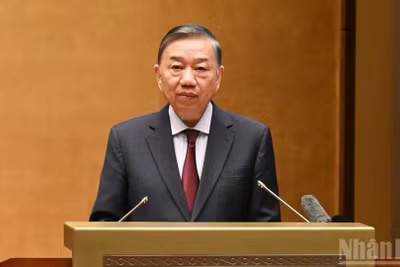
Issuing a resolution on the National Security Strategy
The development model is reformed to operate synchronously under the mechanism of "Party leadership, State management, and people's ownership"; based on modern national governance and a harmonious and effective relationship between the State, the market, and society. The central task is to develop the economy and society while protecting the environment; to build a clean, strong, and comprehensive Party and political system as key; to develop culture and human resources as the foundation, endogenous resource and driving force, and national soft power; and to strengthen national defense and security and promote foreign relations and international integration as crucial and ongoing priorities. Institutional reform and national governance are considered breakthroughs; and the effectiveness of coordination, quality of service to the people and businesses, and problem-solving capacity are used as benchmarks.
Regarding objectives, according to the Resolution, by 2030, the foundations for a new development model across all sectors will be completed, in line with the level of development of a developing country with modern industry and high middle income. By 2035, the transition to a self-reliant, innovative, humane, sustainable, and integrated national development model will be fundamentally completed; and the component models across all sectors will be synchronously formed.
By 2045, the transition to a self-reliant, innovative, humane, sustainable, and integrated national development model will be completed, with component models across all sectors operating synchronously, harmoniously, and effectively. Vietnam will become a developed, high-income country, steadily advancing towards socialism.
With a vision extending to 2130, Vietnam aims to become a highly developed, civilized, modern, and distinctive socialist nation with enduring creativity and vitality; making a worthy contribution to humanity. To successfully achieve these goals, the Resolution outlines seven groups of tasks and solutions.
The resolution emphasizes that leadership capacity in strategic planning, institution building, implementation, and self-rectification and self-renewal should be the focus; Party building and rectification, organizational work, and personnel management are core elements of national governance. It calls for fundamental reform in the development and implementation of Party resolutions and conclusions. It also calls for perfecting the socialist rule of law state of the people, by the people, and for the people, led by the Communist Party of Vietnam.
Establish a new growth model based on productivity, science, technology, innovation, digital transformation, green transformation, and high-quality human resources. Reorganize the national development space towards a multi-tiered, multi-polar direction. Rapidly develop new, modern productive forces; science, technology, and innovation truly become direct productive forces and the main driving force of growth. Build a disciplined, safe, civilized, harmonious, and developed society capable of adapting and recovering from fluctuations. Build a modern, multi-tiered, sustainable, inclusive, flexible, and highly adaptable social security system; consider investment in social security as investment in development.
Building an advanced Vietnamese culture rich in national identity; implementing a comprehensive system of national values, cultural values, family values, human standards, and social standards in Vietnam from the central to the grassroots level; considering population as a strategic resource for long-term growth. Considering resource and environmental management as a pillar of sustainable development; adapting to climate change and the resilience of the economy. Firmly adhering to an independent, self-reliant, self-strengthening, multilateral, and diversified foreign policy; ensuring the highest national interests based on international law; promoting the combined strength of Party diplomacy, State diplomacy, and people-to-people diplomacy.


