
Red alert on housing prices in Vietnam.
Although housing prices in Vietnam are among the lowest, the ratio of housing prices to income is among the highest at 28 times. Therefore, it's not that housing prices in Vietnam are too high, but rather that people's incomes are too low?
In recent days, news about Vietnam's housing prices reaching alarming levels has become the focus of the market. This information was presented at a meeting between a delegation from the Central Economic Committee and the Ho Chi Minh City Real Estate Association (HoREA) on the afternoon of September 8th to hear assessments of the current state of the Ho Chi Minh City real estate market.
 |
| Illustrative image |
Specifically, at the meeting, the Ho Chi Minh City Real Estate Association stated that not only is there a shortage of affordable housing and small-sized homes, but the recent surge in real estate prices is pushing the dream of home ownership further away for the urban poor. Alarmingly, among them, the poor are gradually losing the ability to buy a home.
It's clear that housing prices in Vietnam have been a much-discussed topic for a long time. Many argue that housing prices in Vietnam are too expensive, while others believe they are still significantly cheaper than in other countries in the region.
This article does not discuss whether house prices are expensive or cheap because, with a concept as relative as "expensive" or "cheap," comparing any commodity is very inappropriate, especially with real estate, which is highly immovable. Furthermore, the issue of whether real estate prices in a country are high or low needs to be compared in relation to many other factors such as income levels, economic conditions, and market conditions.
However, that doesn't mean real estate prices are incomparable. A common method many countries use to compare house prices is to compare the average house price to the average income of their citizens.
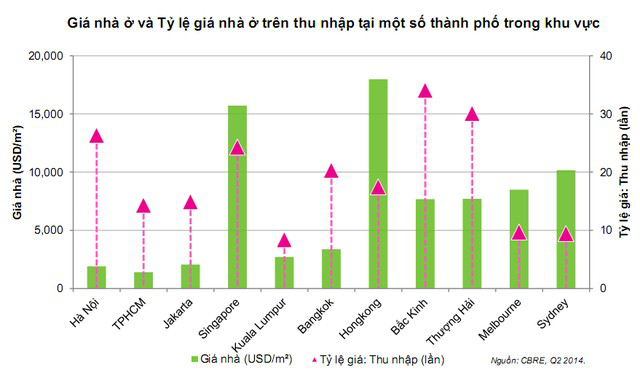
According to a report by real estate consulting firm CBRE, compared to other major cities in the region, house prices in Hanoi and Ho Chi Minh City are relatively low, at only around 1,500-2,000 USD/m2. Meanwhile, house prices in Singapore reach 16,000 USD/m2, and in Hong Kong 17,500 USD/m2.
Although prices are among the lowest, the ratio of housing prices to income in Vietnam is relatively high, reaching 28 times in Hanoi (higher than Singapore) and 18 times in Ho Chi Minh City. This demonstrates that the low income of Vietnamese people results in one of the highest housing price-to-income ratios in the region.
According to CBRE, based on a salary survey of over 500 skilled workers in major Vietnamese cities, CBRE estimates that married couples in Ho Chi Minh City and Hanoi with stable jobs and incomes can begin thinking about buying a house after 7 years of saving.
Specifically, after 7 years of effort, a young family can save up to 800 million VND. If considering buying a mid-range house priced at 1.6 billion VND, the savings would be enough to cover 50% of the house's value. The remaining amount could be borrowed from a bank, family, or other connections.
 |
| Photo: Internet |
Besides CBRE, Cushan & Wakefield, Colliers also provided an interesting comparison of real estate prices in Ho Chi Minh City with cities of similar population size. In this comparison, most properties in Ho Chi Minh City are cheaper than in other cities such as Bangkok, Manila, and Jakarta.
Regarding housing prices in Vietnam, Mr. Nguyen Tran Nam, Chairman of the Vietnam Real Estate Association and former Deputy Minister of Construction, once stated: "Don't complain about high housing prices; it's simply because workers' wages are too low. The media often reports that housing prices in Vietnam are too high. But I've searched extensively and can't find any statistics showing that Vietnam is among the top 20 countries with the highest housing prices in the world."
Although housing prices in Vietnam are not high compared to other cities in the region, the reality is that when comparing housing prices to people's incomes, the disparity is enormous. People in major cities are struggling to pay prices that are 26 times higher than their income. This raises the question of whether people need to increase their income or whether government agencies need to implement policies to support and lower housing prices so that people can afford to buy a house.
According to Cafe
| RELATED NEWS |
|---|


