
School violence and corporal punishment as a form of education.
(Baonghean) - Recently, the incident of female students in Quynh Luu beating a classmate, with the video being posted online, has once again ignited social concern about school violence. What's noteworthy is that, in the face of this situation, many people focus solely on blaming the school, the education sector, the moral decline of society, and even the entire system, rather than the way children are educated within their families.
Of course, schools and the education sector also have their share of responsibility, but if we only rely on the school's responsibility while neglecting, or even making mistakes in, educating children from the family environment, then no matter how talented and responsible the school and teachers are, it will be difficult to transform a misbehaving child into a well-behaved one. Unfortunately, this is precisely what is happening in our society.
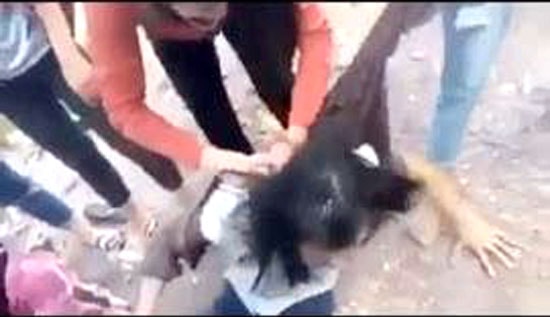 |
| Images of the student beating incident in Quynh Long commune (Quynh Luu district). (Image cropped from a video clip) |
Even now, many parents still use corporal punishment to discipline their children when they disobey or do wrong. The concept of "spare the rod and spoil the child" in child rearing has been extremely prevalent in Vietnamese tradition from ancient times to the present day.
However, modern psychologists and educators argue that hitting and scolding children reflects a parent's inability to control their anger and a flawed approach to parenting. This will negatively impact the child's character development later in life. Modern laws prohibit this, yet it still occurs daily to varying degrees, albeit less frequently than before. Changing a deeply ingrained habit that has existed for thousands of years since the establishment of the family is no easy feat.
This method of corporal punishment influences the formation of children's personalities, tending towards increased aggression and lack of self-control, because what a child receives to shape their character begins in their first educational environment, which is their family. And then, these children, later in life, tend to behave according to what they observed and experienced from their early years.
Many of my teacher friends complain that teaching is too difficult now, not only because of the heavy curriculum, but also because teachers are no longer allowed to hit or scold students as they used to. Classroom discipline is therefore very difficult to maintain. In reality, teachers themselves, as well as many parents, still confuse corporal punishment with strictness. Strictness doesn't always have to involve corporal punishment.
Of course, each child has very unique temperaments requiring different educational methods, but partly because teachers are preoccupied with cramming a heavy amount of knowledge, and partly because they lack patience and suitable methods, they don't have the energy to focus on the differences between children in their education. However, this is something that must be done at home. Parents must understand their children better and be able to guide them in a positive direction through closeness and love. If they don't have enough patience for just a few children, how can they expect teachers to do the same for dozens or hundreds of children at once?
Unfortunately, it seems that many parents today, preoccupied with making a living, lacking responsibility, and lacking understanding, see corporal punishment as a solution. When their children misbehave, they blame the school, bad friends, a chaotic society, and all sorts of other things, as long as it's not their fault. This is precisely what will cause school violence to increase. And the transition from school to society is merely a change in scope.
Bao Ngan


