
What is the best age to start learning English?
Due to the slow progress of English language teaching and learning programs in secondary schools, coupled with the decline in the quality of language centers and the scarcity of even slightly high-quality facilities, parents have decided to take matters into their own hands.
When parents begin teaching their children English, two situations arise. First, those who are proficient in English will make the most of the time by speaking to their children in English at home – due to a vague understanding of ESL (English as a Second Language) and bilingualism.
Secondly, parents who don't know or have poor English skills choose another solution: exposing their children to English as much as possible through online resources, or hiring native English-speaking teachers to "talk" with their children in self-directed classes.
 |
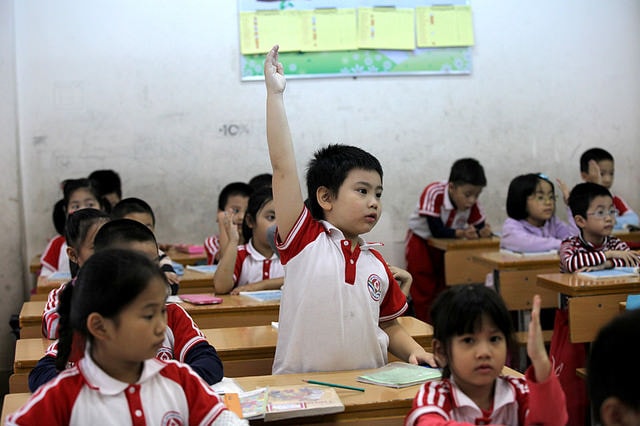
| Children are increasingly being exposed to English by their parents at a young age. |
The story of "right" and "wrong"
Firstly, from a linguistic perspective, we need to clearly recognize that language is a "living entity" that changes over time and space.
English itself has evolved through at least four periods – and words from earlier periods, when used in modern times, can easily sound "ridiculous" or "outdated." Even when discussing the same issue, times change, and societal perceptions differ ten years from ten – using words that inadvertently clash with these changed perceptions can unintentionally cause discomfort for the listener (similar to what happens with Vietnamese).
Therefore, equating English with... English, using any English-language material to teach children, without the necessary explanation and linguistic sensitivity regarding pragmatics (which words to use in which situations...), will only make the goal increasingly distant. As a result, while your English may sound good to native speakers, it will still sound very "Western" to them.
 |
Secondly, regarding culture and language, although language is merely an outer shell, it has a close and interactive relationship with each individual's "culture." In other words, an individual's attachment to a particular language, using it as the primary language of thought, will directly influence how that individual thinks about a problem.
We need to carefully consider: What do we want our children to learn—Western European civilization or their culture? What do we want to pass on to our descendants—Vietnamese culture, or should we borrow foreign cultures?!
Thirdly, regarding ESL and Bilingualism. To achieve ESL and Bilingualism, exposure to language-speaking environments is crucial – if not the most part of the time.
That explains why while it's great for parents to teach their children from a young age, if they lack the necessary resources later on, their children's language skills won't develop as well as desired. The biggest benefit gained is improved pronunciation, while the losses will be significant.
Starting school early only costs money…
The ideal age to learn English and the question of how to learn effectively – this is an age-old topic for professionals and a well-known fact for teachers, but for the business world, it's something the less people know, the better, and the more misunderstandings there are, the better.
There has been much research on this topic before, particularly a series of highly comprehensive studies comparing the strengths and weaknesses of different age groups learning English in EFL environments across three main age groups: children, adolescents, and adults.
In summary, the results are simple: Adults have a significant advantage due to their foundational knowledge and well-developed first-language skills – meaning they don't need much time to understand concepts in their second language. They also learn rules faster because they've already developed habits of learning similar things since childhood… However, they face limitations in pronunciation because their vocal organs are less flexible than those of younger people.
Young people have the greatest advantage because, although they don't develop any skills as dramatically as the other two age groups, they develop relatively evenly across all aspects.
Children, due to their underdeveloped cognitive abilities, generally face many difficulties in learning. Their greatest advantage lies in pronunciation, as they can achieve pronunciation closest to native speakers when they start learning early (before puberty).
In terms of methodology, a comparison of curricula reveals that the progression of levels in adult education is typically confined to just a few books, moving from Beginner to Advanced. In contrast, children's programs space out that knowledge much more widely.
If we compare the highest level currently offered to children, the Flyer level, it's only equivalent to the Elementary level for adults. This clearly shows the "effectiveness" of teaching English to children in terms of time and money compared to the results achieved.
 |
In terms of "awareness," it can be asserted that the younger the students, the less aware they are of regular linguistic phenomena (grammar), therefore it is very difficult to help them advance to the Intermediate level.
If parents try to do this without guidance, it will lead to their children developing naturally. And in an ESL environment, they will rely on the environment (teachers, curriculum, friends, etc.) to change on their own, but it will take a very, very long time.
In an environment where English is a foreign language, students are forced to revert to grammar-based curricula – but these are often unsuitable for their age and developmental stage, leading to frustration at learning something that is both "lower" in difficulty and rigid.
What is considered good?
In fact, the principle remains the same: contact – the more the better – just as parents are already doing and achieving success with. This principle of contact applies to all ages, differing only in two aspects: interest/concern and initiative.
Regarding interest/compassion, people of all ages need attention and interest to absorb information and make it their own.
The difference between children and adults is that adults can force themselves to care about something because they know it benefits them, while children pay no attention to the "benefit" aspect, but are instead swept along by their instinctive feelings about things/phenomena.
Regarding proactive learning, which stems from an understanding of how necessary learning is for oneself, adults tend to be more proactive in their learning than children. And when people are proactive, they learn more and remember more of the information they encounter.
In addition, there must be an environment to use what has been learned. At the lower level, this means having people to communicate with so that what has been learned can be applied to situations, thereby developing language reflexes.
At a higher level, it's about creating a "product" of thought that stems from what is acquired through language.
To progress from lower to higher levels, a step-by-step development plan is needed, which includes a thorough understanding of the different "levels," combined with many new pedagogical skills to achieve the desired results.
Another issue is the need to enhance vocabulary in various areas of language and society. This isn't simply a matter of teaching; it requires significant effort to help children understand, connect, and absorb the information, or for adults to have the knowledge to understand and remember it.
The English proficiency standard has changed.
Many believe that early learning is beneficial to take advantage of the wealth of human knowledge expressed in English, but in reality, knowledge is boundless, and it's impossible to know when you'll ever learn enough.
Furthermore, since the brain is "programmed" to receive different things at different ages, recent studies have shown that introducing academic knowledge to young children too early is harmful to their development.
And finally, those interested in education are likely aware of the skills emphasized by the Partnership for 21st Century Skills (P21, a non-governmental organization comprising members from educational institutions in many countries around the world) as essential for the new century, including the 4 Cs (Collaboration, Communication, Critical Thinking, and Creativity).
And training people for the future should focus on these skills, not on a specific profession or area of knowledge.
Furthermore, with 75% of global communication taking place in English, but between non-native speakers, the required standard of English in this era is no longer British or American, but rather an international standard.
Therefore, the need for English pronunciation that "sounds like a native speaker" is no longer as important as it once was.
My conclusion is…
Language is intrinsically linked to culture, and it's what shapes one's self-worth in the world: "Who am I, where am I, and what is there to be proud of in my world?"
You shouldn't expect to create an ESL or bilingual child if you don't enroll them in an international school and instead have them join the Vietnamese public school system.
Age doesn't actually play as important as many people think. In fact, older children learn (and achieve) better than younger children. If you consider the economic aspect of the investment, pouring too much money into English education for children isn't very "economical."
From the perspective of someone who has been teaching adults for the past decade or so, I've clearly observed that it's crucial to lay a foundation for a positive learning attitude from a young age. This involves encouraging children's interest in and proactively seeking information, rather than simply trying to teach them as much as possible.
And we need to have the right perspective on how to teach and approach foreign language instruction, thereby filtering out what is truly effective to save time, effort, and money, while achieving the best possible results.
In other words, choose to do what's "easy," because those things have a much higher chance of success!
According to Vietnamnet


