
Russian Presidential Election 2018: Important things to know
(Baonghean.vn) - The 2018 Russian presidential election will officially take place on March 18th. This race for the Kremlin marks meticulous preparation, as well as many innovations in the way elections are organized in Russia.
 |
| The 2018 Russian presidential election officially took place on March 18. Photo: TASS |
Openness and transparency
Surveillance cameras
In 2018, for the first time in Russian election history, internet-connected surveillance cameras were installed not only at polling stations, but also in local election commissions.
While no polling stations were equipped with surveillance devices during the 2012 presidential election, by 2018, 100% of polling stations were fully equipped.
Social monitoring
In the 2018 presidential election, not only the candidates and political parties, but even social departments were granted observer rights during the election.
International Observers
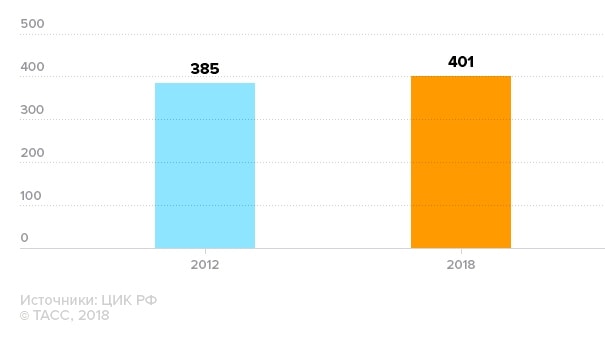
In this election, as many as 86 countries and 14 international organizations accepted Russia's invitation and sent observer delegations to monitor the Russian presidential election taking place on March 18th.
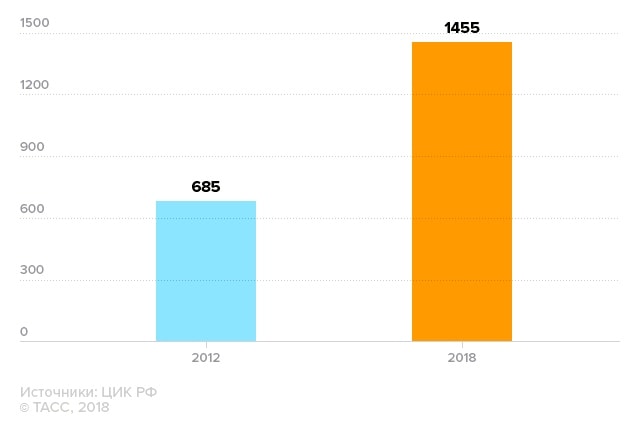 |
| The chart shows the number of international observers who participated in the Russian presidential elections in 2012 and 2018. (According to TASS) |
Modern technology equipment
Vote Counting Committee
High-tech equipment has been installed to facilitate the vote counting process. Invalid ballots will be automatically discarded. The election results at any polling station will be displayed as soon as voters complete their ballots.
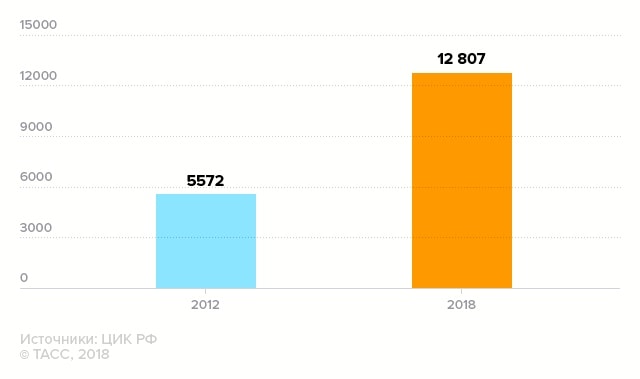 |
| The chart shows the number of machines installed to assist in vote counting during the 2012 and 2018 presidential elections. (According to TASS) |
Apply QR code
Election results records are now provided electronically. The QR code system helps avoid data entry errors and replaces manual information entry.
While QR codes were not used in the 2012 presidential election, by 2018, 93.2% of election results were being recorded using QR codes. This resulted in a sevenfold reduction in the time required to enter election results data.
Digital media
In preparation for the 2018 presidential election, throughout 2017 Russia focused on equipping local election commissions with modern digital communication and transmission equipment.
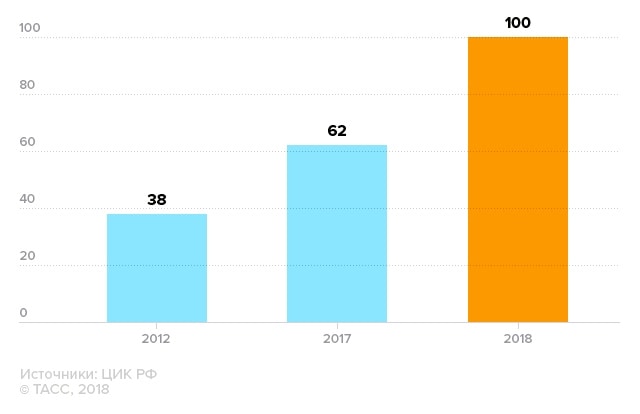 |
| The chart shows the number of election commissions equipped with digital communication devices over the years. (According to TASS) |
Give voters more opportunities.
Electronic voting
The most significant new feature of the 2018 presidential election was the opportunity for voters to cast their ballots at any polling station. Furthermore, with the "Electronic Voting" project, voters only needed to register at any local election commission or online portal to be provided with the application and electronic voting services.
As of March 14th, there have been5.63 million votersRegister to vote electronically.
Ensuring the right to vote for people with disabilities and infirmities.
For voters who are disabled or unable to go to polling stations due to health reasons, there is still an opportunity to vote from home. The local election commission will be responsible for assigning staff to collect the ballots.
Facilitating the lives of Russian residents abroad.
For voters working and living abroad, there is still an opportunity to exercise their right to vote. The Russian election commission has organized early voting for these individuals in 81 countries around the world.
 |
| The chart shows the number of Russian citizens abroad who participated in presidential elections over the years. (According to TASS) |
In Crimea and the territory of Sevastopol
In Crimea and Sevastopol, elections will be held for the first time since their annexation by Russia in 2014.7,000,000 votersFor the first time, they were granted the right to vote in the Russian presidential election.


