
China's AI drone swarm and the strategic risk to the US.
China accelerates AI-powered swarm UAV deployment: CETC tests 119 drones, Jiu Tian SS-UAV with a 25m wingspan; US faces the challenge of defense costs and the need for direct human monitoring.
China is investing heavily in AI-powered UAVs employing swarm tactics, posing a direct challenge to U.S. military superiority. These inexpensive, difficult-to-intercept, autonomous systems, capable of making their own decisions, could saturate defenses, placing significant cost pressure on Washington. The difference in the rules governing the use of AI-powered lethality—the U.S. placing humans in a loop, China prioritizing speed—further intensifies the technological race.
Overview: The Military AI Race
Beijing is pursuing a comprehensive military-civilian integration model, mobilizing defense enterprises and laboratories to accelerate development. Lessons from Ukraine and the Houthi forces' use of inexpensive UAVs in the Red Sea are seen as catalysts for advancing swarm tactics. The goal is to use numbers, speed, and automation to break down the dominance previously based on aircraft carriers, fifth-generation fighters, or destroyers.
Meanwhile, the U.S. must also accelerate to avoid being left behind. Both sides are caught in an “armed AI” race, where fears of being overtaken outweigh considerations of security and strategic risks.
AI "Swarm UAVs": Capabilities and Foundations
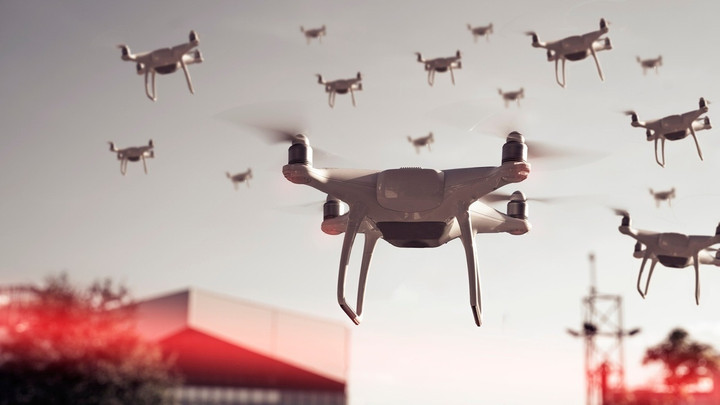
In 2017, China Electronics Corporation (CETC) tested a formation of 119 truck-launched suicide drones, attracting international attention. This was followed by what were believed to be larger-scale tests, integrating real-time cooperative algorithms, auto-routing, auto-target identification, and multi-agent reinforcement learning, allowing the UAV clusters to operate without a command center.
China is simultaneously pursuing fighter-sized UAVs to work in conjunction with manned aircraft. Prototypes such as the Feihong-97 and GJ-11 Sharp Sword have repeatedly appeared alongside the J-20, forming a combat structure where UAVs perform reconnaissance, electronic warfare, or suicide missions. The US is pursuing a similar approach with its CCA program, working in conjunction with the next-generation F-47 fighter within the NGAD framework.
In 2025, images of the Jiu Tian SS-UAV were released, depicting a UAV "mothership" with a 25-meter wingspan, capable of deploying entire swarms of drones while in flight. The question then arises: why does the US lack a comparable platform if Beijing has already realized this design?
At sea, China deploys JARI — unmanned surface vessels configured as miniature versions of destroyers, incorporating AI navigation and compact weaponry. Underwater, the HSU-001 autonomous submarine has entered service, reportedly tasked with reconnaissance and providing guidance for long-range missile systems.
Tactics: Saturate the defense and disrupt the system.
Swarm tactics exploit the design limitations of modern air defenses. Air defense systems, optimized to counter a few dozen targets simultaneously, can be paralyzed by several hundred low-flying kamikaze drones that constantly change their flight paths and coordinate their targets. This cooperative mechanism creates gaps in the sensor network, making it difficult for radar and reactive firepower to achieve consistent effectiveness.
Air bases that rely on fixed runways are at risk of disruption from low-cost but potentially crippling attacks. Even multi-million dollar fifth-generation fighter jets struggle to maintain overwhelming superiority against AI-powered suicide drone swarms that can approach from multiple directions, disperse, and regroup flexibly.
One notable impact is "budget erosion": swarms of UAVs costing a few thousand dollars force adversaries to use expensive interceptor weapons, driving up defense costs significantly. Under this scenario, the US could spend tens of billions of dollars just to counter a cheap target.
The problem of rules of warfare: Humans in a loop
Washington maintains the principle of human approval or oversight of lethal decisions to control AI risk. China appears to place no similar limits, instead prioritizing speed and processing power. Its command culture values decisive action, making automated systems more susceptible to higher levels of empowerment in target identification and firing.
This puts the U.S. in a difficult position: either accept a slower pace and the risk of falling behind, or loosen the safeguards that have been deemed necessary. Both options carry strategic risks.
Regional impact and prospects
With its vast UAV force, China can influence the balance of power in the Western Pacific. When swarms are deployed simultaneously in the air, on the surface, and underwater, they not only overload radar but also create defensive gaps, forcing adversaries to disperse their firepower.
The future of this competition becomes more dangerous as both Beijing and Washington accelerate innovation to avoid being overtaken. In this direction, AI in UAV warfare continues to be a focal point, with increasingly clear tactical and cost implications.


