
Wastefulness
(Baonghean.vn) - President Ho Chi Minh once pointed out: "Only by being thrifty and avoiding extravagance can one maintain integrity and purity. If one is extravagant and wasteful, one will inevitably have to find ways to obtain money. This gives rise to corruption, embezzlement, and hypocrisy."
For a long time, this has been discussed extensively in Party and State documents and in the mass media.wastefulnessWastefulness is understood as the act of agencies, organizations, and individuals responsible for managing and using national capital, assets, labor, working time, and other resources, including those of agencies, units, and individuals, in a manner that violates principles, regulations, or is inefficient.
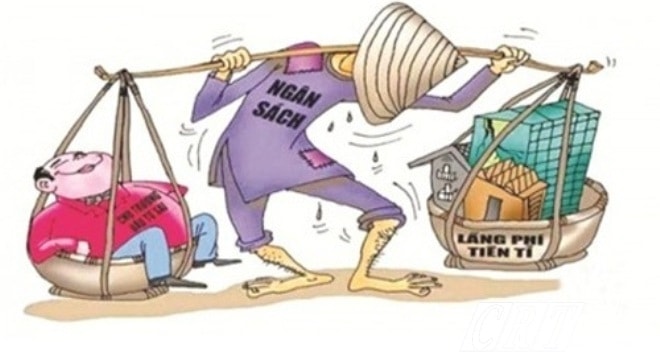
At the macro level, through mass media, in recent years there have been cases of waste and loss of state finances, assets, budgets, land, and resources worth hundreds or thousands of billions of dong.
 |
| Illustrative image. |
Public investment is inefficient or ineffective. Many state budget expenditures are unnecessary, such as conferences, seminars, groundbreaking ceremonies, inaugurations, and festivals. Many projects are unnecessary or inefficiently utilized; many infrastructure projects using state budget funds are expensive but of poor quality, requiring significant maintenance and repair costs.
The use of outdated technology in resource exploitation leads to inefficiency, waste, and environmental pollution. Most exports are in raw form at low prices; however, we have to import raw materials, fuels, and other components, many of which are produced from the very same raw materials we export, at high costs, resulting in a balance of payments deficit. Poor management and exploitation lead to resource depletion, budget losses, and environmental pollution.
State-owned enterprises, envisioned as "steel fists," enjoy numerous advantages in terms of capital, resources, technology, and policies, but in reality, their operational efficiency is very low compared to the private sector. Many state-owned enterprises misuse capital, investing indiscriminately in sectors unrelated to their core business, resulting in significant losses and waste of state budget and assets.
The procurement and use of public assets are often not in accordance with regulations, and management is lax. The waste in the procurement and use of thousands of official vehicles alone is significant. Public funds are spent arbitrarily and without principle in many places. Furthermore, we also waste human resources and labor time, etc.
In our daily lives, we still see many instances of wastefulness. These include stalled or unimplemented development plans, impractical programs and projects that fail before completion, and inefficient initiatives. There are also pointless meetings and excessively large meals, and so on.
President Ho Chi Minh once pointed out: "Only by being thrifty and avoiding extravagance can one maintain integrity and purity. If one is extravagant and wasteful, one will inevitably have to find ways to obtain money. This gives rise to corruption, embezzlement, and hypocrisy,"...
There are many causes of wastefulness, both objective and subjective. However, the main cause remains the weak awareness of law enforcement and regulations among both those in authority and those implementing them. What's concerning is that some individuals like to set "records," creating "grandiose" and "high-class" displays. They believe that this is what makes them "big, doing big things, thinking big," even disregarding frugality and those who practice it! And in reality, this wastefulness is essentially public money that they consider "free money," whereas their own money is much more carefully managed.
Wastefulness is one of the manifestations of ideological and political decline, moral decay, and lifestyle degradation, as well as "self-evolution" and "self-transformation," as pointed out in the Party's Central Resolution 4 (12th Congress).
The Law on Practicing Thrift and Combating Waste, and many regulations in other laws on this matter, are quite complete and comprehensive, but enforcement remains limited. Every year, numerous corruption cases and cases related to waste are tried, revealing that the awareness of legal compliance among those involved, both those in authority and those enforcing the law, is still limited and weak.
***
When President Ho Chi Minh was alive, corruption and waste were not as prevalent as they are now, but he clearly pointed out the harmful effects of waste: “Corruption is harmful, but waste is sometimes even more harmful; it is more detrimental than corruption because waste is so widespread…” “Corruption, waste, and bureaucracy are a kind of ‘internal enemy,’ an enemy of revolutionary morality and of socialism. We must resolutely combat waste in our agencies and in our daily lives. We must fight against the reckless spending of the people's money and the government's capital.” Currently, there are opening ceremonies, celebrations, and banquets costing tens of thousands or hundreds of thousands of dollars that need to be stopped… “Wastefulness is not just about squandering the people's money, sweat, and tears, but more dangerously, extravagance and luxury will lead to corruption, harassment, loss of character and morality among officials and Party members, causing a loss of trust among the people, and thus negatively affecting the construction and development of the country.”
Uncle Ho's teachings from years ago still hold true.


