
Portugal lost to Ireland 0-2, Ronaldo received a historic red card.
In the 61st minute in Dublin, VAR upgraded Ronaldo's yellow card to a direct red card after a swing at Dara O'Shea – his first in 226 matches, risking him missing the opening match of the 2026 World Cup.
Portugal lost 0-2 to Ireland in Dublin on the morning of November 14th, but what made the match even more talked about was Cristiano Ronaldo's historic red card. In the 61st minute, after VAR intervention, his initial yellow card was upgraded to a direct red card for swinging his arm at Dara O'Shea's face. This was the first time in 226 appearances for the national team that Ronaldo had been sent off.
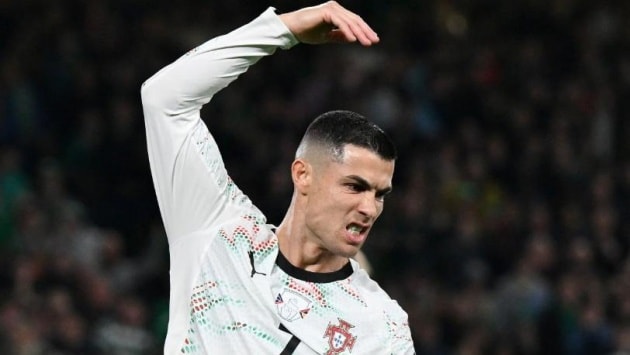
The decisive moment in Dublin
The incident stemmed from what seemed like a normal challenge when Ronaldo tried to get into position ahead of Dara O'Shea to receive a cross. Instead of shielding the ball skillfully, he lost control, allowing his elbow to strike his opponent's face. The referee initially issued a yellow card, but VAR reviewed the incident for about 30 seconds and changed the decision to a direct red card. For a player known for his discipline over more than two decades, that moment was just as shocking as the scoreline.
VAR, penalties, and implications for the 2026 World Cup.
The problem doesn't stop at the red card. According to the rules for violent conduct, the suspension will not be carried over to the rest of the qualifying round, but will be transferred directly to the 2026 World Cup. This means that if the suspension is two matches or more, Ronaldo could miss the first few matches of the tournament where he is expected to conclude the final chapter of his international career. This risk means that a momentary mistake becomes a variable that could impact the entire team's plans.
Tactical and psychological perspective: when a team relies on a symbol.
A bigger issue arises: the sensitivity ofSelecaoGiven Ronaldo's emotional state, as the newspaper Record analyzed, when the "number 7" is full of energy, the team moves forward; when he is affected, the whole team tends to slow down. Against Ireland, the red card was like a broken wire, dragging his teammates into a state of confusion in their reactions. This is not the only blame to be placed on Ronaldo, but a reality that has existed for many years. Post-match statistics, from this perspective, further reinforce the observation about the team's emotional dependence on its biggest icon.
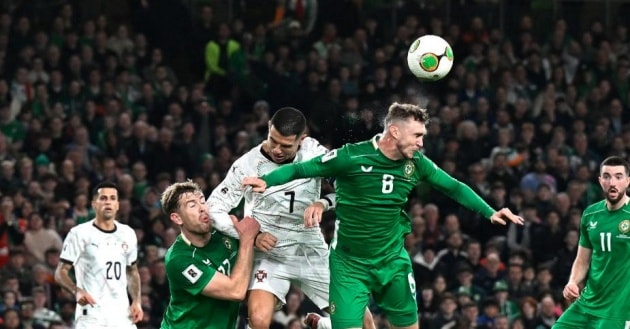
Reactions from the Portuguese media
Even A Bola, a newspaper known for its cautious language, wrote bluntly: "A day to forget." This wasn't just a critique of a rash reaction, but also a highlight of the crack in the disciplined image that had set Ronaldo apart. O Jogo warned of the direct impact: the red card could cost him the opening World Cup match. Amidst this, the Portuguese media didn't turn their backs on Ronaldo, but instead assessed him by the standards of a player – not a legend. In a sense, that was respect: stature comes with responsibility.
Pressure, opportunities, and questions for the final chapter.
Ronaldo has long been an inspiration and a pillar of faith for the national team in critical moments. But can a spiritual leader allow his instincts to erupt in that way? His fiery temper doesn't negate the value he brings, but it exposes a rare vulnerability. And sometimes, it is these stumbles that reveal the path forward.
The red card in Dublin, viewed positively, could be an opportunity for Ronaldo to reflect on himself: how does he want to conclude his international journey – with glorious success or with regret over a missed opportunity? Dublin could be the ellipsis. The ending, as is often the case in the major chapters of his career, still lies in how Ronaldo continues to write his own story.


