
Abolishing the minimum entrance score for university admissions in 2017: Will quality be left to chance?
(Baonghean) - Abolishing the minimum university entrance score is one of the new points in the Draft regulations on university and college admissions in 2017. However, there are many conflicting opinions surrounding this issue regarding the quality of admissions.
2017 marks the third year the National High School Graduation Examination has been held. However, the official examination and admission plan for 2017 has not yet been announced. Most recently, at the end of December 2016, the Ministry of Education and Training released several new options for public consultation and revision.
Accordingly, in the upcoming exam, candidates can register for an unlimited number of preferences and an unlimited number of schools. During the registration process, candidates must arrange their preferences in order of priority, and in the main admission round (round 1), candidates will only be admitted to the highest-ranked preference possible in their list of registered preferences.
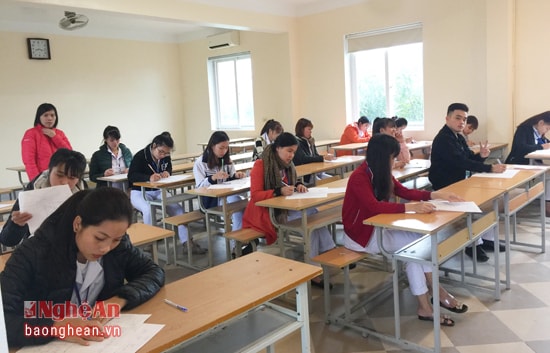 |
| Students of Viet Anh Vocational College. |
In addition, a new point attracting public attention is the Ministry of Education and Training's plan to abolish the minimum university entrance score. The main reason is that the current regulation of a common minimum score does not promote the dynamism, autonomy, and accountability of universities in determining scores that are appropriate to their specific conditions and the requirements of each training program, as well as aligning with the universities' quality policies.
The Ministry of Education and Training also plans to only stipulate the necessary condition for candidates to be to have graduated from high school, while universities will set the sufficient conditions for accepting applications, depending on the training program, reputation, and development strategy of the school. This will be done as it was for colleges in 2016.
Immediately after the draft admissions regulations were released, they received much mixed feedback, especially regarding the removal of the minimum score requirement. The most worrying issue was the potential for widespread and uncontrolled admissions, making quality control difficult.
In Nghe An, this is even more plausible because, in reality, over the past few years, the entrance scores for universities have mostly been equal to the minimum passing score; or some universities have even "loosened" their admissions process by reviewing academic transcripts. Low entrance scores can lead to poor quality graduates. This is also a consequence of the widespread unemployment among graduates today.
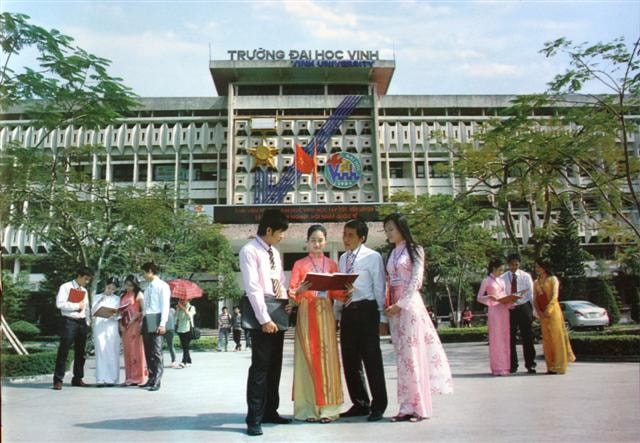 |
| Students of Vinh University. |
Similarly, at vocational colleges, the opportunity to recruit high-quality students is very difficult, because the doors to university are always wide open for applicants.
Discussing this issue, Mr. Nguyen Duy Nam - Principal of the Vietnam-Korea Industrial Technical College - stated: The minimum score serves to classify students, and those who do not meet the minimum score will have a second or third choice to attend vocational colleges. However, if the Ministry of Education and Training abolishes the minimum score, students will flock to universities, leading to lax admission standards.
Without stricter quality control, the quality of university education will be difficult to guarantee. As a result, thousands of graduates will be produced who do not meet requirements and are not recognized by society or businesses. In reality, if students lack the ability to enter university, they should pursue vocational training to secure employment and a stable income after graduation.
Sharing the same opinion, Mr. Phan Huy Hoang, Principal of Viet Anh Vocational School, said: “Students who go to university and become ‘teachers’ must possess special qualities in terms of intellect, thinking, and intelligence. In Vietnam, in recent years, there has been a reality that there are too many ‘teachers,’ but the training effectiveness is not high. For example, at our school, every year 60-80% of our university graduates are unemployed and have to go back to vocational school.”
Furthermore, the Ministry of Education and Training's decision to abolish the minimum entrance score and relax admission requirements for universities would contradict the current policy of educational streaming. Meanwhile, according to Directive 10 of the Politburo, the goal is for 30% of graduating students to pursue vocational training by 2020.
Elaborating on this point, Mr. Phan Huy Hoang offered a comparison: “In countries with developed education systems, they don't have minimum entrance scores or publish admission scores for universities and colleges, but they have already streamed students into vocational paths from the junior and senior high school levels, allowing them to choose schools and professions according to their abilities. Currently, we organize vocational streaming, guiding students towards vocational training, but if we abolish minimum entrance scores, the pool of applicants for schools will shrink. This is especially true given that the emphasis on academic degrees is still very strong among the majority of the population.”
From the universities' perspective, while they support abolishing the minimum admission score, their leaders are also very cautious when discussing this issue. Furthermore, they argue that the minimum score is a "double-edged sword," and that simply relying on it cannot guarantee easy student recruitment.
According to Mr. Duong Cong Hiep, Vice Rector of Vinh University of Technology and Education: “Abolishing the minimum entrance score will give universities more sources of enrollment. However, universities cannot be lenient with themselves because if they recruit students with low entrance scores and the quality of training is not guaranteed, parents and students will turn their backs on the school within one or two years. The most important thing now is for universities to continuously improve the quality of teaching, focus on graduates, and train students to meet the labor market needs of society.”
The purpose of the minimum admission score is to ensure the quality of student intake and guide student streaming. Therefore, abolishing the minimum score will clearly lead to problems, and moreover, disrupt the future labor structure, exacerbating the situation of "too many teachers, too few skilled workers."
According to current forecasts, the national unemployment rate will increase by approximately 1 million people in 2017; of which, about 200,000 master's and bachelor's degree holders will be unemployed. Given this concerning reality, it is clear that parents and students need to carefully consider career choices for their children.
Most importantly, one must choose a profession that matches their abilities, strengths, and the employment needs of society, avoiding wasting societal resources.
Song Hoang


