
Abolishing intra-provincial quarantine: Concerns about the proliferation of contaminated meat.
(Baonghean) - In recent times, outbreaks of diseases among livestock and poultry have been widespread, raising concerns about food safety and the farming environment. The Veterinary Law, effective from July 2016, will contribute to improving disease prevention and control, slaughterhouse management, and ensuring food safety and hygiene.
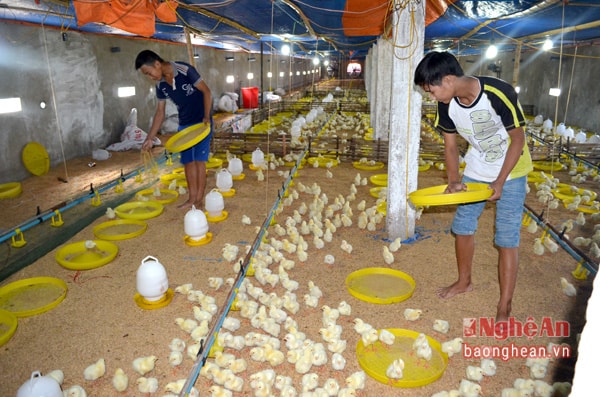 |
| Mr. Nguyen Van Ty's chicken farm (Nghi Truong commune, Nghi Loc district). |
Enhancing government accountability
Despite having a large number of livestock and poultry, Nghe An province consistently has a low vaccination rate. According to the Provincial Veterinary Department's report, the annual vaccination rate for cattle and buffaloes reaches 65-68%; while vaccination rates for pigs, swine fever, and rabies in dogs are below 35% of the planned target. In particular, some communes have completely neglected vaccination, leading to frequent outbreaks of disease in unvaccinated livestock and poultry, causing significant losses for farmers and the government.
In particular, Nghe An is one of the provinces with the highest number of rabies cases in the country and the highest number of deaths among provinces in the North Central region. From 2014 to the present, 39 people have died from rabies in Nghe An. All of the victims did not receive rabies vaccine or serum, but instead used herbal remedies and traditional medicine.
According to Mr. Dang Van Minh, Deputy Head of the Provincial Department of Animal Husbandry and Veterinary Medicine, the reason for the low vaccination rate is the limited awareness of the people regarding proactively vaccinating their livestock. Some families, despite being encouraged and informed, still do not purchase vaccines. In addition, some local authorities have not paid sufficient attention and lack decisive direction in vaccination efforts.
"That's very dangerous, especially given that our livestock population is very large but mostly consists of small-scale, fragmented farming as it is now. Authorities cannot control it without the active cooperation of the households themselves," Mr. Minh said.
Currently, apart from localities that receive vaccines under the State's program, in other localities, according to the Veterinary Law, people must buy vaccines themselves to vaccinate their livestock and poultry. The current high price of vaccines for swine fever and foot-and-mouth disease, at over 17,000 VND per dose, is a significant reason why many small-scale farmers are reluctant to spend money and only vaccinate their animals on a "hit or miss" basis.
The 2016 Veterinary Law delegates the authority to declare disease outbreaks to the Chairman of the People's Committee at the district level, creating conditions for localities to proactively prevent and control diseases effectively, conveniently, and quickly, ensuring that outbreaks are contained as soon as they occur in the area, reducing losses for livestock farmers.
In addition, the law stipulates that districts must develop plans for disease prevention and control, and allocate funds for disease control when an outbreak occurs. For a long time, funding for purchasing chemicals for disease control has primarily relied on provincial and central government budgets.
Regarding this new regulation, according to the leaders of Hung Nguyen district, decentralization to the district level is a favorable condition for strengthening responsibility to ensure effective disease prevention and control.
However, due to limited local budgets, when an outbreak occurs, the district can only allocate a small amount of funds to purchase lime and disinfectants for the affected area, while vaccines and other medicines have been largely unavailable. This also somewhat hinders disease prevention and control efforts.
Difficulties in intra-provincial quarantine.
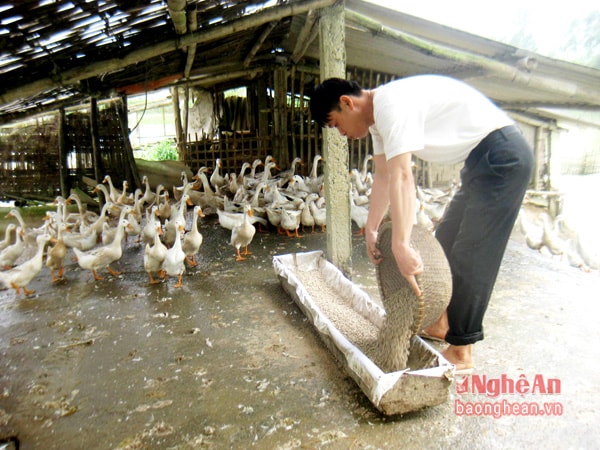 |
| Mr. Nguyen Van Tuan's livestock farm in Hung Tan commune (Hung Nguyen district). |
To facilitate and promote the development of the domestic livestock industry, the Veterinary Law stipulates that quarantine is only required for animals and animal products exported from other provinces; at the same time, it abolishes the quarantine regulation "based on quantity and weight" as in the 2004 Veterinary Ordinance.
Quarantine is managed based on the risk of animal diseases; for example, facilities participating in disease surveillance programs or disease-free facilities are not required to undergo quarantine but only need to register with the veterinary authority to obtain a domestic circulation quarantine certificate.
However, according to the veterinary agency, the removal of intra-provincial quarantine has created difficulties in inspecting and controlling slaughterhouses, processing facilities, storage and trading centers, and the transportation of animals and animal products. Meanwhile, the province has more than 40 slaughterhouses, but only a few industrial, semi-industrial, and centralized manual slaughterhouses meet veterinary hygiene and food safety standards. The rest are small, scattered slaughterhouses located in residential areas, making it difficult to determine the origin of animals for quarantine and slaughter control purposes.
The abolition of intra-provincial quarantine means that a large quantity of animal products risk arriving at markets and being sold to consumers without proper quarantine. Meanwhile, the sale of livestock and poultry meat by street vendors outside market areas or along main roads is quite prevalent.
According to Mr. Dang Van Minh, to prevent the sale of animals that do not meet food safety and hygiene standards, the Sub-Department has issued guidelines to relevant agencies, local authorities, and livestock farmers, requiring them to fully comply with commitments and regulations regarding planning, farm conditions, vaccination, etc.
If, during transportation, authorities determine that the animals do not meet food safety and hygiene standards, they will be destroyed or processed for animal feed. However, the difficulty lies in controlling this for small-scale, household-based livestock farms.
Currently, the veterinary workforce is understaffed, and their allowances and qualifications are limited, making it difficult to manage and inspect compliance with veterinary regulations at various establishments. With the introduction of new regulations, the responsibility of local authorities is also crucial. Without close coordination, control becomes very challenging.
It is evident that, although the Veterinary Law has created a comprehensive legal framework to improve disease prevention and control, slaughter control, and food safety and hygiene, the aforementioned obstacles necessitate increased responsibility from livestock farmers and all levels of government.
In the coming period, in addition to strengthening inspection, control, and penalties for livestock and slaughtering facilities that violate food safety and hygiene regulations, the work of disseminating information and mobilizing the public to strictly comply with legal regulations, and guiding people to choose safe food, also needs to be given more attention and implemented effectively.
Nguyen Hung


