
The Ministry of Health wants to ban the sale of alcoholic beverages during certain hours.
77% of Vietnamese men consume alcohol; to curb this, the Ministry of Health is considering including regulations prohibiting the sale of alcoholic beverages after 10 PM or midnight in the law on preventing the harmful effects of alcohol.
The Ministry of Health is developing a law to prevent the harmful effects of alcohol, in which experts are considering banning the sale of alcohol after 10 PM or midnight. Many countries have implemented this ban and have shown clear effectiveness.
According to Mr. Nguyen Huy Quang, Director of the Legal Department of the Ministry of Health, studies worldwide show that drinking alcohol between 8 PM and midnight has a significant impact on human health, affecting the nervous, digestive, and respiratory systems, while this is the time when people need to rest to regenerate their energy. In fact, the rate of traffic accidents during this time is very high.
It is expected that the Ministry of Health will only be able to submit the draft law on preventing the harmful effects of alcohol to the National Assembly for consideration in 2018.
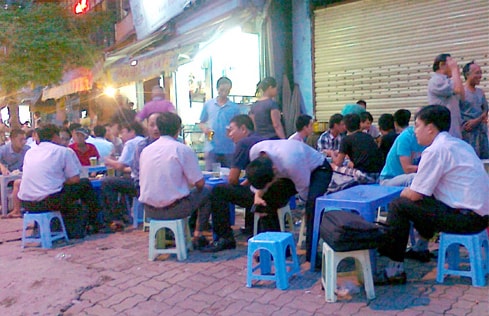 |
| Many Vietnamese men have a habit of stopping by beer bars after work. (Illustrative image: PD) |
Speaking at a workshop on the draft law on preventing the harmful effects of alcohol, held in Hanoi on September 26-27, Deputy Minister of Health Nguyen Thanh Long stated that Vietnam ranks second in Southeast Asia in alcohol consumption (after Thailand), tenth in Asia, and 29th in the world. While the economy and living conditions have improved, this growth cannot keep pace with the increasing number of alcohol users.
According to the latest survey by the Ministry of Health, over 77% of Vietnamese men consume alcohol, and nearly half drink at harmful levels. In Vietnam, alcohol is consistently one of the top 10 causes of death. An alarming fact is that the age of alcohol drinkers is getting younger. People over 50 drink daily, while younger people use it less frequently but consume a higher total amount than older adults.
"Without drastic control measures, Vietnam could become the world leader in alcohol consumption, instead of its current 29th position," Deputy Minister Long emphasized.
According to Dr. Tran Quoc Bao from the Department of Preventive Medicine, Ministry of Health, Vietnam ranks 22nd in the world for adult alcohol consumption, higher than all other Asian countries and behind countries in tropical and temperate regions of Europe. Nearly 50% of Vietnamese men drink at a harmful level, the highest rate in the world. No other Asian country, including South Korea and Japan, has such a high rate of harmful drinking as Vietnam. In the five years from 2010 to 2015, the percentage of Vietnamese people drinking alcohol at a harmful level increased from 25% to over 44%, contrary to the global trend.
The Preventive Medicine Department also advises that there is no standard for what level of alcohol consumption is harmful. The reason is that the risks and consequences of alcohol use vary depending on age, gender, and other biological characteristics of each individual, as well as circumstances and methods. This means there is no safe level of alcohol consumption. Scientific evidence shows that even very small amounts of alcohol can cause certain health risks and consequences.
Alcohol is considered a cause of oral, pharyngeal, laryngeal, esophageal, colon, liver, and breast cancer. The more one drinks, the higher the risk, and cancer often appears after 2 to 15 years of drinking, even after quitting. Hanoi Psychiatric Hospital treats 450-500 alcoholics annually, compared to only a few dozen patients a year about 10 years ago. Some patients become addicted to alcohol as young as 15 years old.
Current estimates indicate that Vietnamese people consume 3.4 billion liters of beer, 70 million liters of registered spirits, and approximately 200 million liters of unregistered spirits annually. From 2010 to 2015, beer production increased by an average of 7% per year, and spirits production increased by 4.4% per year. Beer and spirits are relatively inexpensive, advertising and promotions for beer are almost completely unregulated, while advertising for spirits with an alcohol content above 15% is prohibited.
According to VNE
| RELATED NEWS |
|---|


