
Exposing the tricks used to steal ATM card data.
After entering Vietnam, some Chinese nationals secretly installed devices to steal customer information at ATMs in order to engage in theft.
Recently, Vietnamese authorities have repeatedly arrested groups of Chinese nationals who entered Vietnam under the guise of tourism. In reality, these groups came to Vietnam to engage in theft. Many ATMs located in banks or public places were used by these individuals with advanced technology to steal customers' personal account information and embezzle money.
 |
"Witches" vandalize ATMs.
In early July 2017, through intelligence gathering and surveillance, the Financial, Monetary, and Investment Security Department of the Hanoi City Police discovered a group of Chinese nationals suspected of secretly installing devices to steal customer account information for the purpose of creating counterfeit ATM cards to embezzle assets.
Specifically, on July 13th, a group of individuals were found attaching miniature cameras and recording cables with memory cards to several ATMs of a Chinese bank with branches in Vietnam. Upon receiving this information, the Department of Financial, Monetary, and Investment Security advised and instructed bank leaders and staff to increase inspections, install additional camera systems for monitoring and recording, and deploy security personnel in the ATM area.
After nearly two weeks of surveillance, on the morning of July 27th, at the aforementioned ATM, authorities discovered two members of the group returning to the ATM. Detectives secretly followed them and found that the group was temporarily staying at two hotels in Trung Hoa ward, Cau Giay district, Hanoi…
At approximately 6:30 PM on the same day, when the two young men arrived to retrieve the equipment, the authorities raided the location and caught them red-handed. A search of the suspects' residence yielded 248 blank cards, including 245 blank cards and 3 cards with data, card information recording equipment, a camera, a recording device, a data recorder for printing information onto the blank cards, two laptops, numerous chips, memory cards, accessories for ATM keypads, batteries, a soldering machine, adhesive tape, and other items.
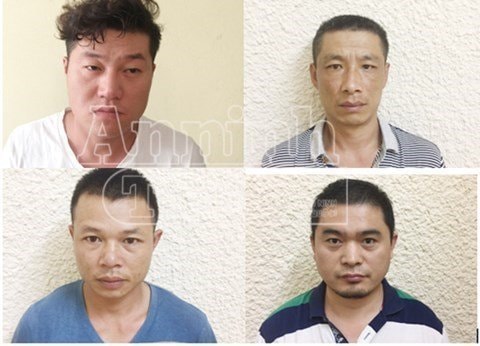 |
| The group of Chinese nationals was led by Shao Hai Meng. |
Authorities have identified the individuals involved in the case as follows: Shao Hai Meng (born in 1988) residing in Linjin City, Shandong Province; Qu Guo Hui (born in 1979) residing in Zhuhai City, Guangdong Province; Lu Jin Ghe (born in 1979) residing in Lingyun County, Jiangxi Province; and Li Chun Gui (born in 1975) residing in Kunming City, China.
At the police station, the suspects confessed that, starting from July 24th, the Shao Hai Meng group entered Vietnam through the Huu Nghi border gate in Lang Son. Afterward, they went to ATMs in Hanoi and attached electronic devices to steal customer account information for the purpose of defrauding people. Some devices placed at ATMs earlier (on July 13th) were installed by another group of suspects...
Unmasking criminal tactics
Lieutenant Colonel Nguyen Thanh Long, Head of the Financial, Monetary, and Investment Security Department, stated that recently, the situation of foreigners, especially Chinese nationals, secretly installing devices into ATMs in Vietnam to record data, thereby creating counterfeit ATM cards and stealing money from customers, has become increasingly complex and widespread, causing fear among customers and negatively impacting the security and safety of credit institutions. The perpetrators operate in organized groups with sophisticated methods and a tightly organized division of labor.
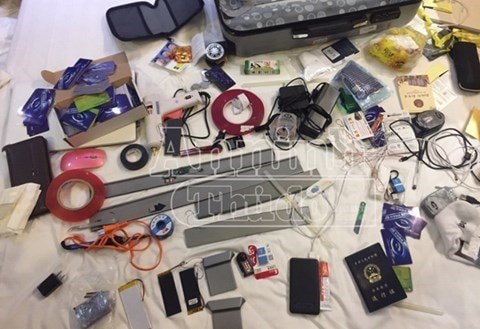 |
| Police discovered evidence at the residence of the group of Chinese nationals. |
“The method used by criminals to steal ATM cardholder information is not new, but it is showing signs of resurgence. Most cases of ATM card information theft in Vietnam involve cards made with magnetic stripe technology (magnetic cards). Currently, most banks are still issuing ATM cards using magnetic stripe technology, which has low data security and is very easy to copy. When customers withdraw money from ATMs, they should observe for any unusual devices. If they detect or suspect anything, they should not proceed with the transaction to avoid the risk of losing information and money, and should immediately report it to the authorities,” Lieutenant Colonel Nguyen Thanh Long advised.
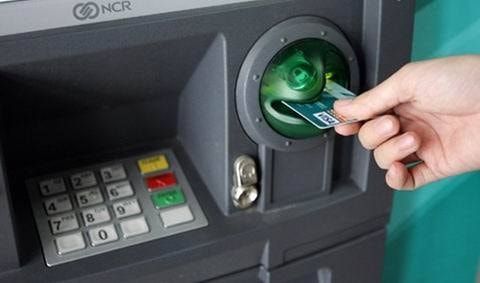
According to the commander of the High-Tech Crime Prevention Police Department of Hanoi City Police, the use of high technology to steal money from ATMs is quite sophisticated. Criminals often use the tactic of attaching a data copying device, colored to match the ATM machine itself, right in front of the card reader slot. When a cardholder inserts their card for a transaction, this device copies the customer's credit card information. Simultaneously, a hidden camera is mounted on top of the ATM machine to record the card's PIN. Once they obtain this information, criminals use specialized equipment and software to create counterfeit cards and steal money.
Major Nguyen Duc Tuan, Head of the Banking Security and Counterfeit Money Crime Prevention Team, Department of Financial and Monetary Security, said that to mitigate this, some Vietnamese banks have also issued debit cards using fingerprint recognition technology. However, the upgrading of technology among banks is not synchronized due to varying investment costs.
According to VNN
| RELATED NEWS |
|---|


