
When did football in Nghe An province begin?
(Baonghean.vn) - In 1921, the first Vietnamese football team in Vinh was called "Lam Thanh Football Team". "Lam Thanh Football Team" regularly played against the French soldiers' team and other teams in the city. Notably, the team also traveled to Thanh Hoa and Nam Dinh to compete.
In Vietnam, football is believed to have arrived with the Foreign Legion soldiers from France and its colonies in the late 19th and early 20th centuries. In 1920,Vinh National High School(Vinh College) was founded. A year later, the school's football team was also established. According to Professor Nguyen Xien's memoirs, this was the first Vietnamese football team in Vinh. The team was named "Lam Thanh Football Team". Interestingly, most of the team's members were later famous figures in modern Vietnamese politics and science, such as Ton Quang Phiệt, Nguyen Loi, Hoang Xuan Han, Dang Thai Mai...
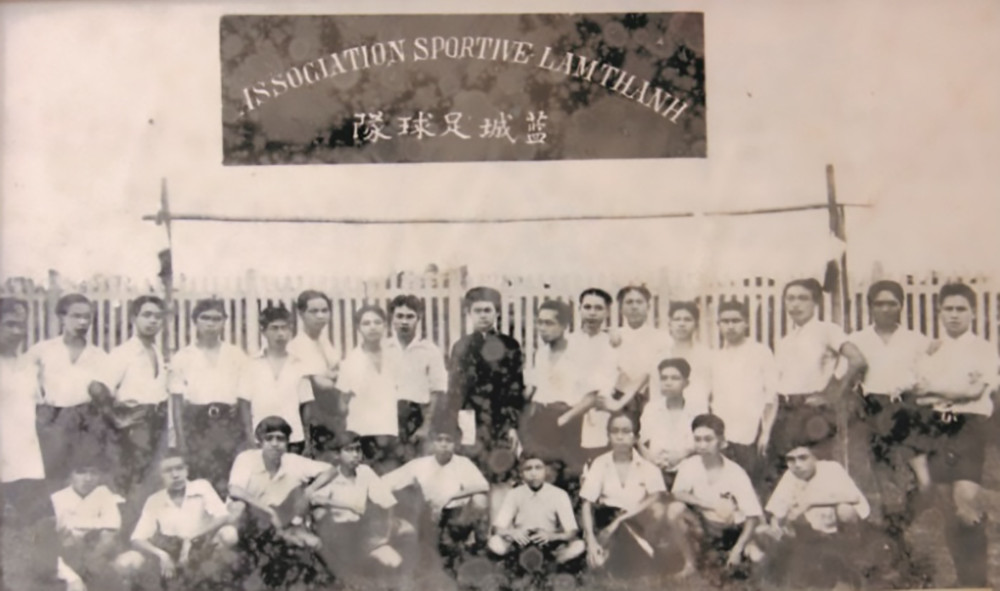 |
| "Lam Thanh Football Team" of Vinh National High School, the first Vietnamese football team in Vinh, was founded in 1921. (Archival photo) |
Professor Nguyen Xien's memoirs state: "In 1921, the first football club in Vinh was established, named 'Lam Thanh Football Team'. The photograph still exists, and we can recognize that surrounding Ton Quang Phiệt, wearing a turban and long robe, carrying the club president's briefcase, were players in tank tops and shorts. Among them were strong players like Dinh Van Tuong, Tran Van Thuy, Hoang Xuan Khang, and Phan Tuyen, capable of competing against the French soldiers. Beside them were lighter but equally enthusiastic players such as Dang Thai Mai, Nguyen Kim Cuong, Loi (Loi Lu), Son (Coc), and even Hoang Xuan Han, a student from the third graduating class." The "Lam Thanh Football Team" regularly played against the French soldiers' team and other teams in the city. Notably, the team also traveled to Thanh Hoa and Nam Dinh to compete...
Besides the "Lam Thanh Football Team," Vinh had 5-6 other football teams, such as: Candasport (Western soldiers); Garder Indigene (blue striped shirts) (green uniforms) (Vietnamese soldiers); ASAT (Truong Thi Railway Factory); Lacomec (Health sector); Corix Rouge (red striped shirts) (Red Cross)... Among them, the most famous was the ASNA team, the team of the Nghe An Sports Association (ASNA stands for "Association sportive Nghe An"). This team was almost the official representative of Nghe An when participating in regional and Central Vietnam tournaments. The team wore yellow shirts and white shorts, so they were often called the Yellow Shirt team.
In Vinh during the 1930s, there were several football fields (commonly called "fields") like the one belonging to...Truong Thi Railway FactoryThe football field behind Vinh Train Station, the Nha Tam field in the Cua Ta area… The ASNA team's field (often called the Yellow Shirt field) was considered the city's official stadium (Stade municipal Vinh). This field was located outside Nghe An city, in the area of Pham Ngu Lao Street, Cua Nam ward today. The field was built with clay soil and lacked a drainage system, so it was very slippery, even muddy, whenever it rained.
The match between ASNA and Corix Rouge on the afternoon of September 18, 1933, had to be canceled due to rain and a muddy pitch, making it unplayable. At that time, the pitch didn't have grandstands and was surrounded by a fence, initially made of bamboo, later replaced with an iron fence. Whenever there was a festival, celebration, or an important match, people would erect a tent and borrow seats from theaters.
The football matches here were sold for charity. Tickets with seats in the theater usually cost 1 dong, while tickets without seats cost 1 hao (0.1 dong). Compared to the price of 5 cents per kilogram of rice and the living standards of the people at that time, football tickets were quite expensive. Some matches reported in the press raised between 250 and nearly 400 dong from ticket sales. This means that between 2,000 and 3,000 spectators attended the matches. With the population of Vinh at that time only around 20,000 people, this shows how passionate the people of Nghe An were about football.
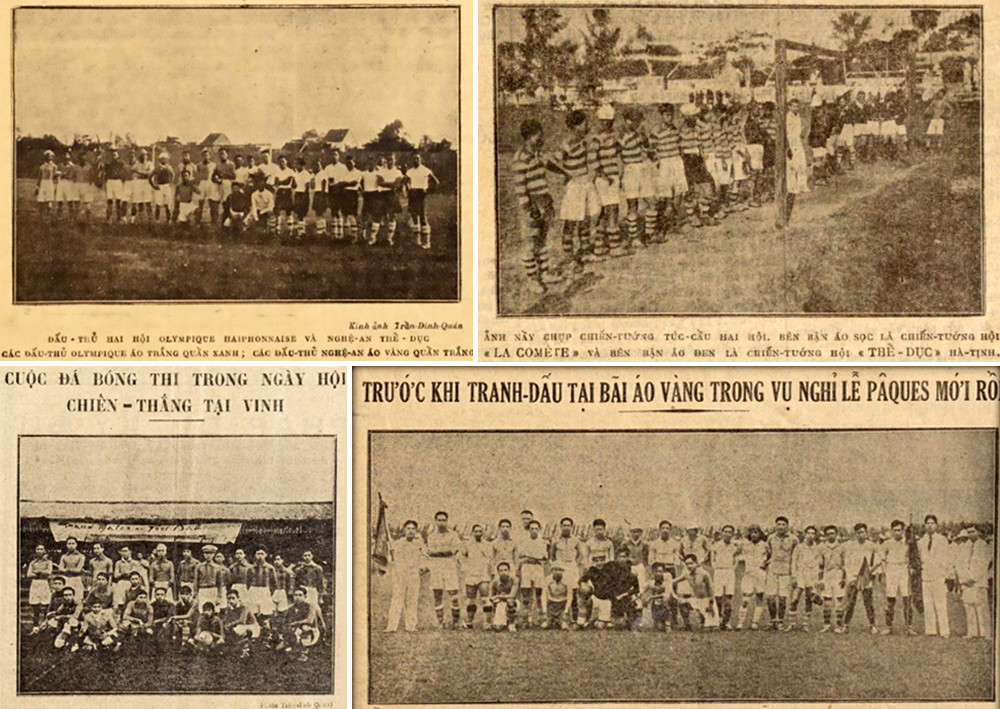 |
| Some football matches from the 1930s. Photo from Thanh Nghe Tinh Tan Van newspaper. |
Until the 1940s, the name "football" was not widely used; it was commonly referred to as "round ball." Teams were often called "Round Ball Associations." Players were often called "generals," "warriors," or "football generals." Similarly, positions on the field had many different names today, such as "defender" for defenders; "attacking midfielder" for midfielders; "central striker" for "center forward"... Not only were there no professional teams, but the refereeing was also amateur. Some tournaments even used team captains as referees. Article 9 of the Regulations for the Second Division Round Ball Tournament of North Central Vietnam, held in Vinh in September 1933, stipulated: "Captains of all associations may be appointed as referees, but they are not allowed to blow the whistle for matches between their own association and other associations."
The duration of each match was not fixed at 90 minutes, but could vary slightly depending on the circumstances. For example, in the friendly match for the "Le Do" Cup between ASNA and Da Nang on April 17, 1933, the score was still 2-2 after two halves. The two teams had already gone to rest, but the organizers, seeing that it was still light (the stadium didn't have lights at that time), requested an additional 20 minutes of play to determine the winner.
In the 1930s, besides official tournaments, there were many sports and football competitions organized or prizeed by businesses (such as SIFA, Truong Thi Railway), entrepreneurs (such as Le Viet Loi, Ky Sung Thuc, etc.), and officials (such as Governor-General Nguyen Khoa Ky, representative Tran Ba Vinh, etc.). Therefore, the sports and football movement in Vinh during this period developed quite vigorously.
In the Thanh Nghe Tinh newspaper of the 1930s, almost every week there were articles and photos reporting on football matches between different associations. The 1930s saw frequent friendly football matches between teams from Nghe An, especially ASNA, and teams from Nha Trang, Da Nang, Hue, Thanh Hoa, Hanoi, and Hai Phong. The ASNA team from Nghe An participated in many official tournaments in Central Vietnam and reached the later stages. However, despite having several talented players on the Central Vietnam team, Nghe An football at this time did not achieve high results in Central Vietnam.
Although amateur-level, Nghe An football during the French colonial period produced many players considered "skilled" footballers. Notable examples include Khanh (forward, captain of ASNA, and member of the Central Vietnam team); Tri Sui (midfielder) of ASNA; Urini (goalkeeper of ASNA); A Quang, Rinh, Nhu, Nghia (Commete team)... The press also mentioned the attacking trio (Thụ, Tịch, Được) of ASNA who dominated the football fields at the time.
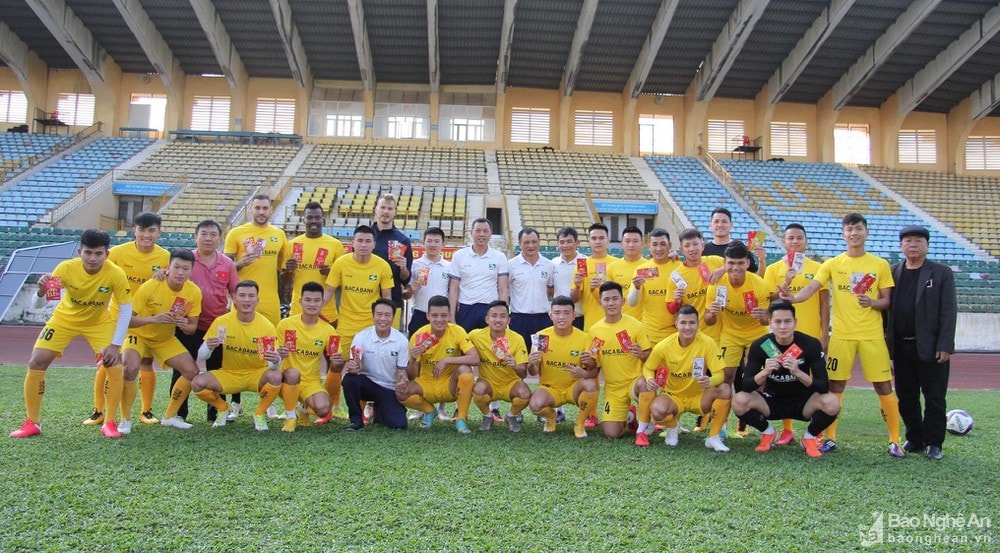 |
| The current yellow jersey of the SLNA football team is a continuation of the team of the Nghe An Sports Association from nearly 100 years ago. (Photo: Ba Tuan) |
However, the most famous and influential player in Nghe An during the French colonial period was Tran Xuan, originally from Nam Dinh. He served in the French army, but because of his football skills, he was recruited into the Hai Phong Olympic team. After his discharge in 1941, he and his wife moved to Vinh to open a restaurant. Having already achieved fame as a player, Tran Xuan was reborn and flourished upon his return to Vinh. He was invited to join the Corix Rouge team. Shortly after, the Corix Rouge and several other teams were merged into the ASNA (Association of National Football Associations), and Tran Xuan became the captain of the renowned Yellow Jersey team. Despite his advanced age, for two consecutive years (1942 and 1943), Tran Xuan participated and performed excellently in the Central Vietnam football team at the Indochina Football Tournament, named after Marshal Petain. Later, Mr. Tran Xuan became the Deputy Director of the Nghe An Department of Physical Education and Sports, and was instrumental in laying the foundation for Nghe An football today.
More than just a hobby or a sport, football is also a place to showcase and hone the character and identity of the people of Nghe An. I believe that the 100th anniversary of Nghe An football should be celebrated in a suitable way!


