
Vietnamese football and the roadmap to realizing the World Cup goal.
Following the historic treble in 2025 under coach Kim Sang-sik, Vietnamese football is now focusing on developing its internal strength to aim for the 2030 and 2034 World Cups.
Following a brilliant 2025 with a historic treble under coach Kim Sang-sik, Vietnamese football not only affirmed its dominant position in Southeast Asia but also opened a new chapter full of hope. These consecutive successes have become an important springboard for the Vietnam Football Federation (VFF) and fans to begin to take a more realistic view of qualifying for the biggest football event on the planet – the World Cup.
Building on the glories of 2025
2025 marks a glorious milestone in the history of Korean football. After a turbulent transition period, coach Kim Sang-sik quickly rebuilt the team and revived the fighting spirit of the national teams at all levels. In just a short time since taking over in May 2024, the South Korean strategist has completed an impressive collection of titles.
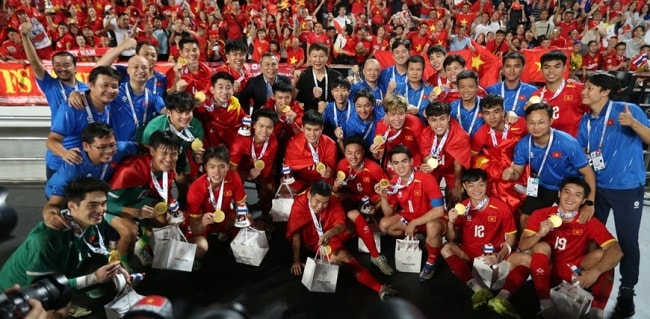
This achievement includes winning the ASEAN Cup 2024, the Southeast Asian U23 Championship, and the gold medal at the 33rd SEA Games. Notably, in all three finals, the Vietnamese teams demonstrated unwavering composure by defeating the host teams on their home turf. This is proof of the remarkable progress in tactics and mental fortitude in top-level competition.
Challenges and opportunities from an expanded World Cup.
The dream of participating in the World Cup was once rekindled under coach Park Hang-seo when Vietnam reached the final qualifying round in the Asian region. Now, with FIFA increasing the size of the 2026 World Cup to 48 teams, the opportunity is becoming even wider for developing countries. However, this path still faces many formidable challenges, especially as regional rivals like Indonesia and Thailand are carrying out large-scale naturalization campaigns for players.
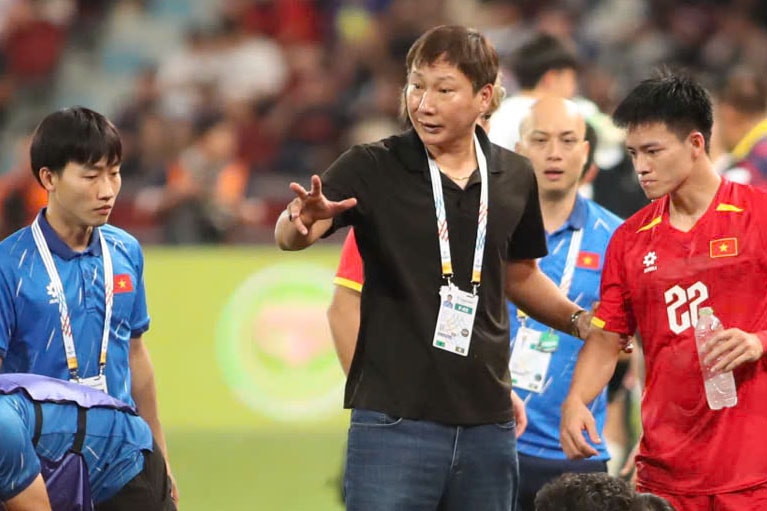
In this context, coach Kim Sang-sik's philosophy is a combination of discipline and flexibility in personnel use. Avoiding the trend of mass naturalization helps the team maintain its unique identity while maximizing opportunities for domestic talents to develop.
Sustainable internal development strategy
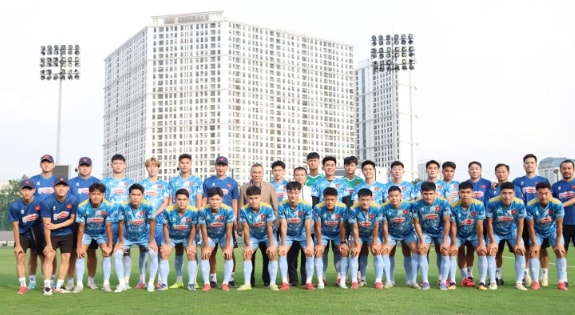
Unlike short-term pursuits, Vietnam has consistently pursued a path of development based on its internal strengths. This is the result of a well-planned preparation process spanning many years. A prime example is the preparation for the 2026 AFC U23 Championship, where young players received training in Qatar and competed against strong opponents such as the Syrian U23 team.
According to the Strategy for the Development of Physical Education and Sports until 2030, with a vision to 2045, the Vietnam Football Federation (VFF) has identified participation in the 2030 and 2034 World Cups as a core focus. International recognition from FIFA President Gianni Infantino regarding the potential of emerging nations further strengthens this direction.
Lessons from the rise of Asian nations
Looking at the success of Uzbekistan or Jordan, Vietnamese football can see that participating in world competitions is entirely possible if there is perseverance in youth training and a consistent roadmap. Currently, Vietnamese football has all the favorable factors: a generation of players in their prime, a promising next generation of young players, and a coaching staff with a deep understanding of East Asian football culture.
Success in 2025 is not just about winning trophies, but more importantly, about accumulating confidence and experience. With a spirit of steady progress, singing the Vietnamese national anthem at the World Cup is gradually becoming a concrete goal with a roadmap, rather than just a distant dream.


