
Brazil: Has the storm broken out?
(Baonghean)As expected,TBrazilian President Dilma Rousseff lost a parliamentary vote on April 17th that would have decided whether to impeach her. The worst political crisis in Brazilian history has only just begun, and it could end 13 years of the Workers' Party's leadership in Latin America's largest economy.
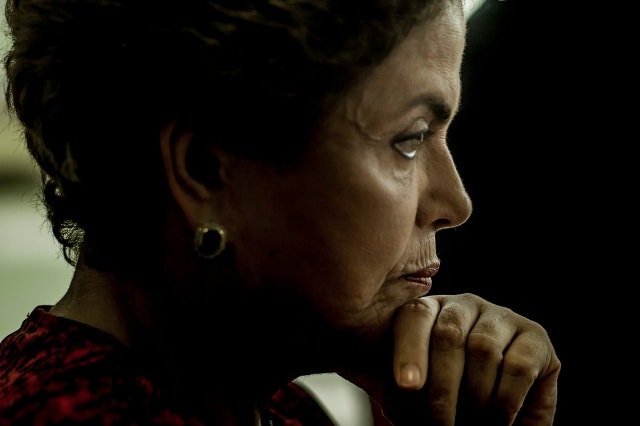 |
| Brazilian President Dilma Rousseff is going through the most difficult days of her political career (source: New York Times). |
When the President is not blameless
The vote in the Brazilian House of Representatives has created significant disadvantages for President Dilma Rousseff. The opposition secured enough votes, 342 in total, equivalent to two-thirds of the representatives, to send the impeachment proceedings against President Rousseff to the Senate. The Senate vote is expected to take place in early May. If 41 out of 81 senators vote in favor, Rousseff will have to leave office within 180 days, making way for Vice President Michel Temer. In a statement shortly afterward, Brazil's ruling Workers' Party acknowledged defeat in the House vote on impeachment. Speaking to the press, the leader of the Workers' Party in the House, Jose Guimaraes, said the ruling party would now focus on preventing the Senate's move to remove Rousseff from office.
The political nightmare that has lasted from the end of 2015 until now has become a reality, threatening even President Rousseff's political survival. Following the departure of parties in the ruling coalition, protests from disillusioned citizens over the economic downturn, and a series of corruption scandals involving the state-owned oil company Petrobras being brought to light, Rousseff and the ruling Workers' Party have never felt the political crisis to be so terrible.
The root of all the trouble was the corruption scandal at Petrobras, which broke out in March 2014. According to police, the network used approximately $4 billion to bribe numerous politicians and senior officials at Petrobras. This scandal cost Petrobras $2 billion and led to investigations into many of the company's officials and key politicians in Brazil. More than 100 individuals were formally convicted of corruption, money laundering, and forming a criminal gang, including dozens of leaders from Brazil's leading construction and engineering companies. And senior national leaders were not immune from blame either.
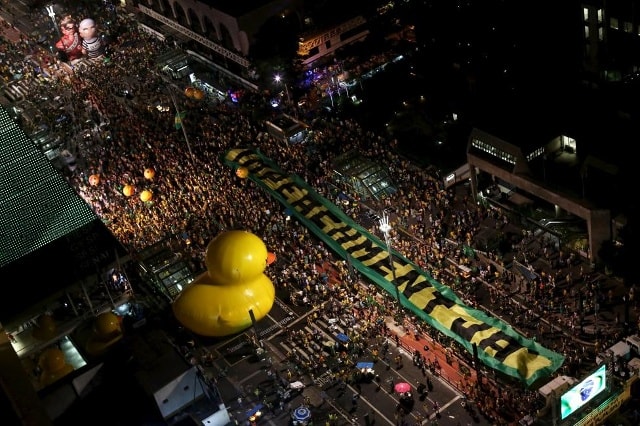 |
| Protesters against Rousseff in Sao Paulo await the results of the referendum in the Lower House on April 17 (Source: Reuters). |
According to Delcidio do Amaral, a senator also implicated in the Petrobras scandal, current President Dilma Rousseff "had a firm grasp" of everything happening at the state-owned oil company. In an interview with the weekly magazine Veja on March 19th, Amaral, a former leader of the ruling Workers' Party in the Senate, stated that former President Lula da Silva planned and orchestrated the embezzlement schemes at Petrobras, which Rousseff then used to fund her 2014 election campaign. These shocking revelations are further corroborated by President Rousseff's unusual actions in appointing her predecessor, Lula da Silva, to the position of Chief of Staff. "Misfortune never comes alone," and shortly after this decision was made, a recording of a conversation between Rousseff and her close advisor was leaked, revealing that the main purpose was to help Lula da Silva avoid criminal prosecution for charges related to Petrobras. Such cover-ups only added fuel to the fire of the Brazilian public, already outraged by corruption and the deteriorating socio-economic situation.
Was the attack on the flank?ther?
There have been accusations that the current wave of anger and opposition, spilling from the parliamentary chambers to the streets, is a conspiracy by the opposition against the leaders of Brazil's left-wing movement. These renewed accusations cite the opposition's relentless actions aimed at pushing the ruling Workers' Party and President Rousseff to the brink of immediate resignation. The dramatic television footage of armed police forcibly removing former President Lula da Silva on March 4th for questioning regarding the corruption scandal at the state-owned oil company Petrobras is one such example. Rousseff criticized the judiciary and police for using force instead of summoning Lula – who has never refused to cooperate with authorities. She accused the opposition of plotting to overthrow the government and hold general elections before 2018.
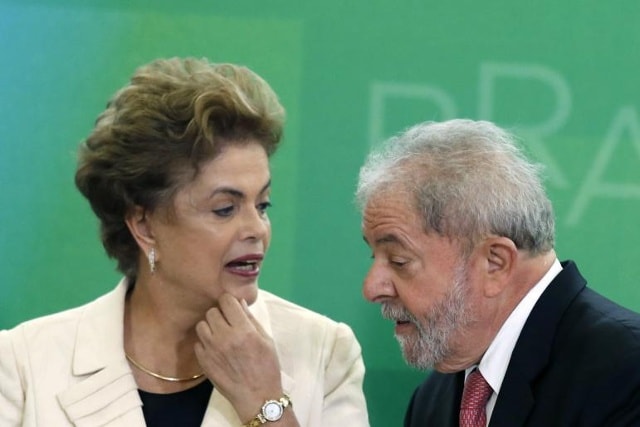 |
| President Rousseff and his predecessor Lula da Silva are embroiled in a series of corruption investigations unprecedented in history (source: Newsweek). |
Professor David Fleischer, a political science specialist at the University of Brasilia, argues that the reaction to the March 4 incident shows that supporters of the Workers' Party are increasingly convinced that the legal attack on Lula and Rousseff is an attack on the core of the national left-wing movement. Former President Lula has denied receiving bribes and called his police arrest a "staged" attempt to discredit him. The former president is under investigation for a series of corruption allegations, ranging from Petrobras to construction companies during his presidency from 2003 to 2010. Current President Rousseff, who served as Brazil's Minister of Energy – the agency that oversees Petrobras – under Lula, is also likely to be held accountable.
But in reality, it's also untrue that the opposition's plot to weaken and overthrow the left-wing government in Brazil is the root of the problem. In fact, the millions of people who have taken to the streets to protest against the government in recent months are also due to the poor performance of the economy. In its latest report, credit rating agency Credit Suisse forecasts that Brazil's gross domestic product (GDP) growth rate will be negative for the period 2015-2017. This would be the first time the country's economy has declined for three consecutive years since 1901. 2015 was the year Brazil's GDP fell by a record amount in the last 25 years. Meanwhile, commodity prices in the country have been continuously rising for several years, and public debt currently stands at 65.1% of GDP – the highest level since 2006 and an 8% increase compared to the end of 2014.
With a weakening economy, Brazilian businesses and consumers are cutting back on spending, leading to rising unemployment. Brazil's credit rating was downgraded to BB+ by Standard & Poor's last September, the first time since 2008 that the country has been downgraded to "junk" status. The stagnant economy, high unemployment, and financial scandals and corruption are causing Brazilian society to turn against the government. So, is the opposition deliberately slowing down the economy to "overthrow" the ruling coalition? That is a major question for President Rousseff.
Thanh Son


