
Brazil: Is suspending the President the way out?
(Baonghean) - Brazil has a new president, but in a way that few people wanted. A vote in the Brazilian Senate on May 12th passed an impeachment motion, meaning the temporary suspension of President Dilma Rousseff's presidency and the dissolution of her entire cabinet. South America's largest economy is on the brink of a major shock amidst a political crisis that has lasted for more than two years.
A coup without gunfire.
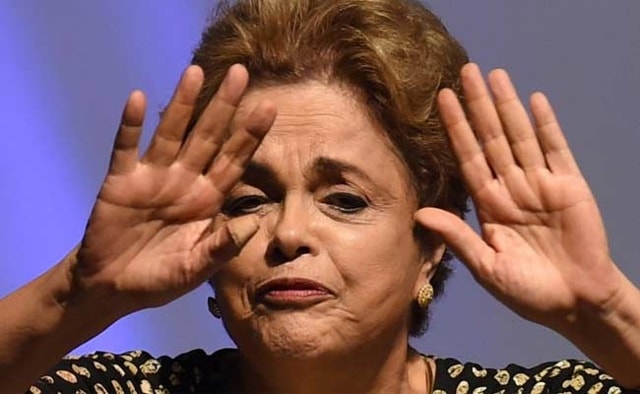 |
| Brazilian President Dilma Rousseff has just experienced one of the darkest moments of her political career. Photo: AFP |
The victim of the impeachment motion – President Dilma Rousseff – immediately spoke out, calling it a coup not only aimed at overthrowing her but also against the will of Brazilian voters.
Speaking to a crowd of supporters outside the Presidential Palace, Rousseff declared it a sad day and a tragedy for Brazil's fledgling democracy. She called herself a victim of great injustice, and added that the incoming government would be formed from a coup, which would be the cause of the political crisis.
Meanwhile, in a television interview, Rouseff continued to denounce what was happening in the country as a coup and affirmed that she would fight to the end using all necessary legal means to prove her innocence.
She also called on supporters to unite and fight through legal means. She warned that the social achievements the South American country had made during 13 years of Labour Party (PT) rule, such as poverty reduction, protection of children and youth, and people's access to healthcare and housing, were under threat.
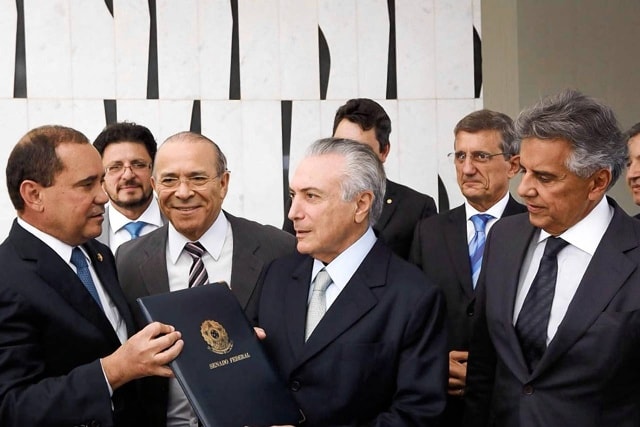 |
| Vice President Michel Temer received the decision to replace Rousseff as interim president. Photo: Wall Street Journal |
On May 12th, Brazilian Vice President Michel Temer, who will replace Rousseff as interim president, announced the composition of his new cabinet. President Temer's goal is to pull Latin America's largest economy out of what is considered the worst recession since 1930, through measures aimed at balancing budget deficits and reviving the economy to boost job creation.
Recent developments in Brazil are adding to the chaos already plagued by scandals. These include investigations into the corruption scandal at the state-owned oil company Petrobras, where Rousseff once served as chair, resulting in at least 100 convictions for corruption, money laundering, and forming a criminal gang, including dozens of leaders from Brazil's top construction and engineering companies.
But political scandals wouldn't have caused such turmoil in Brazilian society if the country's economic situation hadn't been in such a dire state. Gross domestic product (GDP) fell by 3.8% in 2015, the sharpest decline since 1990.
Last year alone, unemployment in Brazil soared, consumer confidence plummeted, and the Brazilian real depreciated by 24% against the US dollar. The economic downturn has severely impacted the country's middle class, with approximately 3.7 million Brazilians falling back into poverty.
What is the way out for Brazil?
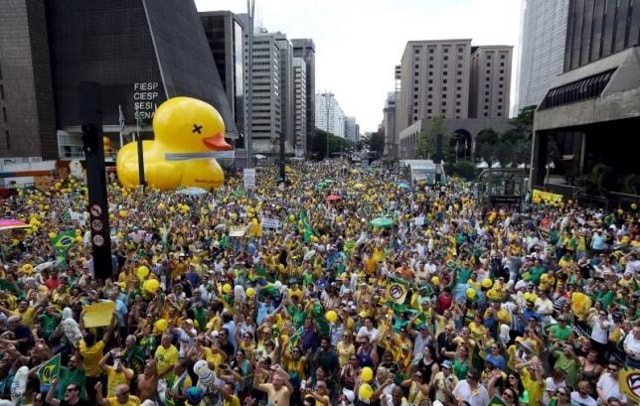 |
| Anti-government protests outside the Brazilian Congress building (Source: Associated Press) |
Clearly, Brazil is at the height of political turmoil, while its economic downturn shows no sign of abating. But will the current political upheaval lead to a cleaner and more honest government in the eyes of the people? Or will the interim government be able to pull the country out of its current predicament?
This question seems difficult to answer because interim President Temer himself is among the politicians suspected of receiving bribes in the Petrobras scandal. Furthermore, as many as 352 out of 594 members of Parliament have been accused of wrongdoing.
The current coup, therefore, may well be only a half-hearted revolution. Rousseff's statements following her suspension suggest she will not easily relinquish her former position, using the "weapons" at her disposal, hinting at launching street protests to pressure the final verdict of her impeachment trial in 180 days. At that point, there are fears that Brazil will descend into internal conflict and infighting while the country's socio-economic problems remain unresolved.
Thanh Son


