
Transformation of agricultural cooperatives in Do Luong district
(Baonghean) - Do Luong district is focusing on decisively directing the transformation and reorganization of agricultural cooperatives in accordance with the 2012 Cooperative Law. To date, 34 out of 36 agricultural cooperatives in the district have been transformed.
Making money from loans from internal credit funds.
After transitioning under the new law, cooperatives have developed production and business plans, diversified their activities, and served the interests of their members. A typical example is the Van Son Agricultural Service Cooperative, located in Van Son commune. In addition to traditional services, the cooperative offers internal credit services to help members borrow capital for production and business development. The cooperative has 384 members, all of whom contribute capital at a rate of 500,000 VND per share.
Notably, the cooperative attracted 300 members to deposit money into its internal credit fund. To date, the fund's total capital has reached 15 billion VND, enabling nearly 300 members to borrow capital. Members have invested this borrowed capital in developing production, service industries, purchasing plows and harvesters, buying buffaloes and cows, or lending to their children for overseas employment, with loan amounts ranging from 20 million VND to 700 million VND. Many member households have risen out of poverty and achieved legitimate wealth thanks to loans from the cooperative's internal credit fund.
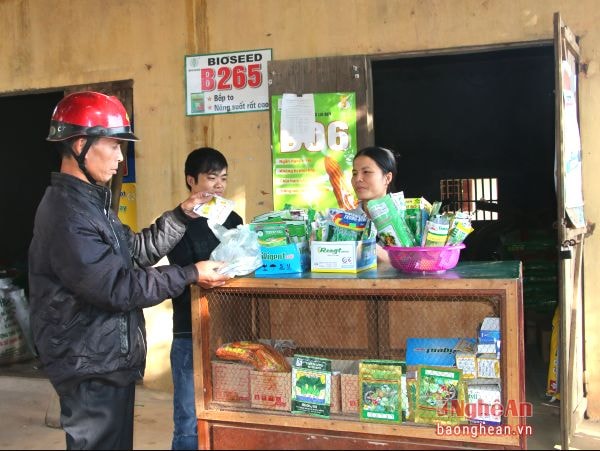 |
| Giang Son Dong Agricultural Cooperative (Do Luong) supplies pesticides to its members. Photo: QL |
Mr. Tran Van Yen's family in Hamlet 10, formerly a poor household facing extreme difficulties, borrowed tens of tons of rice from the cooperative. For several years, they borrowed 80 million VND from the cooperative's internal credit fund to send their four children abroad for work. By 2015, the family had repaid all their debt and even had money saved to deposit into the internal credit fund. Similarly, Mr. Le Dinh Hong's family in Hamlet 4 borrowed over 600 million VND from the internal credit fund to invest in excavators and trucks for dredging irrigation canals and transporting construction materials. He has now established his own company, and his business is thriving.
Mr. Nguyen Thai Hung from Hamlet 6 chose to develop a farm-based economy to get rich. Initially, he borrowed 500 million VND from the cooperative's internal credit fund, a medium-term loan with an interest rate of 10.2% per year, to invest in raising pigs for meat and breeding sows, and a fish pond. Mr. Hung shared: "Thanks to the internal credit fund, I was able to borrow a large amount of capital at a suitable interest rate and for a long period, which was convenient for my family to rotate capital. Recently, after selling my pigs, my family repaid 350 million VND to the cooperative, and we still have 150 million VND outstanding."
Serving the interests of members
Mr. Nguyen Dang Ha, Director of Van Son Agricultural Service Cooperative, said: "The 2012 Cooperative Law has truly created a legal framework for cooperatives to operate more steadily, fostering a shared responsibility between the management board and members, forming a commodity production chain, and increasing product value. The role of cooperatives after the transformation under the 2012 Cooperative Law is more clearly demonstrated in their operation for the benefit of their members. Not only have they maintained and developed their internal credit fund effectively for the past 10 years without any risks, with interest collected quarterly and members voluntarily paying interest in full on time, but the cooperative also always has capital readily available to pay customers who need to withdraw at any time. This also builds trust among members and helps them feel secure in investing their money in the cooperative."
Mr. Nguyen Canh Thin, Director of Giang Son Dong Agricultural Cooperative, said: "We plan to expand production and business in 2017 to include all goods and services supporting agricultural production, prioritizing selling at cost price to members to attract more members. At the same time, we will establish a construction team to undertake the construction and upgrading of irrigation canals in the area, creating jobs and increasing income for members. In addition to rice and other crops, the cooperative aims to encourage members to expand the area for off-season sugarcane cultivation to increase income. Currently, the total area planted with sugarcane in the commune has reached nearly 120 hectares."
Every year, the cooperative actively supplies seeds and agricultural materials to meet the needs of the people, providing tens of tons of various fertilizers and 7 tons of seeds annually. The cooperative contracts with factories to supply fertilizers at wholesale prices. In addition, the on-field irrigation service ensures sufficient water for irrigation; during drought years, in addition to electric pumps, the cooperative increases the number of diesel pumps to maximize drought relief efforts. After the cooperative transitioned under the 2012 Cooperative Law, members benefited from lower prices for fertilizers and pesticides compared to market prices.
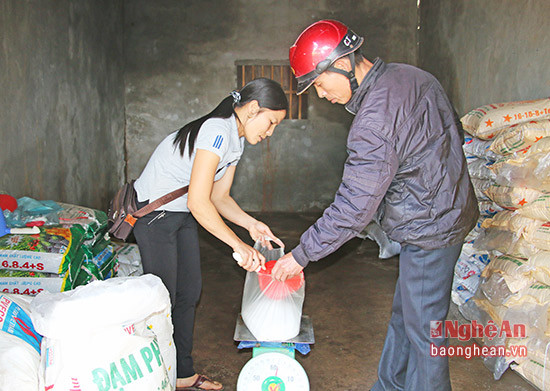 |
| Giang Son Dong Cooperative provides supplies to its members. |
To date, 34 out of 36 agricultural cooperatives in Do Luong district have successfully undergone transformation. Two cooperatives, Da Son and Giang Son Tay, have yet to hold their general meetings for transformation. In the near future, if these two cooperatives fail to hold their general meetings, they will be dissolved and new ones will be established.
According to Mr. Tran Doan Hung, Head of the District's Agriculture Department: Currently, cooperatives in the area, after the transformation, have become dynamic and creative in their professional work. Some cooperatives have taken on projects to build irrigation canals. Initially, some cooperatives have expanded their linkages with companies and units to produce rice seeds, such as Van Son, Yen Son, and Thinh Son service cooperatives; or linked with TH Milk Factory, and contracted with farmers to produce commercial corn for livestock feed, such as Giang Son Dong and Bac Son agricultural cooperatives... In particular, Giang Son Dong agricultural cooperative has expanded the model of growing off-season sugarcane to provide refreshing drinks during the hot season, not only serving the market in the district and province, but also expanding consumption in Ha Tinh,...
However, like other localities, the transformation of agricultural cooperatives in Do Luong also faces many difficulties, because the potential of most agricultural cooperatives is weak in all aspects, lacking capital, production and business plans, and a capable workforce. Currently, in the market economy, the services of cooperatives face strong competition from many private businesses. In addition, some profitable service activities for cooperatives, such as electricity services and irrigation fees, are gradually being transferred to state management, so many cooperatives are operating at a reduced capacity and are performing poorly.
Quynh Lan
| RELATED NEWS |
|---|


