
Dien pomelo has become the main crop in Thanh Chuong.
(Baonghean)Given the fragmented and small-scale nature of local production and the stagnation in attracting industrial investment, Thanh Chuong district (Nghe An province) is focusing on developing high-value, promising key crops alongside promoting commercial livestock farming. Among these, bDien grapefruit has been included in the list with policies to encourage its development.
Leveraging the strengths of traditional crops
Identified as one of the key tea-growing areas in Nghe An province, Thanh Chuong district currently has over 4,000 hectares of tea plantations (approximately 55% of the province's total area). Tea is considered a traditional crop, as it has been rooted for decades, and although its value is not yet high, it provides a stable income for growers.
Over the years, farmers have increased investment in intensive farming, applied scientific and technological advancements, and used bio-fertilizers, resulting in a continuous increase in tea yield (approximately 13 tons/ha/year). With 3,650 hectares under cultivation, the annual tea leaf production reaches over 43,800 tons, generating a product value of approximately 150 billion VND, accounting for 4.15% of the total product value of the agricultural sector.
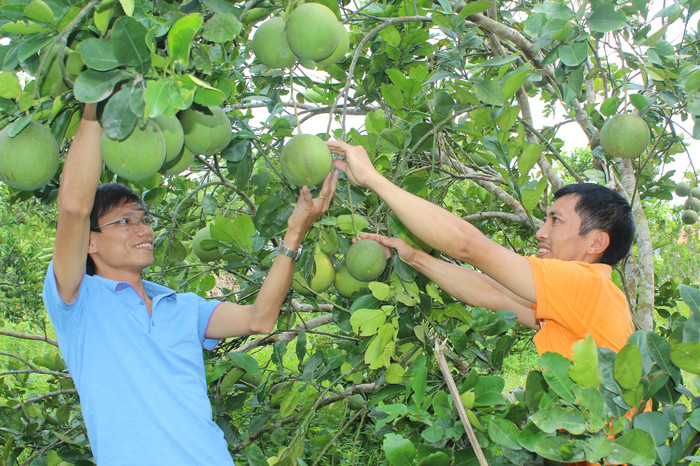 |
| The pomelo orchard of Mr. Ho Sy Phuong's family (right) in Hamlet 5, Thanh Lien commune (Thanh Chuong district) - Photo: Nguyen Son |
According to Mr. Nguyen Xuan Anh, Deputy Head of the Agriculture and Rural Development Department of Thanh Chuong district, tea cultivation in the district is gradually demonstrating its socio-economic effectiveness, contributing to raising people's income and becoming one of the key crops in the area.
One hectare of tea plantation yields a net profit of around 25 million VND per year. Tea cultivation is linked to 5 companies and enterprises, and 50 private processing plants and facilities in the communes. In recent years, these tea processing factories have promptly purchased fresh tea leaves from farmers.
However, most production lines and equipment are outdated, tea products are mainly in raw form, of low quality, and lack competitiveness; production costs are high, product value is low, and reinvestment by factories and sustainable links with tea growers are not strong.
At the same time, tea cultivation in the area faces several limitations such as low yields, persistent pest and disease problems, low product quality, and low income from tea. Nevertheless, tea remains a sustainable crop, and the district will focus on directing investment in intensive cultivation, improving productivity, and linking to increase product value.
In Thanh Chuong district, cassava cultivation is also maintained with a raw material area of over 2,800 hectares. This crop has been present in the district for decades and has been identified as suitable for many areas of barren hilly land, contributing to poverty alleviation, job creation, and economic benefits for producers.
In particular, over the past few years, the Intimex cassava starch factory, with a processing capacity of 600 tons of fresh cassava tubers per day, has organized the timely purchase of fresh cassava through 60 product collection points for farmers in each locality and production area, so there is no worry about the market for cassava tubers.
However, cassava cultivation has experienced fluctuations in area and yield in recent times. Due to its ease of cultivation, farmers have not followed proper technical procedures; most cassava fields are planted at incorrect densities, too densely, and lack attention to intensive farming practices, resulting in unstable and declining cassava yields.
According to calculations, one hectare of cassava yields a net profit of 21-23 million VND per year. While this income level isn't particularly attractive to the local population, most of the hilly land in the district, after careful consideration, is deemed most suitable for cassava cultivation, especially given its stability when linked to a processing plant.
Furthermore, rice cultivation areas in Thanh Chuong district mainly serve the purpose of food security. As for timber forests, households estimate that they only earn about 6-7 million VND/hectare/year. Therefore, developing "multi-purpose" forestry trees, which have both environmental value, increase forest cover, and economic value, such as Melaleuca alternifolia, Terminalia catappa, and jackfruit, is crucial.
Faced with this reality, Thanh Chuong is grappling with finding ways to develop new crops with high economic value that are suitable for the terrain and climate.
"Taking care of key crops and livestock in Thanh Chuong"
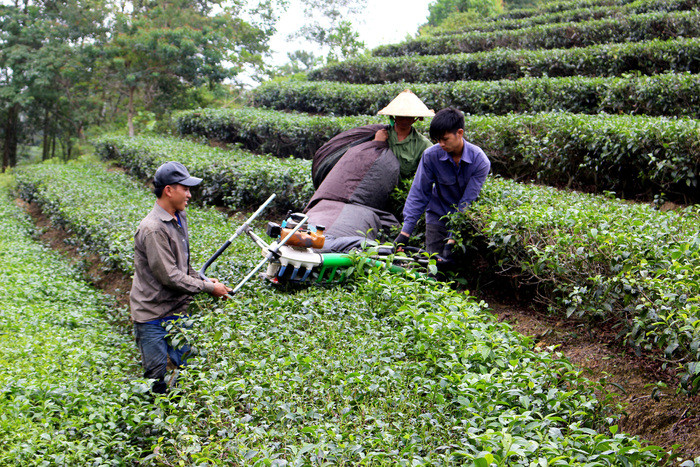 |
| Farmers in Thanh Chuong harvest tea. - Photo: Dinh Ha |
Expectations for the new tree
When discussing key crops to increase value and income for the people, Mr. Le Dinh Thanh – Vice Chairman of the People's Committee of Thanh Chuong district – was very enthusiastic about oranges and Dien pomelos.
According to Mr. Thanh, many people consider it a "new crop," but in reality, for many years, Dien oranges and pomelos have taken root and provided income in many areas such as: in the youth volunteer brigades; and in the communes of Thanh Lien, Thanh Nho, Thanh Duc, Thanh Thuy, Thanh Tien, etc.
Surveys show that oranges and pomelos grown in these areas yield high productivity in their 9th and 10th years (120 quintals/hectare for oranges; 104 quintals/hectare for pomelos). These two crops are estimated to generate an income of 340-370 million VND/hectare/year. Therefore, Thanh Chuong district has carefully studied the area and included in its plan to plant approximately 500 hectares of oranges (currently over 330 hectares) and 110 hectares of Dien pomelos (currently 24 hectares) by 2020, along with policies to encourage their development.
According to Decision 2817/QD-UBND (July 2016) of the People's Committee of Thanh Chuong District, households growing oranges (V2 variety, Xa Doai) will receive support at a rate of 10,000 VND/tree for households growing oranges in the planned area (Thanh Hoa, Thanh Nho, Thanh Duc, Hanh Lam, Thanh Thuy communes) with a minimum concentrated planting area of 1,000 m2 or more. As for households growing Dien pomelos, the district will provide support of 20,000 VND per seedling and funding for land preparation at a rate of 5,000,000 VND per hectare for households growing Dien pomelos in the planned area (Thanh Lien, Thanh Tien, Thanh Ngoc, Thanh Phong communes) with a minimum concentrated planting area of 1,000m2 or more. |
The family of Mr. Ho Sy Phuong in Hamlet 5, Thanh Lien Commune, was a pioneer in planting Dien pomelos when the district did not yet have a support policy. Since 2008, he boldly planted 1 hectare of Dien pomelos (500 trees) and now has planted nearly 3 hectares.
With the support of the district, Mr. Phuong continued to reinvest, and currently, his family's planned area for growing Dien pomelos is about 5 hectares. A favorable factor for his family is that they were able to lease 5% of the land allocated by the commune, thus creating a large-scale commercial Dien pomelo growing area.
In 2016, Diễn pomelos in Thanh Chương district sold for 25,000-30,000 VND per fruit, bringing a significant income to Mr. Phượng's family. Notably, this type of pomelo can be stored for 2-3 months after harvest, so there's no worry about slow sales. With support from the district and some successful models in the area, farmers in Thanh Liên, Thanh Ngọc, and Thanh Phong communes are now actively consolidating land for Diễn pomelo cultivation.
Implementing the project on developing several key crops, in the first six months of 2017, Thanh Chuong district planted over 5.2 hectares of V2 oranges; 10.6 hectares of Xa Doai oranges; 7.71 hectares of Dien pomelos; and 1,100 hectares of concentrated forest.
During the discussion, Mr. Le Dinh Thanh added: Crops such as oranges and Dien pomelos in Thanh Chuong district are mainly grown on small, scattered plots of land, on a household scale, and many people have not invested in intensive farming or strictly applied technical measures in care, therefore the yield is low.
Meanwhile, the Dien orange and pomelo trees are "fussy" plants, requiring strict soil conditions and cultivation techniques. Therefore, the district prioritizes thorough research on suitable land and climate during planning implementation, along with the effective application of technical measures to achieve high economic efficiency. Based on this, with the proposed plan, the district strengthens planning management and actively seeks stable markets for the products.
Nguyen Son
| RELATED NEWS |
|---|


