
Vinh University Medical Center: Treatment of knee osteoarthritis with platelet-rich plasma combined with stem cells.
(Baonghean.vn) - Vinh University Medical Center Hospital has implemented the research project: "Study on the treatment of osteoarthritis of the knee using platelet-rich plasma combined with autologous adipose tissue-derived mesenchymal stem cell transplantation".
With the desire to treat and improve people's health, reduce the burden of disease, and prolong life expectancy, and with the permission of the Ministry of Health and the Science Council of Nghe An province, over the past two years, Vinh University Medical Center Hospital has implemented the research project: "Study on the treatment of osteoarthritis of the knee using platelet-rich plasma combined with autologous adipose tissue-derived mesenchymal stem cell transplantation."
CAUSES AND SYMPTOMS
Osteoarthritis of the knee is a condition involving damage to the articular cartilage, subchondral bone, ligaments, and surrounding tissues, and is the second leading cause of disability in older adults after cardiovascular disease.
In Vietnam, according to statistics from 10 years (1991-2000) on inpatients treated at the Musculoskeletal Department of Bach Mai Hospital, osteoarthritis ranked third (4.66%) among diseases involving joint damage.
Among osteoarthritis cases, knee osteoarthritis accounts for 56.5%. Knee osteoarthritis most significantly affects mobility. Severe knee osteoarthritis is a major cause of disability for many patients, increasing healthcare costs for families and society.
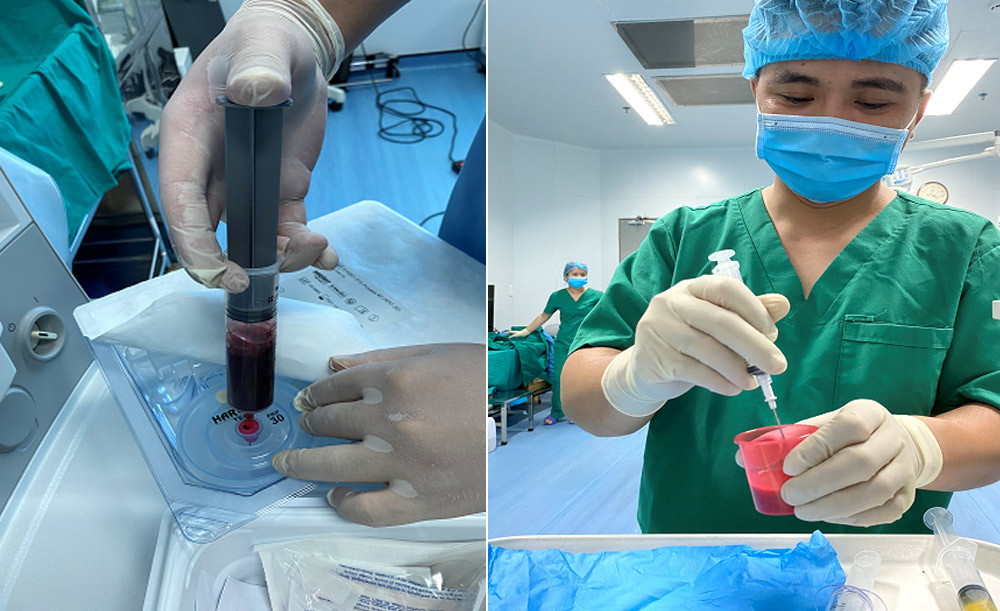 |
Separating platelet-rich plasma, mixing stem cells and platelet-rich plasma. Photo: PV |
Osteoarthritis of the knee is divided into two types: Primary osteoarthritis, caused by the aging process, usually appears late in people over 60 years old, affects multiple locations, progresses slowly, gradually increases with age, and is not severe.
Over time, cartilage cells age, their ability to synthesize collagen and mucopolysaccharides decreases and becomes disordered, leading to a gradual decline in cartilage quality, particularly in elasticity and load-bearing capacity. Furthermore, adult cartilage cells lack the ability to reproduce and regenerate.
Secondary osteoarthritis of the knee: Caused by mechanical factors, occurs at all ages (usually under 40), localized to a few areas, severe and progressive over a large area of the articular surface and intervertebral disc. Causes include congenital deformities, secondary deformities after trauma, and increased load-bearing factors such as excessive weight gain due to obesity, occupational overload, and lifestyle habits.
Symptoms of knee osteoarthritis: Clinically: Primarily pain, which intensifies with movement and worsens in cold weather. There may be crackling or popping sounds in the knee joint, sometimes accompanied by swelling and warmth due to inflammation or joint effusion. In later stages, movement may be restricted due to deformity and misalignment of the joint.
Regarding paraclinical findings: X-rays revealed bone spurs, joint space narrowing, joint misalignment, and subchondral bone sclerosis; ultrasound showed joint effusion; arthroscopy provided clearer visualization of the lesions; and magnetic resonance imaging (MRI) provided a comprehensive assessment of the damage, including bone spurs, cartilage damage, and ligament injuries.
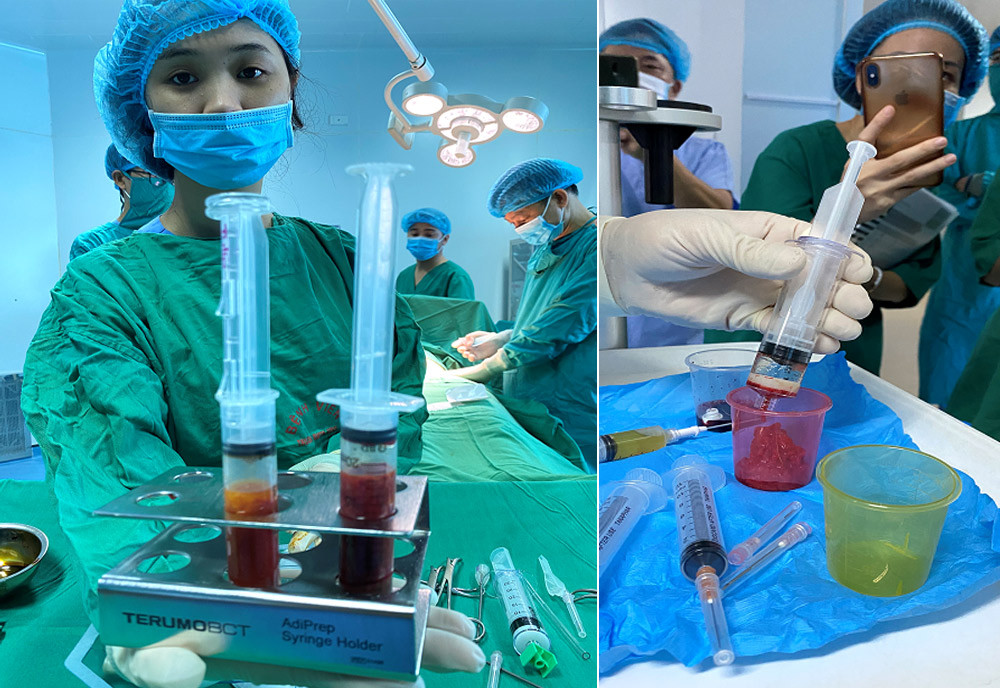 |
The product is a mixture of abdominal adipose tissue and stem cells extracted from abdominal adipose tissue. Photo: PV |
Treatment options for osteoarthritis of the knee: Medical treatment: Use non-steroidal anti-inflammatory drugs (NSAIDs) such as Diclofenac, Mobic, Acorxia, Celebrex… Anti-osteoarthritis drugs such as Glucosamine, Cordroitin, Atrodar. Intra-articular corticosteroid injections are used when there is inflammation and effusion.
Physiotherapy: Ultrasound, shortwave therapy, light therapy, heat therapy, etc. Joint injections: Hyaluronic acid, depending on the type, may be injected every 6 or 9 months. Platelet-rich plasma: The patient's blood is separated to extract the plasma containing platelets, which increases the platelet count by 5-10 times. This plasma is then injected into the joint to promote cartilage regeneration.
Stem cell therapy: Using autologous stem cells extracted from adipose tissue and injected into the joint to replace and regenerate new cartilage, increase cartilage growth, reduce degeneration, and repair damaged cartilage, facilitating easier joint movement. Combined therapy involves platelet-rich plasma and mesenchymal stem cells from autologous adipose tissue. This treatment is considered a promising strategy for treating articular cartilage damage and osteoarthritis.
Simultaneously, this therapy uses platelet-rich plasma (platelet extract) to stimulate cartilage proliferation and adipose tissue stem cells to replace old cartilage cells with new ones, allowing the joint to recover from damage caused by degeneration.
EFFECTIVE, SAFE, WITH FEW COMPLICATIONS
Over more than two years of implementing the project: "Research on the treatment of osteoarthritis of the knee using platelet-rich plasma combined with autologous adipose tissue-derived mesenchymal stem cell transplantation," despite the global COVID-19 pandemic, including in Vietnam, and the difficulties regarding equipment and patient travel, the project, with the determination of the Director of Vinh University Medical Center and project leader, along with the efforts of the research team and scientists, has achieved the following objectives: Adopting the technique of isolating mesenchymal stem cells from adipose tissue and platelet-rich plasma using the ADI-25-01 ADIPOSE PRCEDURE PRAK and PRP, APC 30 PRP PRCEDURE PRAK kits from the United States.
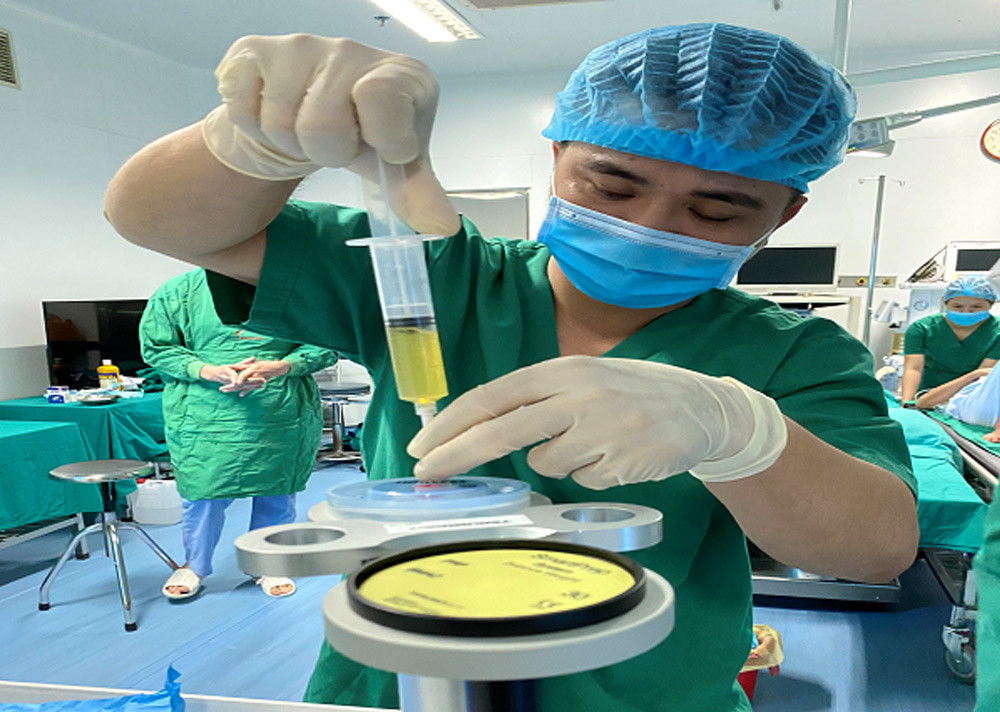 |
| Platelet-rich plasma is extracted from the patient's own blood. Photo: PV |
Under the guidance of technicians from Terumo Medical Equipment Company of Japan, the research team established a group to perform abdominal fat harvesting techniques. The research team received and used the equipment of the abdominal fat harvesting kit: ADI-25-01 ADIPOSE PRCEDURE PRAK for stem cell and PRP extraction, and APC 30 PRP PRCEDURE PRAK for platelet-rich plasma extraction. Notably, the research team proactively performed the technique of extracting stem cells from abdominal adipose tissue and independently operated the Harvest stem cell extraction machine.
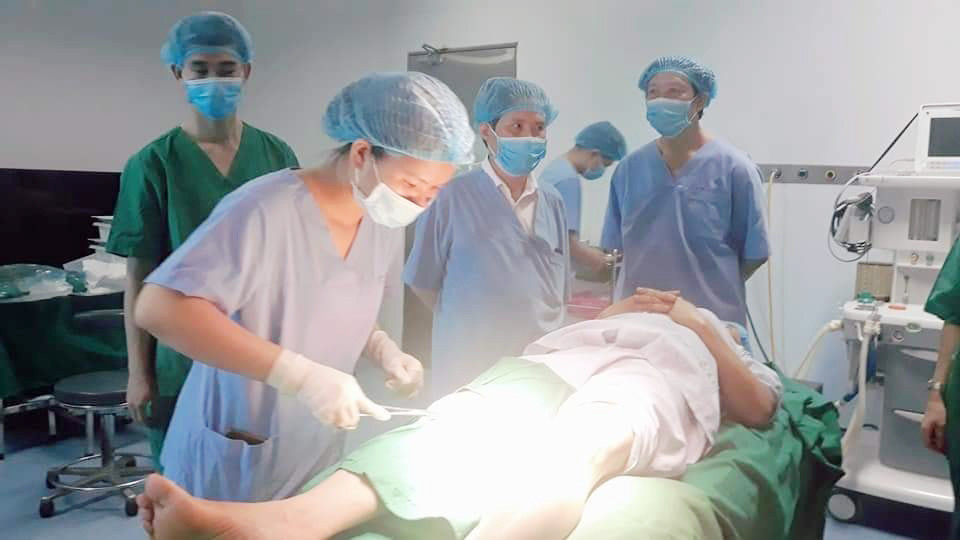 |
| Leaders of Vinh University Medical Center directly supervised the injection of a mixture of stem cells and platelet-rich plasma into the knee joint. Photo: PV |
During the implementation process, the research team administered platelet-rich plasma injections to 30 patients, 26 female and 4 male, with an average age of 58.63 ± 11.11 years and an average disease duration of 5.3 ± 4.6 years.
The research team conducted follow-up immediately after injection, during the first week, after 1 month, 3 months, and 12 months. The results showed that platelet-rich plasma (PRP) injection therapy combined with autologous adipose tissue-derived mesenchymal stem cells was safe: As demonstrated by 30 patients - 60 injected joints, 45 joints were pain-free, 4 joints experienced complete pain relief after 6 hours, 3 joints experienced complete pain relief after 6-12 hours, 2 joints experienced complete pain relief after 12-24 hours, and only 6 joints remained painful after 24 hours and the pain subsided after a few days.
No patients experienced joint or periarticular infections. There were no complications during the liposuction procedure, including external bleeding or secondary subcutaneous hemorrhage.
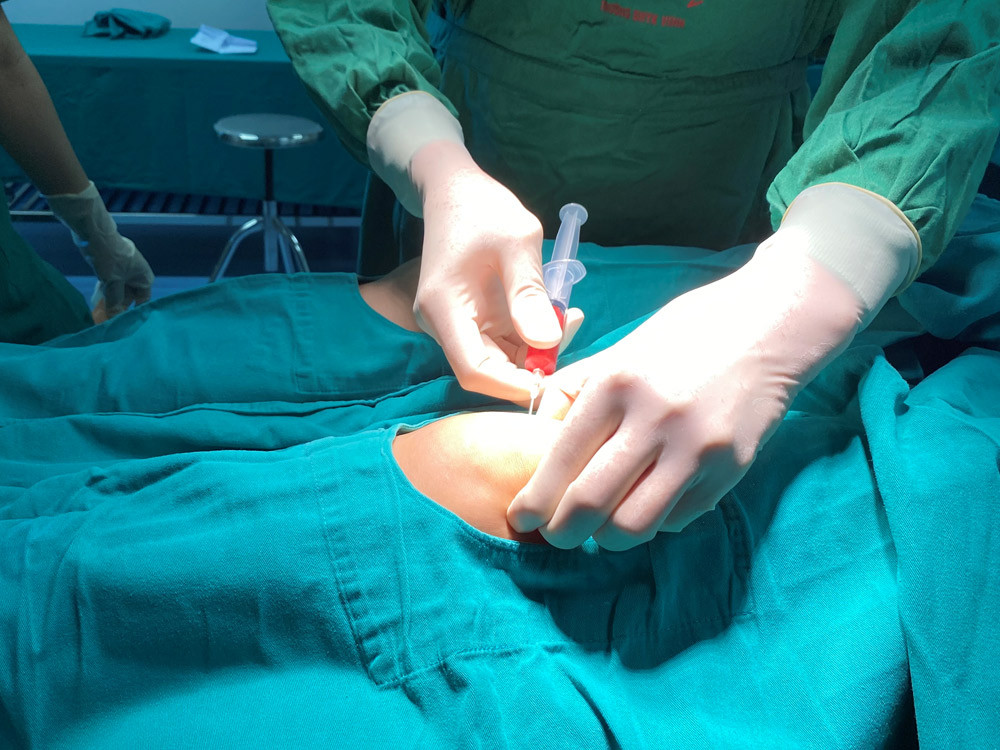 |
| Injecting a mixture of stem cells and platelet-rich plasma into the knee joint. Photo: PV |
After 12 months of treatment, the VAS pain score of the right knee decreased from 6.0 to 1.91; the VAS score of the left knee decreased from 6.34 to 2.25, a statistically significant difference.
Patients' mobility improved significantly, pain decreased, and stiffness lessened. Articular cartilage thickness on magnetic resonance imaging (MRI) is an important indicator for evaluating treatment outcomes and the cartilage regeneration capacity of stem cells. After 12 months of treatment, cartilage thickness increased significantly in all areas. After 12 months of treatment, 96.3% of patients were satisfied or very satisfied with the treatment results.
The project's implementation successfully mastered the technique of treating knee osteoarthritis using platelet-rich plasma combined with autologous adipose tissue-derived mesenchymal stem cell transplantation at Vinh University Medical Center. This confirms that the treatment of knee osteoarthritis using platelet-rich plasma combined with autologous adipose tissue-derived mesenchymal stem cells is effective, safe, and has few complications.
Steps to implement the treatment technique for osteoarthritis of the knee using platelet-rich plasma combined with autologous adipose tissue-derived mesenchymal stem cell transplantation in Nghe An:
Step 1: Selection and screening, clinical examination to assess pain level and mobility (30 patients).
Step 2: The patient undergoes X-rays, ultrasound, blood count, and other necessary tests to assess the lesion and rule out other conditions.
Step 3: Perform an MRI scan to assess the damage.
Step 4: Extract mesenchymal stem cells from abdominal fat using the ADI-25-01 ADIPOSE PRCEDURE PRAK kit from the USA.
Step 5: Separate the platelet-rich plasma.
Step 6: Mix the stem cells and platelet-rich plasma.
Step 7: Inject a mixture of platelet-rich plasma and autologous adipose tissue-derived mesenchymal stem cells into both knee joints, performed by a surgeon or rheumatologist.
Step 8: Monitor the patient during the first day and first week.
Step 9: After a week of monitoring without complications, the patient is discharged home and will continue monitoring after 1 month, 3 months, 6 months, and 12 months.


