
Whales stranding on shore is considered a good omen in the beliefs of fishermen.
(Baonghean.vn) - Along the 82 km of coastline in Nghe An, there are numerous spiritual structures related to the worship of the Whale God (whale).Germany rescues fishermen in distress on their voyage to conquer the open sea.And there are many places where dead whales wash ashore. Fishermen in these areas still believe that whales washing ashore is a good omen for the fishing village.
On May 25th, a giant whale stranded on the beach of Dien Thinh commune, Dien Chau district. Authorities and local residents successfully rescued it and released it back into the sea. On May 27th, fishermen from Dien Thinh reported discovering a decomposed whale carcass about 1km from shore. A team from the Department of Agriculture and Rural Development of Nghe An province is currently approaching the carcass to handle the situation. |
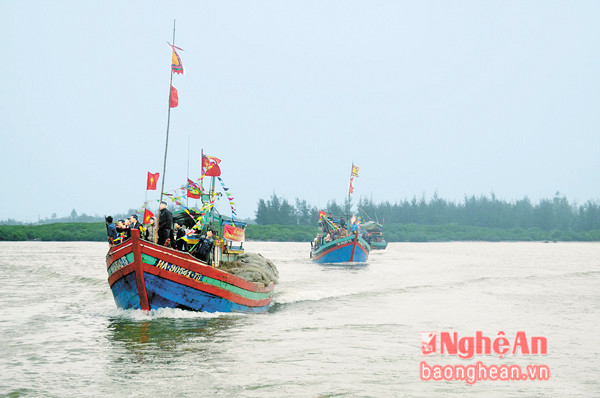 |
| The fleet of boats participates in the Fishing Festival in Dien Ngoc commune (Dien Chau). |
I can't remember how many times I've set foot in the Lạch Vạn estuary. Each time I return to this land, the pungent smell of seafood lingering in the villages along the estuary still fills my heart with a feeling that is both familiar and strange. This estuary, less than ten kilometers long, embraces and nurtures countless lives of people born and raised here. The sea, generous in providing people with seafood, also harbors countless lurking dangers. And the inhabitants of Lạch Vạn have been grateful to the sea for generations, grateful for the miraculous intervention of the Whale God who saved them from calamities in the open sea.
The worship of the Whale God among the coastal residents of Dien Chau district has a long history, holding a special place in the spiritual and religious life of the fishing community. According to legend, on a stormy day in the early 18th century at the Lach Van estuary, while fishermen on a ship were battling strong winds and waves, a huge Whale God suddenly appeared, clinging to the side of the boat and pushing it ashore in Ly Nhan village (now Dien Ngoc commune). Having saved the fishermen, the Whale God was exhausted and died shortly afterward. The entire village of Ly Nhan mourned and held a funeral ceremony as if it were a close relative, building a temple to worship the Whale God in Ly Nhan village. Over time, due to many changes, the temple was later demolished. The Whale God shrine in Ngoc Minh village is currently the only shrine in the coastal area of Dien Chau dedicated to the Whale God. It has become a refuge for Dien Chau fishermen on each fishing trip. The belief in the Whale God's protection at sea has helped them confidently venture out to sea and continue their livelihoods...
During a visit to Quynh Long (Quynh Luu district), I heard many mysterious stories from the local fishermen, making me feel like I had wandered into some fairytale land. The small village of Phu Lien faces the East Sea, a coastal area curving like a sail. Anyone who has ever set foot on this land is sure to feel a sense of awe. On this strip of land facing the sea, there is also a small temple nestled against Hon Kien mountain.
Mr. Tran Van Trang, the caretaker of the temple, recounts that long ago, a giant centipede crawled daily from a mountain cave down to the beach. No one directly encountered it, but everyone witnessed the centipede's footprints left on the ground. Remarkably, since the centipede's appearance, the villagers' fishing activities flourished, leading them to discuss building a temple to worship the centipede god. Therefore, the temple is named the Centipede Temple. After many upheavals, the temple was demolished, and later, when business declined, the people of Phu Lien decided to rebuild it. Although the new temple is not as grand as before, it serves as a spiritual center for the local residents. Notably, the Centipede Temple is also where fishermen worship the Whale God, hoping for his blessings on each fishing trip. Next to the Centipede Temple is the whale's tomb, which the villagers respectfully reburied and built a mausoleum for after it washed ashore in this sacred area.
Mr. Ho Xuan Tri, Deputy Head of Dai Bac village, said that no one remembers exactly when the tomb was built, but everyone here knows the story of the whale stranded on the shore, and how the villagers held a solemn funeral for it, along with many other fascinating stories.
According to legend, in the 19th century, when the whale washed ashore, many locals tried to bring it ashore for burial, but it was too large. Having no other option, they decided to cut open its flesh to extract the bones for burial. Legend says this whale was 120 meters long, with its body nearly 5 meters high from belly to back.
After the deity was laid to rest in Dai Bac for 2-3 years, the villagers saw their businesses prosper and their sea voyages were successful, so they built a temple in his honor. Initially, the temple consisted of only one building, but 5 years later it was renovated and expanded into three buildings, each with three chambers, making it one of the largest temples in Nghe An at that time. The temple was bestowed with royal titles by the Nguyen Dynasty kings. Local people still recount some rather intriguing stories about the temple's sacredness, linked to some events that took place in the area in 1970...
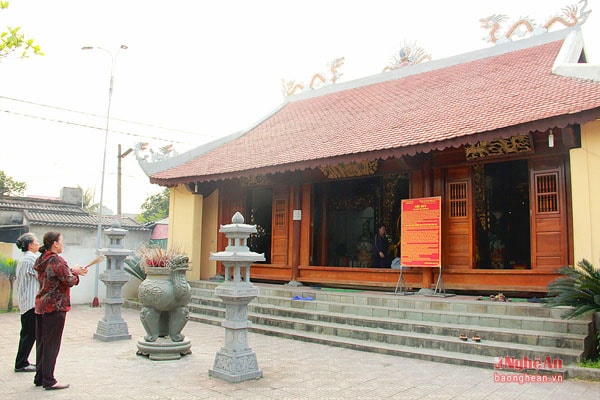 |
| The temple in Lang Hieu village is dedicated to the Whale God. |
In the Cua Hoi coastal area, locals still tell stories about a merchant who helped the poor and was rescued by a whale. Once upon a time, there was a merchant who was known for his charitable deeds. He and his fleet traveled far and wide, from the South to the North, trading goods to earn money to help the poor. One day, on his way back, his boat was robbed, and he fell into the sea. As the merchant tossed about in the rough waves, a large whale swam by and clung to him. At midnight, the whale tilted its head and released the merchant onto land. To show his gratitude, he hired people to build a house and establish his business in this area (now Cua Hoi), and he often retrieved the whale's carcass that washed ashore to bury and worship it carefully.
The custom of worshipping the Whale God has existed for a long time. In the minds of the fishermen of Cua Hoi, the Whale God is their guardian deity whenever they go out to sea. It's impossible to remember how many whale carcasses have been recovered here, but the people of Cua Hoi often whisper that, in the past, this sacred land was protected by a whale as big as a ship. Whenever boats encountered trouble or strong winds, it would appear to help. When a whale died and drifted ashore, it took 30 pairs of mats to cover its body. In the Cua Hoi area, besides the Lang Hieu temple dedicated to the Whale God with 97 whale tombs, there are other tombs in the surrounding fishing villages.
At the beginning of the new year, the people of Nghe An province show their reverence for the Whale God, with the most unique event being the Fishing Festival. Originating from the custom of worshipping the Whale God among coastal residents, the Fishing Festival is a deeply spiritual activity, aiming for a new year of favorable weather, calm seas, and successful fishing trips for the fishermen. It is also an opportunity for people to encourage each other to continue fishing, fostering closer relationships, unity, and the development of a meaningful cultural life.
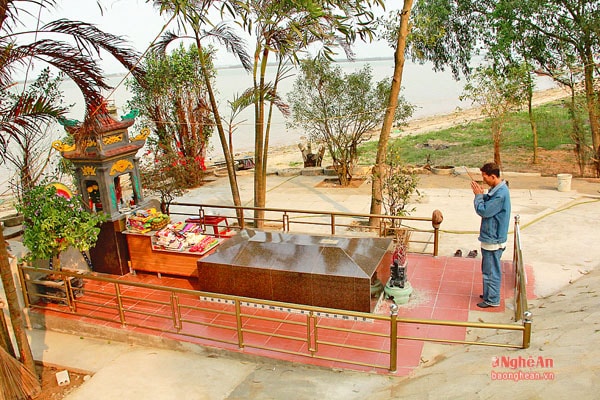 |
| People light incense at the tomb of the Whale God in Nghi Xuan commune (Nghi Loc district). |
Nghe An province currently has nearly 10 temples and shrines dedicated to the Whale God, stretching from Hoang Mai town to Cua Hoi. Quynh Luu district has the largest number with 5 temples and shrines, mainly concentrated in the communes of Quynh Tho, Quynh Long, and Tien Thuy. In addition, many localities organize annual fishing festivals, some of which are very solemn and large-scale, attracting thousands of locals and tourists. This is a unique cultural feature of Vietnamese fishermen in general, and Nghe An fishermen in particular.
The belief in the sea, where fishermen are believed to provide support, helps fishermen overcome all difficulties and continue to venture out to sea. And, the fishermen's aspiration to reach the open ocean is further strengthened by the government's support and encouragement mechanisms for building large-capacity vessels, especially with the issuance of Government Decree 67/2014/ND-CP dated July 7, 2014. The policy of supporting fishermen with preferential credit loans has created leverage to increase the capacity and fishing capabilities at sea. In recent times, many large vessels have been launched, bringing confidence and hope to each fisherman...
Lan Thai - Vuong Van


