
How to park correctly with the wheels close to the curb.
Pre-determining the fixed position on the dashboard where it intersects with the curb helps drivers gauge the distance when parking close to the sidewalk, preventing them from parking too far or too close.
Aligning the right-hand wheel track with the closest wheel track to the curb is one of the skills that most new drivers find confusing. Parking too far from the curb can result in a traffic fine, while parking too close can scratch the wheel rims.
Experienced drivers say the proper way to park close to the curb is as follows:
Reduce speed and locate a parking spot.
That's the first thing we need to do.
Through the rearview mirror, you need to observe vehicles behind and to the sides, especially to the right. This is because there may often be motorcycles moving close to your car on the right side. This also helps you identify blind spots when driving.
If you don't slow down, parking will be very dangerous for other road users or for yourself because you won't have enough time to react to any situation that may arise.
Additionally, when pulling over, you need to make sure that parking is permitted in that area, as you are only allowed to park in designated spots. Parking in the wrong place will obstruct traffic and may even result in a fine.
Observe carefully and turn on your turn signal.
The next step is to carefully observe the surroundings and rear by using direct observation, rearview mirrors, and the installed camera to identify obstacles or other vehicles, ensuring the safest possible pullover.
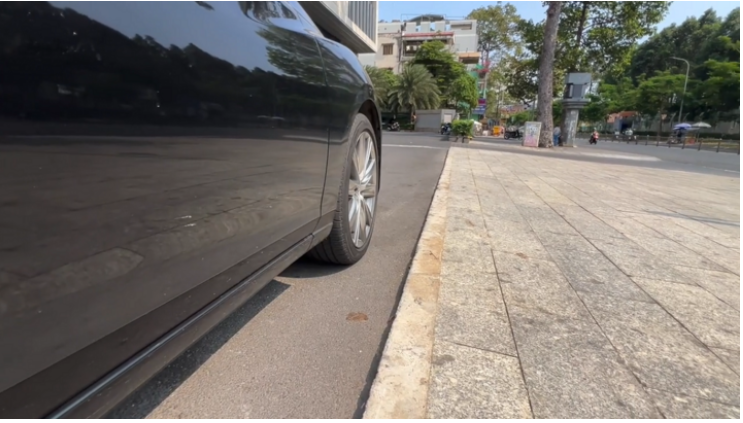
After observing and confirming that it is safe to park, the next step is to turn on the right turn signal to indicate your intention to move, letting other vehicles, especially motorcycles, know your direction of travel.
This helps vehicles behind to know what to do and react accordingly, such as swerving to the left to overtake or slowing down to yield the right of way.
In general, using turn signals is an extremely important step when pulling over because it signals to all other vehicles your purpose and direction of travel, so you must pay attention to this and not forget it.
Turn the steering wheel gradually to the right.
Continuing with the process of parking, we proceed to turn the steering wheel to the right, then carefully adjust the angle between the front of the car and the curb to 30-45°.
Next, slowly move the car into the pre-determined area. When the front of the car is about 15-20 cm from the curb, quickly turn the steering wheel to the left and drive the car until it is parallel to the curb, leaving a 25 cm gap, as required by road traffic regulations.
If you're driving a vehicle with high ground clearance, you can let the front wheels climb onto the curb, then steer to the left to lower the front wheels, and then adjust the steering to park the car close to the curb.
This method will help the car pull over to the side of the road faster and is very suitable for use in narrow parking spaces. However, this method should only be used when the sidewalk does not have sharp edges and the car's undercarriage is not too low to avoid damaging the vehicle.
Perform a final check before parking.
Once you've pulled over, you need to double-check to make sure the wheel spacing is correct. If the wheels are still too far from the curb, you need to reverse and steer to adjust the car closer to the curb.
This will help your vehicle park properly, avoiding traffic congestion caused by improper parking. It also prevents damage to your vehicle, as improper parking on the curb can easily lead to collisions with other vehicles and hinder traffic flow.
These are the ways to pull over to the side of the road that you need to be aware of and remember when participating in traffic to ensure safety.
Some tips for safely parking your car.
Here are some tips to keep in mind on how to pull over safely and quickly:
Avoid pulling over abruptly: One of the key tips for safe pulling over is to avoid doing so suddenly, whether in a quiet or busy area. This is extremely dangerous, as it prevents vehicles behind you from reacting in time and could lead to a rear-end collision, potentially causing an accident.
Use a convex mirror for better observation and parking: sometimes, when visibility is difficult, equipping yourself with a small convex mirror will help widen your field of vision and observation space, making it easier to safely park your car.
Alternatively, you can choose a spot with a clearly marked sidewalk to practice parking; this will help you get used to it and handle it more easily.


