
How to identify food contaminated with borax.
The Lunar New Year is a time when demand for various goods (especially food items) increases dramatically. Therefore, consumers need to be wary of foods containing harmful additives, especially those containing borax.
Not included in the list of substances permitted by the Ministry of Health for use in food processing.
According to Dr. Tran Quang Tung from the Institute of Chemical Engineering (Hanoi University of Science and Technology), borax is the common name for the chemical sodium tetraborax decahydrate. It is an antioxidant and has mild antiseptic properties. This chemical was previously used in the food industry due to several advantages, such as its ability to keep food fresh for a long time without spoiling, so it was often used to preserve fish and meat. In addition, borax can increase the elasticity of food, therefore, it is often added to vermicelli, pho, sausages, fermented pork rolls, etc.
However, studies show that borax is not completely eliminated from the body and can accumulate up to 15% of the amount ingested. In the long term, this can cause chronic poisoning, gradually leading to kidney and liver failure, resulting in pale skin, loss of appetite, and general weakness. It can even cause testicular atrophy, infertility, or digestive system complications in those who use it frequently.
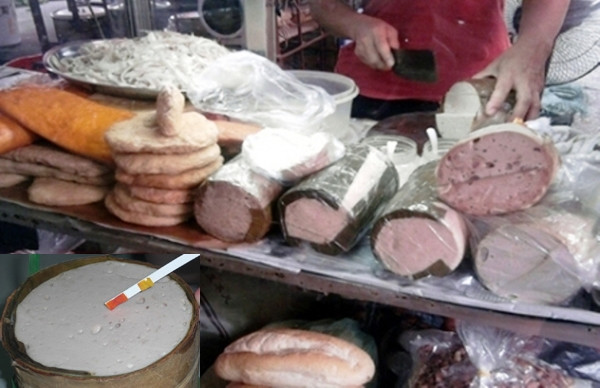 |
Experts warn that consuming large amounts of food containing borax is very harmful to health. (Illustrative image) |
Dr. Tran Quang Tung analyzed: “When it enters the body, borax reacts with the acid in gastric juice to release boric acid. This active substance inhibits phagocytosis, reduces the body's resistance, and has the property of binding to food, making it much more difficult to digest than normal. Long-term use of borax in children leads to slow development in adulthood. If pregnant women are poisoned by borax, the residue can be excreted through the placenta and breast milk, causing poisoning to the fetus and young children.”
Some specific examples of borax's toxicity can be seen in its use as an insecticide. People may apply a layer of borax to wood or soak it in a borax solution to prevent termite infestation. A 5.5% borax solution is used to kill black ants in kitchens… In Vietnam, borax is not on the list of substances permitted by the Ministry of Health for food processing due to its toxicity.
Tips for identifying foods containing borax.
Pork and various types of sausages and ham are indispensable foods on the Vietnamese family's spring festival feast table. However, the fact that some production facilities, driven by profit, abuse borax in preserving and processing these foods has caused concern among housewives. Therefore, be a smart consumer in identifying foods containing borax to ensure your health during the Tet holiday.
Experts say there are many ways to distinguish food treated with borax, such as through smell and color. Specifically, for pork, meat treated with borax looks very fresh, with firm but dry muscle fibers. When cut, the inside is soft, watery, and lacks elasticity. When eaten, the meat is crumbly and has a foul odor. Conversely, fresh, good quality pork is not slimy on the outside, is firm, and has high elasticity. When pressed, the meat feels soft, indents quickly, and returns to its original shape. When boiled, the water is clear, the meat smells good, and it has a chewy texture.
As for Vietnamese pork sausage (giò lụa), when buying, pay attention to the color and smell. Good quality sausage has a subtle aroma of meat blended with the scent of the wrapping leaves, a light pink color when sliced, a surface with many tiny holes, a smooth and slightly moist feel to the touch, and a sweet, fragrant taste that is not too crispy or crumbly. For Vietnamese pork sausage (chả), a good quality one will have a slightly rough outer layer and a soft, smooth surface. Sausage treated with borax will lack the characteristic richness of meat and will be unusually crispy and chewy.
Besides visually identifying foods containing borax, scientists have also pointed out a method using turmeric paper to accurately detect the amount of borax "preserved" in pork and sausages. According to them, borax is alkaline, so when it reacts with turmeric paper, the paper changes from yellow to red. Therefore, for convenience, housewives can buy ready-made turmeric paper on the market or make their own at home to test.
Here's how to make turmeric paper: Peel and wash fresh turmeric, let it dry, then crush it or blend it in a blender. Soak it in alcohol for 2-3 hours, filter out the liquid, and discard the pulp. Soak filter paper in the turmeric solution for 1-2 hours, then remove it, dry it, and observe the color of the paper. If the turmeric paper is too pale, the borax content test will not be accurate. Therefore, quality turmeric paper is characterized by a uniform yellow turmeric color that is neither too dark nor too light.
Finally, place the turmeric paper on the test product (pork, ham, sausage, etc.). Press the turmeric paper onto the surface of the product (if the product surface is dry, you can wet the turmeric paper with a dilute acid solution before testing). After a few minutes, if the turmeric paper changes from yellow to red, it indicates that the product contains borax.
Remember to choose safe food during Tet.
To ensure the safety of your Tet (Lunar New Year) feast, only use safe, pre-processed foods with natural colors and clearly labeled packaging or origin. For slaughtered meats like chicken, pork, and beef, only buy those that have been inspected. For fish, shrimp, and other seafood, choose fresh, live produce without any strange odors. Buy fresh, undamaged fruits and vegetables from reputable vendors with guaranteed quality. Avoid foods that are brightly colored, gaudy, or excessively crunchy or chewy.
To ensure the safety of your Tet (Lunar New Year) feast, only use safe, pre-processed foods with natural colors and clearly labeled packaging or origin. For slaughtered meats like chicken, pork, and beef, only buy those that have been inspected. For fish, shrimp, and other seafood, choose fresh, live produce without any strange odors. Buy fresh, undamaged fruits and vegetables from reputable vendors with guaranteed quality. Avoid foods that are brightly colored, gaudy, or excessively crunchy or chewy.
According to Vietnamnet
| RELATED NEWS |
|---|


