
How to distinguish between Vietnamese and Chinese plums.
During the season, thousands of tons of Chinese plums are imported into Vietnam through the Lang Son and Lao Cai border gates each year, but these Chinese plums are always marketed as "Sapa plums".or "Vietnamese plums". So, how can you distinguish Chinese plums from Vietnamese plums?
Tam Toa plum, Hau plum: Exclusive to Vietnam
According to Ms. Nguyen Thi Van, who has 20 years of experience in fruit trading and is a wholesaler specializing in exporting various types of Vietnamese and Chinese plums at Long Bien wholesale market (Hanoi), there are dozens of types of plums sold at the wholesale market, which are then distributed to retail markets or street vendors for sale along the roads.
However, if people don't like buying Chinese fruits, they can rest assured buying Tam Hoa plums or Hau plums. These two types of plums are exclusive to Vietnam; they are currently only grown in Vietnam and not in other countries.
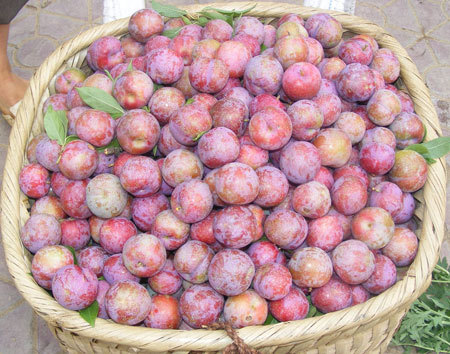 |
| Plum varieties like the "Mận hậu" and "Mận tam hoa" are specialties found only in Vietnam. |
Ms. Van said that Tam Hoa plums and Hau plums are mainly grown in Moc Chau (Son La) and Bac Ha (Lao Cai) regions. When ripe, the skin of these two types of plums will have tiny white and red spots. When bitten in half, the inside will be a deep reddish-purple color. They are crunchy, and ripe plums have a sweet and sour taste.
Early season plums retail for 150,000-200,000 VND/kg, mid-season prices range from 25,000-60,000 VND/kg depending on the variety, and towards the end of the season, plum prices will increase by another 10,000-20,000 VND/kg compared to mid-season.
Giant black plums are found only in China.
Ms. Van also stated that in August and September each year, a type of dark purple plum appears on the market. The fruit is as large as a fist (3-4 times larger than the Tam Hoa plum), with yellow, juicy, soft, and sweet flesh inside. This type is often advertised by street vendors as Sapa plums. However, in reality, these plums are imported from China.
According to Ms. Van, there is also a type of black plum in Vietnam, but the fruit is only about the same size as the Tam Hoa plum, and the production is not abundant.
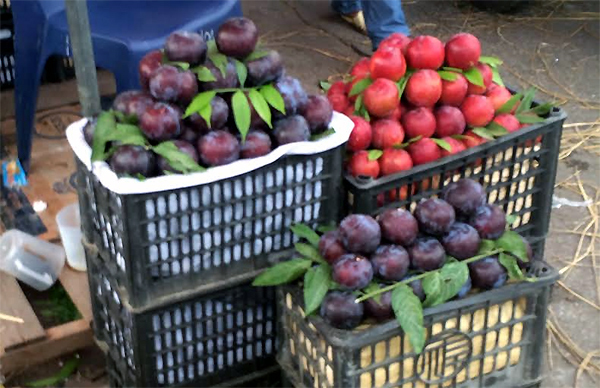 |
| Giant black plums, as big as a person's fist, are 100% Chinese plums. |
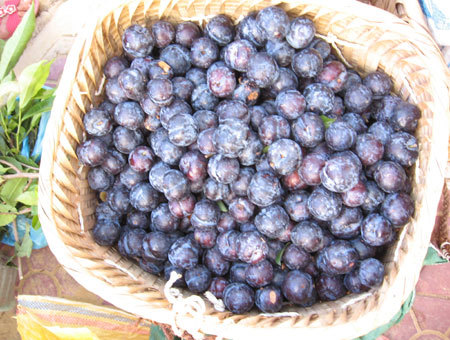 |
| Vietnamese black plums are small, similar in size to the three-flowered plum. |
Meanwhile, the head of the Department of Agriculture and Rural Development of Lao Cai province also confirmed that there is a type of black plum in Lao Cai, but the fruit is small, and the plum season ends around July.
Chinese plums are easily mislabeled as Vietnamese plums.
After the season of the three-flowered plum, the sugar plum will be widely available in markets throughout Hanoi. The price of this type of sugar plum ranges from 25,000 to 40,000 VND/kg depending on size.
This type of plum is characterized by its green skin, which turns slightly yellow when ripe, sometimes with red spots. It is crunchy and sweet, and the pit separates easily when bitten in half, making it very popular among consumers.
 |
| Following the season of Vietnamese three-flowered plums, Chinese sugar plums are dominating Vietnamese markets. |
On the market, vendors still advertise this type of plum as Vietnamese plum. However, Vietnamese plums are usually available at the beginning of the season, even before the Tam Hoa plum season. They are mainly grown in the Lang Son region. The plums have a sour, astringent, and crunchy taste. Meanwhile, Chinese sugar plums appear after the Tam Hoa plum season ends (starting around June each year).
 |
| Vietnamese plums appear early, even before the harvest season for the Tam Hoa plum. |
 |
| Chinese plums are often mislabeled as Ta Hoang Y plums in Bac Ha, but Ta Hoang Y plums are about one and a half times larger than Chinese plums. |
Ms. Van also added that traders often confuse Chinese sugar plums with Ta Hoang Y plums from Bac Ha (Lao Cai). However, Ta Hoang Y plums are quite famous for their deliciousness, crispness, and sweetness. Compared to Chinese sugar plums, Ta Hoang Y plums are one and a half times larger, or even larger than Tam Hoa plums. Buyers can distinguish this type of plum from Chinese sugar plums by looking at the size.
According to data from the Plant Quarantine Sub-department of Region VII (Lang Son) and Region VIII (Lao Cai), from the beginning to the end of the 2015 plum season, 4,206 tons of various types of Chinese plums were imported into Vietnam. Of this amount, approximately 3,668 tons of Chinese plums were imported through the Lao Cai border gate. |
According to Vietnamnet
| RELATED NEWS |
|---|


