
How to safely handle a sudden tire blowout in your car.
A tire blowout while a car is in motion poses a high safety risk, so what is the best way to handle it safely?
Causes of tire blowouts
Tires that are underinflated or overinflated
Underinflation, where the tire pressure is too low, forces the tire to withstand more pressure than normal. Simultaneously, excessive contact between the tire surface and the road causes the tire to overheat, increasing the risk of blowout. Conversely, overinflation, which puts the tire under high internal pressure, also increases the risk of blowout from strong compression or sudden impacts.
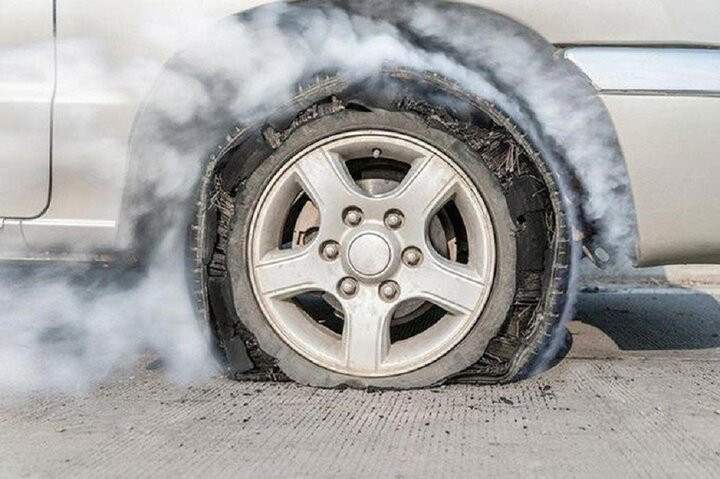
Stabbed by a sharp object.
This is also one of the reasons why car tires explode. Sharp objects such as nails, stones, pieces of metal, etc., can puncture tires, posing a risk of explosion when the car is traveling at high speed.
The tires are too old.
If tires are too old, they will wear down to their limit, and when operating at high speeds, factors such as temperature, pressure, and load will completely destroy your tires. When drivers are driving at high speeds on highways, the friction between the tires and the heat can lead to sudden tire blowouts, especially with old tires that have exceeded their load-bearing capacity.
According to manufacturers' recommendations, drivers should replace their tires after 50,000 km. If you frequently drive on rough roads, you should replace them after 40,000 km or after 5 years of use.
Taking a corner too sharply at high speed.
Tires can also easily burst during sharp turns at high speeds when they are excessively worn.
The rim is broken.
Damaged or defective rim edges can cause scratches on the tire during use. If the scratches are numerous and deep, the tire will not withstand the pressure and may burst.
Overloading
Both vehicles and tires are designed to withstand certain loads. If they are overloaded for extended periods, the tires are very likely to burst.
How to handle a sudden tire blowout in your car.
Hold on tight to the steering wheel.
When a car suddenly experiences a tire blowout, the first sign is that the vehicle will swerve. At this point, the driver needs to firmly grip the steering wheel and steer the car straight. If the car veers to one side, steer in the opposite direction to stay in your lane. Avoid crashing into the median or encroaching on other lanes, which could be dangerous.
Gradually reduce the throttle.
A flat tire will inevitably cause a very bumpy ride. Therefore, it's crucial to control your speed by gradually reducing the throttle, never releasing it immediately.
Apply the brakes
As the speed decreases, the next step is to apply the brakes to reduce the speed.
Observe the surroundings and pull over to the side of the road in a safe location.
At this point, turn on your hazard lights to signal to vehicles behind you and observe your surroundings, looking for a safe place to pull over to the side of the road. Absolutely do not stop in the middle of the road if the vehicle is still moving.
Change to a spare tire or call for roadside assistance.
Once you've parked your car in a safe place, proceed to change the spare tire if you have one. If you don't have one, you can call a tow truck to have your car moved.
Things to note when dealing with a car that has a flat tire.
Avoid sudden braking.
When a car experiences a tire blowout, many people's first reaction is to slam on the brakes to bring the car to a quick stop. However, this is extremely dangerous, especially if the tire blows out while the car is traveling at high speed. Sudden braking can cause the car to tilt, lose balance, and potentially roll over. This is most common in high-ground clearance vehicles such as 5-seater and 7-seater SUVs and crossovers.
Avoid steering too sharply.
The car will wobble when a tire blows out, making it very difficult to control the steering wheel. At this point, don't panic and swerve sharply; this will not only be unhelpful but will also make the situation worse.
Do not suddenly release the accelerator pedal.
Many car users mistakenly believe that suddenly releasing the accelerator pedal will slow the car down. However, this is not a good way to decelerate. On the contrary, it poses many dangers, making the car more likely to lose control and potentially lead to a loss of steering control.
Therefore, instead of suddenly releasing the accelerator, drivers should gradually reduce the throttle and combine it with light braking to slow down.


