
The 2026 Cadillac Optiq's actual charging performance is on par with the Tesla Supercharger.
The 2026 Cadillac Optiq switched to the NACS standard, approaching over 20,000 superchargers in North America. However, tests showed that the power output reached 147 kW and then dropped rapidly; after 25 minutes, it only reached 65%, with the charging speed slowing down noticeably.
The 2026 Cadillac Optiq is one of General Motors' first electric vehicles to use Tesla's NACS charging standard, giving it access to over 20,000 Supercharger charging points in North America. However, real-world fast charging tests on the V3 Supercharger (up to 250 kW) revealed limitations stemming from the vehicle's own charging curve: power peaks at 147 kW and then drops rapidly after reaching 40% battery capacity, making it difficult to achieve the common 25–30 minute charging time.
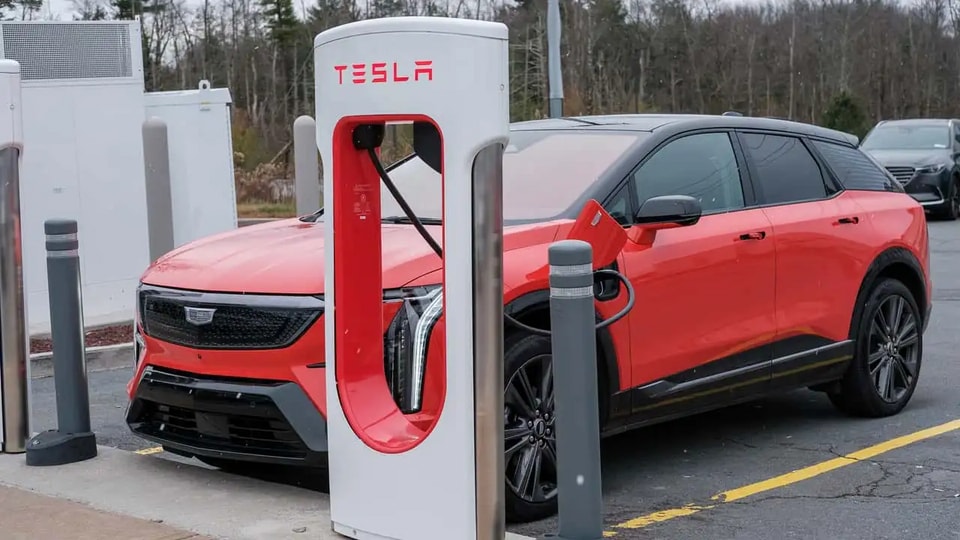
NACS opens the charging network, but the new curve is the "key".
The Optiq uses an 85 kWh battery pack, larger than the Tesla Model Y (75 kWh) and comparable to the Hyundai Ioniq 5 (84 kWh). However, recent GM EV models haven't been known for their fast charging speeds. The Optiq's maximum DC power output is limited to 150 kW, and previous tests have shown that the Equinox EV or Blazer EV often struggle to maintain consistently high power output.
GM doesn't disclose the 10%–80% charging time, but instead states "an additional 81 miles (≈130 km) in approximately 10 minutes" at a 150 kW station. This wording emphasizes the additional range rather than the standard charging time.
Supercharger V3 test data: premature power drop
In a real-world test (battery preheated for about 20 minutes), the Optiq entered the Tesla Supercharger V3 station with 14% battery and showed a range of 35 miles (≈56 km). Key milestones:
- The charging current immediately reaches 147 kW (almost the car's maximum), then gradually decreases.
- 21% after 3 minutes, power started to decrease.
- The power output is at 37%, remaining at 129 kW; the machine is expected to reach 80% in 25 minutes.
- 50% are still below 120 kW.
- 58% (~170 miles ≈ 274 km) remaining, 112 kW.
- 60% dropped to 85 kW (only about half of what it was initially).
- After 25 minutes, the battery reached 65% and the range was 194 miles (≈312 km); at this point, the power output was only 67 kW, and the 65%–80% charging period would certainly be slow.
The test ends when the displayed distance is sufficient for the next leg of the journey.
Quick comparison: competitors maintain power output better.
According to InsideEVs and related tests, the Hyundai Ioniq 5, when charging with NACS at around 126 kW, maintains a stable charge, reaching 10%–80% in about 30 minutes. The 2026 Subaru Solterra, with its smaller battery (74.7 kWh), still stays above 100 kW to over 65%, reaching 16%–80% in about 25 minutes. Meanwhile, the Equinox EV rarely exceeds 100 kW at a 150 kW station; even at a 350 kW station, the 20%–80% charge time is typically around 35 minutes.
The results show that "NACS doesn't automatically make every car a fast charger": the port standard is only part of the equation, and the actual speed depends on how the car manages its battery and the charging curve.
Main specifications (based on test results and related publications)
| Item | Cadillac Optiq 2026 |
|---|---|
| Battery capacity | 85 kWh |
| Charging standard | NACS (Tesla) |
| Charging network is accessible. | Over 20,000 Supercharger stations (North America) |
| Maximum DC charging power of the vehicle | 150 kW |
| Test station | Tesla Supercharger V3 (up to 250 kW) |
| Battery status at startup | 14%, 35 miles (≈56 km) |
| Peak power recorded | 147 kW |
| After 25 minutes | 65%, 194 miles (≈312 km), power ~67 kW |
Looking at it from a fast charging technical perspective.
Optiq's conservative charging curve is evident: high power is only present at low battery levels, then drops rapidly after around 40%. This calibration prioritizes safety and battery life, but at the cost of longer charging times compared to competitors that maintain a more stable high power output.
Conclude
The 2026 Cadillac Optiq benefits greatly from the NACS standard thanks to its Supercharger coverage, but actual charging speeds still depend on the 150 kW limit and the vehicle's own charging curve. With power dropping early, the Optiq's time to charge to 80% may be longer than the current average. Users should have reasonable expectations: NACS provides convenience in terms of charging stations, but the speed ultimately depends on the Optiq.


