
Can the Russia-Saudi Arabia handshake save oil prices?
(Baonghean) - Russia, Saudi Arabia, Qatar, and Venezuela have reached an agreement to maintain oil production levels at the same levels as in January. This "historic" agreement by the giants of the oil industry raises hopes of preventing oil prices from plummeting further in 2016 – which were previously predicted to fall to as low as $20 per barrel.
The Russia-Saudi Arabia handshake
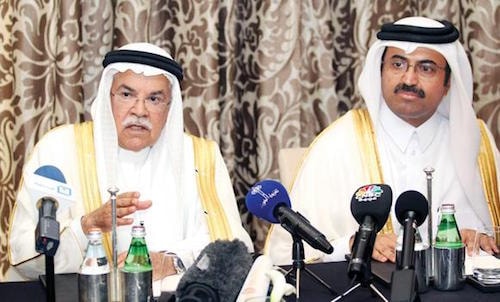 |
| Saudi Arabia's oil minister (left) and Qatar's energy minister (right) at a conference in Doha. Photo: Arabnews |
An emergency meeting of the Organization of Petroleum Exporting Countries (OPEC), including countries outside the organization such as Russia, was held to discuss measures to salvage oil prices, which have fallen by more than 70% since 2014. Following the meeting, Russian Energy Minister Alexander Novak and Saudi Arabian Oil Minister Ali Al-Naimi announced their agreement to maintain production levels as in January, although both still wanted to meet customer demand.
The next step will be for the parties to establish a committee to oversee the oil production cuts by the participating countries, while also working with other nations such as Iran and Iraq to reach a consensus on production cuts. Both tasks are crucial, as the agreement will only be meaningful if the participating parties seriously adhere to the requirement to maintain production levels.
The agreement reached in Qatar is seen as a significant diplomatic victory for Venezuela, which had made numerous trips to a number of major oil-exporting countries in February. However, the most decisive factors were Russia and Saudi Arabia, as the race to increase production and gain market share had previously been primarily between these two nations.
Analysts explain the motives behind this handshake by suggesting that Russia and Saudi Arabia have reached their limits after months of intense competition. Saudi Arabia took the rare step of selling crude oil to Eastern Europe – Russia's backyard market. For its part, Russia surpassed Saudi Arabia in oil exports to China. After these somewhat triumphant victories, both sides began to feel the backlash: the Russian economy contracted by 3.7% in 2015 and is projected to continue this trend in 2016. Similarly, Saudi Arabia's budget deficit reached 15% of GDP in 2015, leaving the country facing the possibility of depleting the necessary financial resources to support spending over the next five years if oil prices and government spending policies remain unchanged.
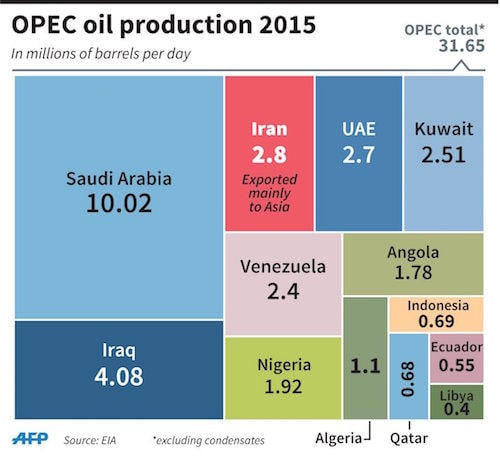 |
| Current total production of OPEC countries. Photo: Arabnews |
The situation culminated in crude oil prices plummeting by over 70% in the past 18 months, falling to $30 per barrel before the meeting. In 2015, oil prices were $50 per barrel, and at $100 per barrel in mid-2014.
"Freezing" is not enough.
About a week before the meeting, the global oil market reacted very positively with spectacular price increases, peaking at 12% on February 12th – the strongest increase since 2009. The upward trend in world oil prices continued into the early part of trading on February 16th – the day the news of the agreement to freeze oil production was announced – with prices trading around $34 per barrel.
However, from the end of trading on February 16th, continuing into February 17th, oil prices reversed course and fell. Analysts believe this clearly reflects the disappointment of the global market as the agreements did not reach the levels previously anticipated. The Doha meeting was expected to lead to a commitment to cut production rather than maintaining the production ceiling – a level far exceeding market demand.
Investors remain skeptical about the significance of the agreement given the absence of Iran and Iraq, and the lack of indications that these two countries will join. As the fifth-largest oil producer in OPEC, Iran ruled out the possibility of production cuts when OPEC met in December 2015, and has not hidden its goal of regaining customers lost during years of sanctions, aiming to catch up with the two leading producers (Russia currently ranks number one with nearly 11 million barrels per day, and Saudi Arabia with over 9.9 million barrels per day).
 |
| Oil production will remain at its current level. Photo: AP |
A source close to Iran revealed that the country would only consider "freezing" production after reaching its pre-sanctions level. Meanwhile, Iraq continues to increase its crude oil production to a record 4.35 million barrels per day.
Those taking a cautious stance believe that the agreement in Doha, Qatar, is unlikely to "save" oil prices in 2016. Meanwhile, some analysts are optimistic, suggesting that maintaining production levels will be the foundation for slightly higher oil prices in the second half of the year.
Thuy Ngoc
| RELATED NEWS |
|---|


