
Going to the hospital with your health insurance card is as easy as... going to the market.
(Baonghean) - In the first six months of 2016, the National Health Insurance Fund spent over 30,300 billion VND, a 40% increase compared to the same period last year; of which, 37 provinces and cities had a deficit of more than 3,400 billion VND. Nghe An ranked second nationwide in terms of deficit with approximately 350 billion VND. Reporters from Baonghean newspaper investigated and clarified the causes and related issues.
Lesson 3:"Health Insurance Fund Overspending: 'Collapse' before any 'firefighting' measures are taken"
Simply put, a deficit in the health insurance fund means that revenue does not cover expenses. This phenomenon occurs partly due to lax and lenient supervision, creating conditions that allow patients and medical facilities to easily "maximize" their costs. |
Going to the hospital is like… going to the market.
Mr. NS (67 years old, residing in a ward in Vinh City) affirmed: Going for check-ups now is very "easy," all you need is a health insurance card, and by making up some illness, you can simultaneously go for check-ups at several hospitals.
To corroborate his statement, on the morning of October 7, 2016, Mr. NS brought his health insurance card (registered for initial examination and treatment at a provincial-level hospital) to Cua Dong General Hospital for examination with symptoms of "neck and shoulder pain". Hospital staff issued him a health insurance card with the code "Patient in line with 5% coverage"; he was directed to examination room 22, 3rd floor, under the supervision of Dr. Nguyen Thi Tam.
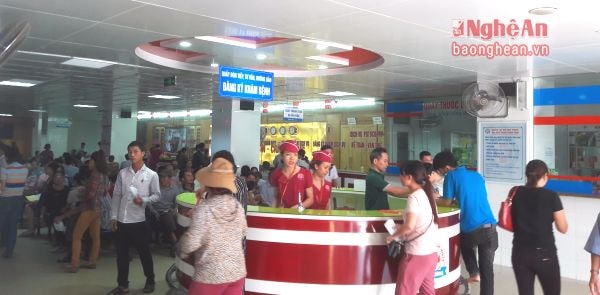 |
| Registration for medical examination and treatment is at Cua Dong General Hospital. |
Here, after asking him some questions and requesting him to do a few stretching and neck rotations, Doctor Tam asked: "Do you want to go to the hospital? Go in for treatment... If you don't want to go in, you can get an X-ray of your cervical spine and a chest X-ray because I see you coughing and expectorating. After the scans, they'll give you medication to take home for treatment, it's up to you. You should go in for a course of treatment to strengthen your health."
Citing a lack of preparation, Mr. NS was scheduled for X-rays of his cervical spine (frontal and oblique views), chest, and lumbar spine (frontal and oblique views). Before using the service, Mr. NS had to pay an additional 144,600 VND for three scans, in addition to the cost covered by health insurance. After the X-rays, Mr. NS was diagnosed by the doctor and X-ray technician with "cervical spondylosis and bilateral bronchitis." Doctor Tam prescribed Mr. NS medication covered by health insurance, including Doxycycline 100 (30 tablets), Medrol Tab 16mg (10 tablets), Meloxicam (20 tablets), and Vitamin AD (20 tablets).
On the afternoon of October 7, 2016, with the same "neck and shoulder pain symptoms," Mr. NS again brought his health insurance card to the Thành An Saigon General Hospital for examination. There, he was warmly welcomed by the hospital staff, who entered his health insurance card number and related information into the computer system. Afterward, he was examined by Dr. Ngô Kim Chung, a medical doctor, who initially diagnosed him with "neck and shoulder pain, history of elevated liver enzymes, and suspected rheumatoid arthritis"; the order included a cervical spine X-ray (frontal and lateral views) and blood tests. The X-rays and tests revealed degeneration of the C4, C5, and C6 vertebrae, narrowing of the C5-C6 and C6-C7 intervertebral discs, and blood test results within normal limits.
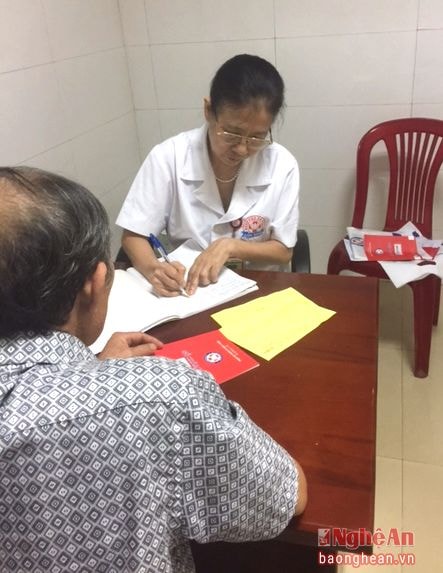 |
| Doctor Nguyen Thi Tam (Cua Dong General Hospital) prescribes medication for the patient. |
Mr. NS was advised by the doctor: "Your cervical vertebrae are in very bad condition. Let me prescribe some medication for you. But to ease the pain, if you want one or two injections, that's fine too." Mr. NS disagreed with using medication not covered by health insurance and was prescribed medication covered by health insurance, which he received at the hospital's health insurance pharmacy. The medication included Mydocalm 150mg (20 tablets), Tatanol (15 tablets), and Scanneuron (30 tablets). The total cost of examination and treatment was 365,650 VND. After deducting the health insurance coverage, Mr. NS had to pay an additional 18,282 VND to Thanh An Saigon General Hospital.
Four days later (October 11, 2016), Mr. NS returned to Cua Dong General Hospital with his health insurance card, still exhibiting symptoms of "neck and shoulder pain." He managed to pass through security and was referred to the same clinic, under the care of Dr. Nguyen Thi Tam. Dr. Tam, seemingly unaware that Mr. NS had visited a few days earlier, continued to request an X-ray and offered inpatient treatment. This follow-up visit cost a total of 360,000 VND. After deducting the service fees covered by health insurance, Mr. NS had to pay an additional 142,950 VND. Dr. Tam again prescribed medication for Mr. NS to receive at the hospital pharmacy, including Meloxicam (20 tablets), Rheumatism Relief P/H (10 packets), and Vitamin AD (20 tablets).
On the morning of October 13th, Mr. NS brought his health insurance card to Vinh International Hospital for examination. With symptoms of "neck and shoulder pain," he was prescribed a general check-up, including straight and oblique X-rays of the cervical spine and lumbar spine. The total cost was 236,000 VND, after deducting the amount covered by health insurance, Mr. NS had to pay an additional 81,150 VND. Diagnosing Mr. NS with degenerative spinal disease in the lumbar and cervical regions, Dr. Tran Thi Thanh prescribed the following medications covered by health insurance: Meloxicam (10 tablets), Scaneuron (20 tablets), Eperison (20 tablets), and Ostocare (10 tablets). This prescription was for 10 days, and he was instructed to return for a follow-up examination after finishing the medication.
Thus, in 7 days, Mr. NS visited 3 hospitals 4 times for check-ups and received medication. If he wanted to continue, he could probably visit a number of other hospitals of the same caliber in the area for check-ups and medication.
In fact, this is a common situation in district-level hospitals for various reasons; it could be going there to "get medicine"; or some patients visit multiple hospitals due to a lack of trust in the competence of doctors and medical staff.
Mr. NXH, 53 years old, from Binh Son commune, Anh Son district, is an example. Mr. H. has a health insurance card, suffered from neck pain, went to the district general hospital for examination and was diagnosed with spinal calcification, received medication for 2 days, but still continued to seek treatment at Cua Dong General Hospital and even intended to go to the Provincial Friendship General Hospital for further examination. He explained: "I have a younger sibling who has a brain tumor, but it wasn't detected at Cua Dong General Hospital; it was only discovered at the Provincial Friendship General Hospital…"
Are healthcare facilities and regulatory agencies lax in their oversight?
According to regulations, all hospitals must install software systems to manage and monitor patients receiving medical examinations and treatment, in order to prevent fraud in the use of health insurance cards. However, as shown in the example above, hospitals are neglecting this monitoring process, readily admitting patients for follow-up visits, offering inpatient treatment (even when the patient's condition does not require inpatient treatment), and prescribing unnecessary tests and equipment. What is concerning is that the Social Insurance agency and the Department of Health are not unaware of these fraudulent practices by medical facilities.
 |
| Cua Dong General Hospital. - Photo: benhviencuadong.vn |
Over the years, through the inspection, verification, and settlement of health insurance medical examination and treatment costs, the provincial Social Insurance agency has been able to clearly identify which medical facilities in the area are abusing medical examination and treatment services and exceeding the health insurance fund. For example, Cua Dong General Hospital, in the first two quarters of 2016 alone, exceeded the fund by over 25 billion VND.
In December 2015, the Provincial Social Insurance Agency issued Official Letter No. 3762/BHXH-GĐBHYT regarding the abuse of laboratory tests, paraclinical examinations, and diagnostic imaging at this hospital; many medical records described 5-6 secondary illnesses alongside the main illness to justify the tests (15-17 tests per patient); widespread ordering of MRJ increased the cost of health insurance medical examinations and treatments… The Provincial Social Insurance Agency had warned that “if this continues, Nghe An Social Insurance will consider requesting a temporary suspension of the health insurance medical examination and treatment contract”; however, despite this warning, no medical facility was actually penalized.
Furthermore, despite the huge budget overrun, the amount of money disallowed by the provincial Social Insurance agency was very low. For example, at Cua Dong General Hospital in the first quarter of 2015, the initial number of registered medical examination and treatment cards was 23,493; the medical examination and treatment fund used in the first quarter was over 2.8 billion VND; and the overspending that had not yet been settled was over 6.4 billion VND. Upon inspection, the amount of overspending due to subjective reasons was only over 22 million VND!
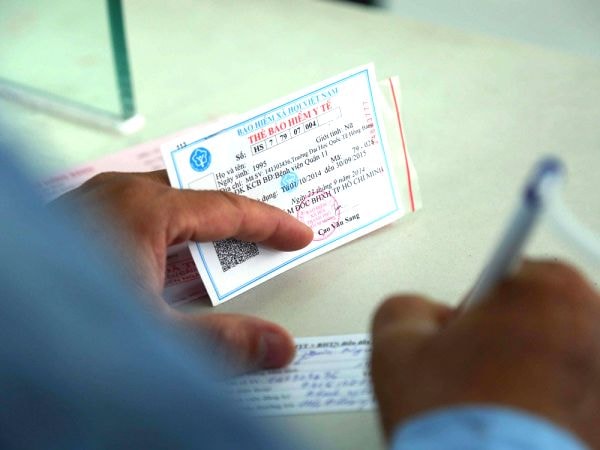 |
| People use their health insurance cards for medical examinations and treatment - Illustration photo |
In 2015, the scandal at Thanh An Saigon General Hospital was considered the most "serious" case of health insurance fund fraud discovered and handled in the province. Specifically, a technician in the hospital's laboratory department forged the signatures of staff and the head doctor of a provincial-level hospital to legitimize tests that lacked receipts, invoices, or verification documents.
The incident came to light when the Social Insurance agency conducted an inspection and discovered that the payments for these tests lacked sufficient documentation to be included in the health insurance reimbursement. The amount of misappropriated funds was determined to be 64 million VND and was recovered. The technician who forged signatures on the documents was dismissed from his job by the hospital.
The case was closed here without any further investigation into the authenticity of the relevant documents, or the responsibility of the individuals in charge of finances and records. Meanwhile, Thanh An Saigon General Hospital remained "unaffected," receiving no disciplinary action whatsoever.
Thus, it can be seen that the health insurance fund is being abused, leading to overspending, due to many reasons stemming from all stakeholders: patients, medical facilities, and management agencies. The mentality of "maximizing revenue" and lax control are "loopholes" threatening the stability of an important social welfare mechanism. However, to carry out these "tricks," could it be that the mechanisms for monitoring and managing health insurance in particular, and social insurance in general, have dangerous loopholes?
(To be continued)
Reporters' Team


