
We need to protect children's right to read.
In this S-shaped land, in many families and schools, children do not have the opportunity or the right to read the books they like.
David is a retired American teacher. After leaving the classroom, he joined a volunteer organization that reads stories to preschool and elementary school children, sharing his reading skills with students in higher grades.
I met David at an English center in Hanoi. In the hallway, holding a book for children aged 0-10, David shared, “Children everywhere in the world are the same; they eagerly and attentively listen to adults read stories. But I’m surprised by the parents in Vietnam; they don’t seem to like that. They ask us to help their children excel in English and achieve high scores in exams. They don’t care about cultivating a love of books in their children. Because a love of books, a reading habit, and reading skills are what will instill in children the ability to learn for life.”
This is not an isolated case. Across this S-shaped land, in many families and schools, children do not have the opportunity or the right to read the books they enjoy.
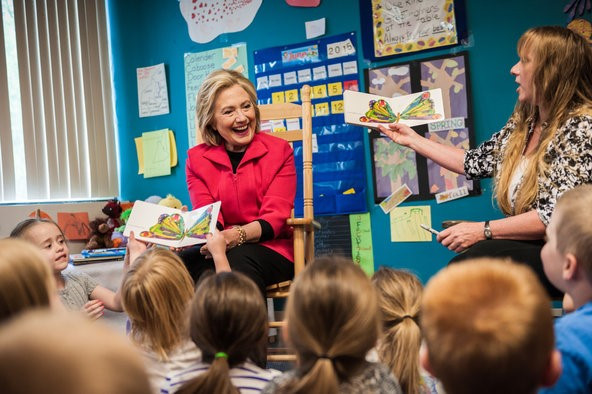 |
| American politicians like Hillary Clinton often spend time reading with children. |
In most Vietnamese homes, bookshelves are not essential items. Sometimes, they serve more as decorative elements than as a true reading space. For many parents, reading is synonymous with doing homework, reading textbooks, and attending extra classes.
In many schools that meet standards, the library remains an outdated space with a meager and unfriendly collection of books. In many classrooms, students and parents work together to build a classroom bookshelf, but these bookshelves are often kept "locked and bolted" for reasons of preservation and theft prevention (?). Libraries and activities encouraging children to read in schools are not truly considered the "heart of the school."
"A thirst for books," and the government's failure to adequately prioritize reading promotion activities for children... These were some of the reasons that motivated Mr. Nguyen Quang Thach to "beg for books" to bring books to rural areas and, at the same time, to urban areas. After nearly two decades of perseverance, tens of thousands of bookshelves have been established, and the Ministry of Education and Training has issued document 6841 on library reform and the development of reading culture in schools. Mr. Nguyen Quang Thach and his "Books for Rural Areas" project received the UNESCO literacy award in 2016.
However, the "struggle" for children's right to read remains challenging if parents and teachers still consider textbooks to be "sacred texts" and homework to be paramount; and if civil society organizations promoting reading are not encouraged and recognized by the government.
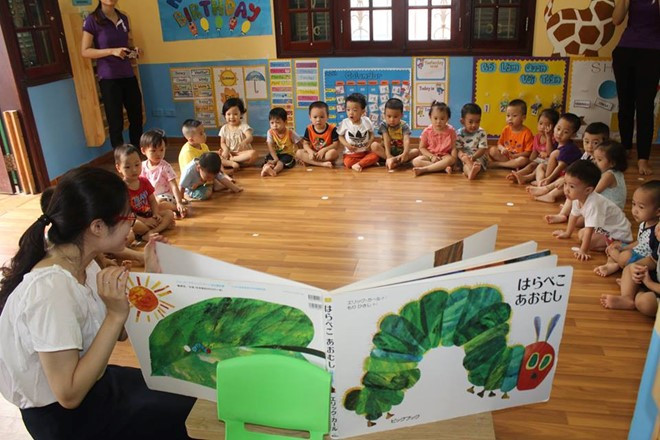 |
| Cultivating a reading habit in children is essential. |
In Japan, in 2001, to promote a reading culture, the Japanese Parliament passed a law encouraging children's reading activities. Following this, in 2005, the Japanese Parliament ratified the Law on the Revival of Reading Culture. The Japanese Parliament instructed the Japanese government, in implementing this law, to "encourage independent reading activities for children; therefore, administrative agencies must not interfere improperly. Parents or guardians must actively... enrich children's reading opportunities and reading habits." This law emphasizes: "A reading culture is essential for the development of a democratic society in which knowledge and wisdom are of paramount importance."
In Western countries, governments consistently encourage and support individuals and civil society organizations in organizing book donation programs, reading activities, and reading skills training for children through specific strategies, policies, plans, and programs.
In developed countries, politicians, despite their busy schedules, annually dedicate a certain amount of time to promoting reading among children. The image of President Barack Obama giving and reading books to children is not unfamiliar to the American people. Closer to home, in South Korea, at every book fair, the image of President Park Geun-hye queuing to buy or read books at the booths is very familiar to readers in that country.
Meeting David again at this year's opening ceremony, as usual, the conversation revolved around the topic of encouraging children to read. David said, "
Cultivating a love of books in preschool and elementary school children is extremely important. It helps children develop a lifelong reading habit. This is the foundation for self-learning and a learning society.
According to Zing


