
Canada chose German company TKMS to build its next-generation submarine instead of South Korea.
Canada has chosen Germany's TKMS as its preferred contractor for a project to build 12 new submarines, beating out rival Hanwha Ocean in a mega-contract worth tens of billions of dollars.
The Canadian government has officially announced its selection of Germany's ThyssenKrupp Marine Systems (TKMS) as the preferred contractor for the Canadian Coast Guard Submarine Project (CPSP). This decision marks a significant milestone in the Royal Canadian Navy's efforts to modernize its underwater combat capabilities, while closing the door on South Korea's bid for the largest defense contract in the country's history.
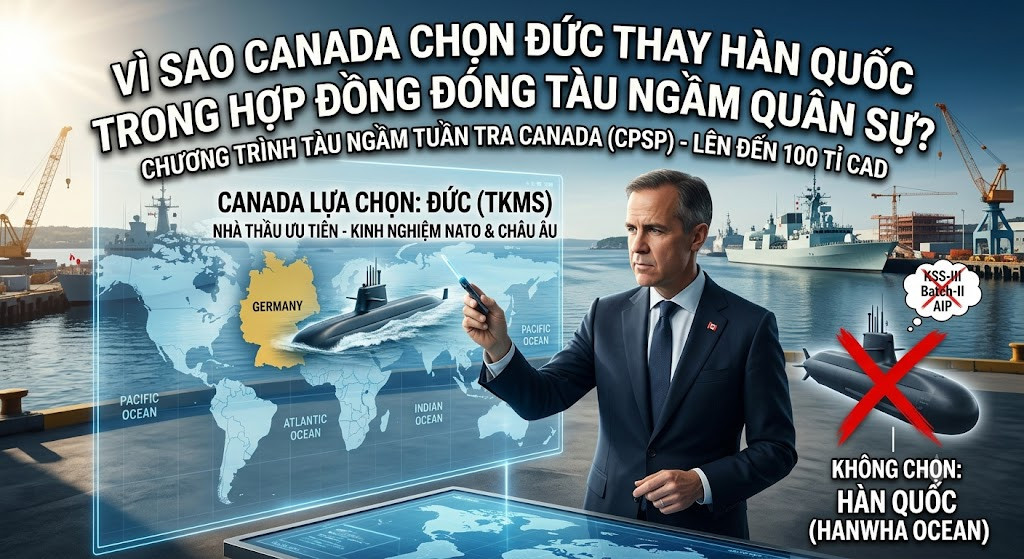
The scale of Canada's submarine fleet replacement project.
The Canadian Patrol Submarine Project is considered one of Ottawa's largest defense procurement programs. Its main objective is to replace all four aging Victoria-class submarines with a fleet of up to 12 new-generation vessels. These submarines are expected to have a displacement of approximately 3,000 tons and utilize modern diesel-electric propulsion.
The total project value is estimated at around 60 trillion won (equivalent to 39.2 billion USD). Including maintenance, repair, and overhaul (MRO) packages over its 30-year lifespan, the total cost could reach nearly 100 billion CAD. Canadian Prime Minister Mark Carney stated that the selection process was highly competitive, with both TKMS and Hanwha Ocean submitting strong technical and economic proposals.
The advantage that helped the German corporation surpass its South Korean rival.
According to analyses from Canadian media, TKMS won thanks to a combination of combat experience and strategic commitments. The German company formed a joint venture with Norway, creating a unified bloc within NATO. Its long experience supplying submarines to European countries within the military alliance is a major advantage in terms of compatibility and logistical support.
In addition, TKMS has also proposed a broader economic cooperation package, emphasizing technology transfer and local job creation. Although this is only the initial selection of a preferred contractor, both parties are expected to continue detailed negotiations for several months before signing the official contract.
Analysis of the technology of South Korea's KSS-III submarine.
This failure came as a shock to Hanwha Ocean, the unit that had proposed the domestically developed KSS-III Batch-II submarine version. Technically, it was an advanced diesel-electric submarine with impressive specifications:
- AIP system:Utilizing air-independent propulsion with fuel cells.
- Battery technology:Combined with lithium-ion batteries, this allows the vessel to operate underwater continuously for more than 3 weeks.
- Displacement:Approximately 3,000 tons, suitable for offshore patrol requirements.
South Korea had committed to delivering the first vessel by 2032 and promised to generate CAD 70 billion in economic value for Canada by 2044. However, these technological advantages and economic commitments were not enough to overcome the reliability of Germany's operational experience in the NATO environment.
Impact on Seoul's defense export strategy
Failing to secure the contract in Canada represents a significant setback for South Korea's ambitions to expand into the North American market. This marks the second time Hanwha Ocean has lost a contract to TKMS, following the Project-75I project in India. This outcome demonstrates that in strategic arms deals, pure technical capability sometimes takes a backseat to factors such as alliances and experience in system integration within large military blocs.
Nevertheless, the strong presence of South Korean defense companies in international tenders demonstrates that the East Asian nation's military shipbuilding capabilities have reached world-leading levels, ready to compete on equal footing with traditional powers in the future.


