
Warning about phrases that negatively impact children.
Becoming a parent requires responsibility, starting with the choice of words used when communicating with your children. Without caution, unintentionally, the words parents utter can alter a child's worldview and negatively impact them.
"You should listen to adults."
Hearing this, the child will think:"All adults are smart and capable. We have to do what adults say."This statement is very dangerous because children will believe that all adults, including strangers, are right, without realizing the bad things that could happen to them.
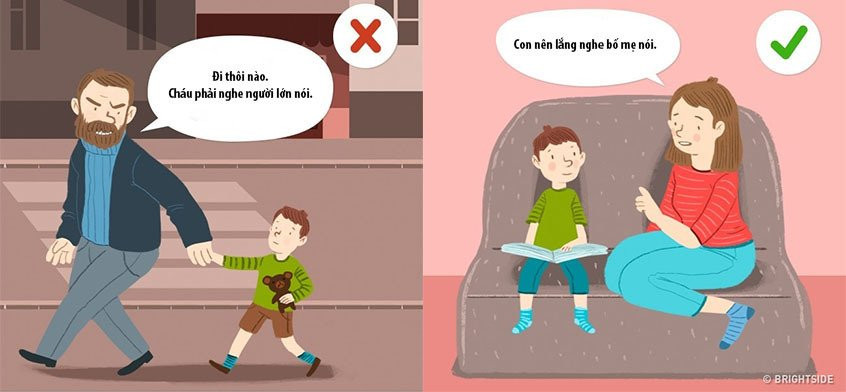
Phrases parents should use:"You need to listen to your parents." This will help children be more cautious when meeting strangers.
"Who taught you to behave like that?"
Hearing this, the child will think:"My parents didn't think I could come up with this idea."This way, the child will not understand that their mischievous behavior is wrong and that they may not be punished.
Phrases parents should use:"Why did you do that?"This will help you determine whether the child did it on their own or was encouraged by someone else. Give the child a chance to explain their actions.
"We'll talk when we get home."
Hearing that, the child will think:"My parents are about to beat me. They don't love me anymore. I don't want to go home."The threats from the child's parents make the child feel that the home is no longer safe but a place of punishment. Therefore, they no longer want to go home.
Phrases parents should use:"Let me tell you what you did that disappointed me."By listening to what their mother says, children learn to be mindful of other people's feelings whenever they act.
"Don't be so greedy."
Hearing that, the child will think:"I have to share everything. Nothing is mine alone."Over time, these thoughts will develop into self-sacrifice. The child will have no concept of protecting their own values and possessions.

Phrases parents should use:"Can you let your friend share your toys for a little while?"; "Would you like to exchange toys for a bit?". Give your child the opportunity to manage their own belongings. If they don't agree to share, parents shouldn't beg or yell.
"You're too young to understand this."
Upon hearing this, the child will think:"I really want to know this information. I have to ask someone else."If a child has questions but doesn't receive the information they need, they will seek information from other sources. These sources are very likely to be negative.
Phrases parents should use:"I can't answer that question right now. Please give me some time."Never refuse to answer any of your children's questions. If they ask, try to answer them. In this way, in the child's eyes, parents are always seen as knowledgeable people, earning their respect and trust.
"Stop crying."
Upon hearing this, the child will think:"It's terrible to show my emotions. I got scolded just for crying."The child may therefore grow up in silence and with little expression of emotion. These latent emotions will sooner or later manifest as aggression.
Phrases parents should use:"Tell me what's bothering you"; "Why are you crying?".If a child falls or gets bruises on their arms or legs, ask gently about it."Are you crying because you're in pain or because you're scared?"This will create a helpful conversation that will help the child identify their own feelings.
"Look at this adorable little girl."
Hearing that, the child will think:"I'm not as cute as her."Comparing a child to others will affect their self-esteem, making them think they can never achieve anything.
Phrases parents should use:"Mom loves you too. You're a lovely child."Point out your child's strengths and show confidence in those strengths. Parents need to remember that each child is unique and possesses their own talents.


