
Licensing for cargo wharves and sand and gravel stockpiling areas is still being done arbitrarily.
(Baonghean) - The situation of illegal sand and gravel mining is currently extremely complex. Along with that, the chaotic stockpiling and transportation of sand and gravel poses many challenges for authorities at all levels and relevant agencies.
Expedite the licensing process.
For a long time, illegal sand and gravel mining has been a persistent and troubling issue, causing public outrage. Authorities have repeatedly launched campaigns to crack down on, prevent, and prosecute illegal sand and gravel mining with the goal of rectifying mining activities and establishing a protective corridor for essential mineral resources. However, illegal sand and gravel mining continues in various forms and areas, particularly on the Lam River, particularly in the districts of Hung Nguyen, Nam Dan, and Thanh Chuong. Why is this situation so difficult to eradicate? Besides high demand and profitability, one of the reasons is the slow pace of current mining permit issuance, which significantly impacts the management of these mineral resources.
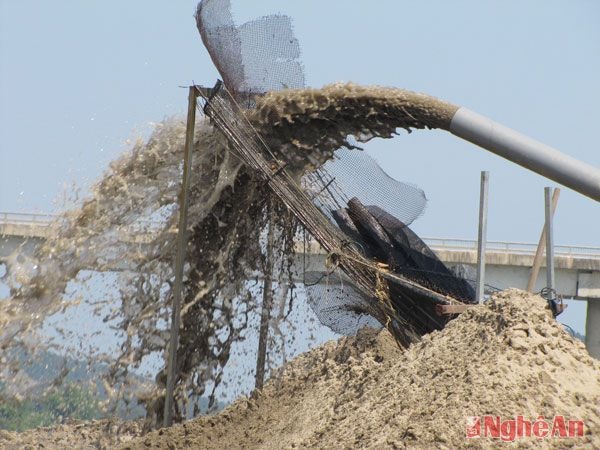 |
| Sand mining at the foot of Ro Bridge, Thanh Chuong. |
| According to the 2010 Mineral Resources Law, to obtain a mining license, businesses must first prepare an application for a mineral exploration license and conduct exploration work. During this time, businesses must develop an investment project, obtain reserve approval, conduct environmental impact assessments, and make commitments. From the time a business submits its application for a mineral license to the start of actual mining operations, the process takes at least 6 months and up to more than 1.5 years. This process also requires approval from various departments: Natural Resources and Environment, Transport, Construction, Industry and Trade, and Agriculture and Rural Development. |
At the online conference on preventing and combating violations of the law in sand and gravel mining activities on rivers and estuaries on October 27th, the Provincial People's Committee requested the Ministry of Natural Resources and Environment to study administrative procedure reforms for granting licenses for the exploitation of minerals such as sand, gravel, and fill soil. In practice, the current system of treating these minerals the same as other minerals, with the same application process and licensing procedures, wastes a lot of time and creates difficulties for businesses and localities.
The Hung Lam and Nghia Son Long cooperatives (Hung Nguyen district) have prepared documents and conducted exploration, but have not yet been granted permits for exploitation. Mr. Pham Van Tung, Chairman of the Hung Lam Cooperative, stated: "The application for a permit was submitted last year, but it has not yet been approved. The delay in the permit issuance process has significantly impacted the lives of cooperative members. Due to the need to earn a living, many members are forced to engage in illegal mining, creating difficulties for state agencies in managing the situation."
Given this situation, expediting the licensing process for mineral mining is crucial. Besides the 42 applications already granted, 19 more companies are currently conducting exploration and completing their applications to obtain mining licenses as per regulations.
According to Mr. Tran Van Toan, Head of the Mineral Resources Department (Department of Natural Resources and Environment), from 2013 to the present, the Department of Natural Resources and Environment has actively coordinated with relevant agencies to advise the Provincial People's Committee on the quick and efficient processing of applications for exploration of sand and gravel for construction, with the aim of shortening the processing time as much as possible, effectively implementing administrative procedure reforms in the field of minerals, meeting the demands of reality, and creating favorable conditions for businesses to quickly obtain mineral exploration and exploitation licenses. In addition, in the near future, auctions for mineral exploitation rights will be organized in some areas. The purpose is to innovate the management mechanism of mineral activities in accordance with the market economy mechanism as stipulated and to attract investment in the efficient exploitation of local mineral resources, increasing state budget revenue.
Eliminate illegal loading docks.
Along with accelerating the licensing process for sand and gravel mining, the Provincial People's Committee is tightening the management of sand and gravel storage and trading wharves in the area. Currently, most illegally mined sand is stockpiled at these wharves. Without proper management of these sand and gravel storage wharves, it will be very difficult to prevent illegal sand and gravel mining. According to preliminary data from the Department of Transport, there are currently 55 wharves in the province. Of these, 31 have licenses and 24 do not. However, this number does not accurately reflect the reality, as surveys in many localities show that the actual number of wharves is much higher, with the majority being unlicensed. In Thanh Chuong district, there are over 20 wharves, and in Do Luong district, there are more than 5. However, when these districts submitted their reports to the Department of Transport, they were incomplete.
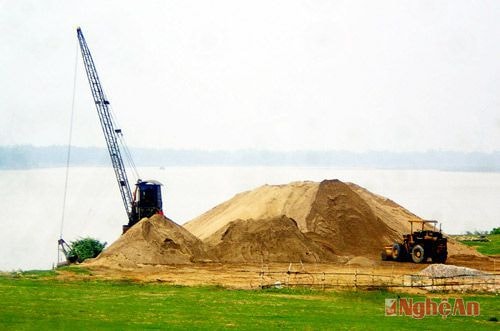 |
| The sand and gravel collection point in Hung Khanh commune (Hung Nguyen district) is operating illegally. |
Since 2005, the provincial People's Committee has delegated the authority to license cargo wharves to the district People's Committees. However, the licensing process remains arbitrary. Most of these facilities lack complete documentation regarding land lease procedures for business purposes; wharf water area maps and access channels, etc. Typically, owners of sand wharves sign a land lease contract with the commune People's Committee on 5% of public land, specifically riverside alluvial land and reserve land for wharves, and pay fees to the commune. Many wharves operate without licenses, located close to transportation infrastructure, yet continue to function year after year. According to Mr. Le Thanh Binh, Deputy Head of the Infrastructure Management Department (Department of Transport), the fact that cargo wharves have not completed the necessary paperwork for licensing has persisted for many years without resolution. This demonstrates a lack of responsibility on the part of the relevant authorities, especially at the district and commune levels.
In Hung Nguyen district, there are 17 cargo wharves for collecting sand and gravel. Of these, only 5 have been licensed, and only 1 is located along the riverbank. At the Yen Xuan railway bridge area (Hung Xuan, Hung Nguyen), there are currently 2 wharves situated right next to the bridge's foundation. According to regulations, no construction or excavation is permitted within a 150m radius of the Yen Xuan bridge that could affect its foundation. The mooring of boats under the bridge and the operation of excavators within the bridge's safety zone violate regulations protecting the bridge's safety corridor. According to the head of the Hung Nguyen District Department of Industry and Trade, regarding the sand wharves at the Yen Xuan bridge's foundation, due to their unlicensed operation, the district has requested the Hung Xuan Commune People's Committee to immediately terminate the land lease contracts for the wharves violating the Yen Xuan bridge's safety corridor and return the land within the bridge's traffic safety zone. For wharves in Hung Khanh and Hung Linh communes, the district has requested the owners to cease operations and apply for operating licenses from the competent authorities as per regulations.
Faced with this situation, since the beginning of this year, the Department of Transport has issued guidelines to the districts and requested reports on the management and licensing of sand and gravel collection points, but the reports have been incomplete. Mr. Tran Khac Xuan, Head of the Infrastructure Management Department (Department of Transport), said: According to the 2012 plan of the Provincial People's Committee, Nghe An only has 3 sand and gravel collection points in Vinh City, Nam Dan District, and Do Luong District. However, due to practical demands, the department is currently coordinating with other agencies to adjust the plan and guide the districts and sand and gravel collection point owners to prepare dossiers for re-licensing according to the correct procedures. Currently, only 1 facility meets the requirements and has been licensed. In the coming time, the department will request the districts to decisively handle illegal collection points that affect transportation infrastructure, dikes, and waterways...
| On October 22, 2015, the Provincial People's Committee issued Document No. 7572/UBND-TN regarding the rectification of sand and gravel mining, transportation, and stockpiling activities on the Lam River. Accordingly, the Provincial People's Committee will establish an inter-agency inspection team, headed by the Provincial Police, to inspect the sand and gravel mining, transportation, and stockpiling activities on the Lam River by relevant organizations and individuals. |
Nguyen Hung
| RELATED NEWS |
|---|


