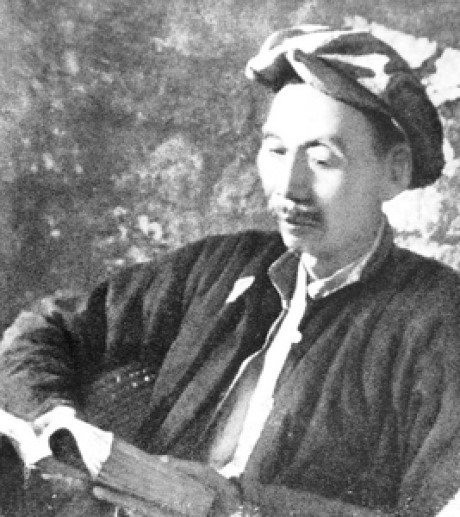
'Third son Khiem' - the older brother of President Ho Chi Minh
"Third son Khiem" - the affectionate nickname people used to call President Ho Chi Minh's older brother - who grew up with him as a friend and brother, loving each other deeply.
In 1901, when moving to Lang Sen village to live, and registering his children in the village register, with the hope that his sons, Khiem and Cung, would be successful in the future, their father gave them new names: "Nguyen Tat Dat" and "Nguyen Tat Thanh".
Nguyen Tat Dat, whose full name at birth was Nguyen Sinh Khiem, was born in the year Mau Ty (1888) in Hoang Tru village, Chung Cu commune, Lam Thinh district, Nam Duong county, Nghe An province (now Kim Lien commune, Nam Dan district, Nghe An province). From a young age, he inherited the patriotic and compassionate traditions of both his paternal and maternal families. He was particularly knowledgeable in folk literature, traditional medicine, geography, and possessed a profound understanding of classical Chinese studies.
.jpg)
Through his knowledge gained from books and his travels with his father, he deeply understood the hardships faced by the Vietnamese people under the rule of French colonialism and the puppet feudal regime. This ignited in him a profound love for his country and people. As he grew up, Nguyen Sinh Khiem actively participated in various struggles aimed at awakening the masses to rise up against the colonial and feudal oppressors.
In 1908, he joined the anti-tax movement in Central Vietnam along with his younger brother Nguyen Tat Thanh (for this, both brothers were reprimanded and expelled from Hue National School). Returning to his hometown, he and his sister, Nguyen Thi Thanh, joined the patriotic movement led by the scholar Phan Boi Chau. In 1910, at the request of the French Resident, he collected and compiled folk songs, proverbs, and ballads from Nghe Tinh. Taking advantage of this, he included many songs criticizing the feudal and colonial regimes.
In 1912, he submitted a petition to Albert Sarraut, the Governor-General of Indochina, demanding that the protectorate government expand democratic freedoms, reduce taxes, and promote education.
In 1913, elected by the people to the village council to oversee local affairs, he boldly implemented reforms aimed at eradicating superstition, alcoholism, and gambling, and promoting education according to the principles of modernization – recovering 36 acres of land and distributing it to the poor. He secretly participated in the Quyen and Phan anti-French resistance organizations; this was exposed on April 1, 1914, and he was arrested by the colonial and feudal authorities. On September 25, 1914, the Southern Court sentenced Nguyen Tat Dat to 3 years of hard labor for the crime of conspiracy to rebel. Three months later, he attempted an escape but failed, and his sentence was increased to 9 years. In 1915, he was exiled to Ba Ngoi, Nha Trang.
.jpg)
Five years later, on March 17, 1920, the French colonial authorities placed him under house arrest in Hue. He resided in Trach Pho village (now Phong Hoa commune, Phong Dien district, Thua Thien Hue province). There, he practiced traditional medicine and taught Chinese characters to the children of working-class people. Although life was extremely difficult, with his kind and generous heart, he was always willing to share his food and clothing with the poor. In 1922, he and his sister, Nguyen Thi Thanh, secretly participated in anti-French activities within the Hue Intellectuals' Organization. In 1929, he moved to Phu Le (now Quang Phu commune, Quang Dien district, Thua Thien Hue province) to continue practicing traditional medicine and helping the people.
With his upright and straightforward character, Nguyen Tat Dat repeatedly fought against traitors and collaborators. The enemy constantly monitored his patriotic activities, restricting his contact with others and preventing his relationships. They cleverly poisoned him with alcohol, aiming to neutralize his character.
On February 6, 1940, the enemy allowed him to return to his hometown. Back home, he continued his involvement in cultural activities, performing patriotic plays, teaching, and instructing martial arts to encourage patriotism among the local children. Because of these activities, on July 28, 1940, the puppet government sentenced him to two months in prison, fined him 20 Indochinese silver coins, and extended his imprisonment to one year. After his release, he continued to seek out like-minded friends and comrades. It was during this time, in 1942, that he found a beautiful spot on Dong Tranh Mountain, part of the Dai Hue mountain range (Nam Dan district), to lay the remains of his beloved mother, Hoang Thi Loan, to rest in eternal peace.

In 1946, upon learning that his younger brother was President Ho Chi Minh, he traveled to Hanoi to meet him. The meeting was incredibly moving. Fearing his brother wouldn't recognize him, he asked a security guard to give President Ho a small piece of paper with just three words: "Dat visits Thanh." President Ho was deeply moved when he received the paper. The two brothers only met for a little over an hour after more than 30 years of separation. That was the first and last time the two brothers met.
Afterward, he returned to Sen Village to live a simple, austere life, surrounded by the love of his relatives from both sides of the family and the people of Nam Lien commune.
At the end of 1950, he fell ill. Despite the dedicated care and medicine provided by the authorities and his relatives, his condition was too severe, and he passed away on August 23rd, 1950 (the year of Canh Dan), at the age of 62.
At that time, due to national duties, President Ho Chi Minh was busy directing the 1950 Autumn-Winter Border Campaign with the Central Party Committee and could not return to attend his brother's funeral. From the mountains and forests of Viet Bac, he sent a deeply moving telegram to his relatives and family:
"Hearing the news of my eldest brother's passing, I was deeply saddened. Because of the heavy burden of national affairs and the long distances, I was unable to care for him when he was ill, and unable to attend to his funeral arrangements after his death."
I confess my infidelity before his spirit and ask for the forgiveness of my relatives for a son who sacrificed family affection for the sake of national affairs.”
Signed: Ho Chi Minh
The life of Nguyen Tat Dat - Nguyen Sinh Khiem is always an example for us to follow and learn from, demonstrating fervent patriotism and tireless struggle for national salvation; an exemplary citizen always ready to help the poor and needy; a pure, upright, generous, and selfless character, living a simple, honest, and compassionate life.