
Tea plants in Nghe An and the challenges of TPP integration.
(Baonghean) - Nghe An has a fairly large raw material area, synchronized infrastructure, and has formed a value chain between production - processing and consumption... these are advantages when joining the TPP. However, the challenges are also significant, requiring strong transformation and new, synchronized solutions.
Leveraging advantages
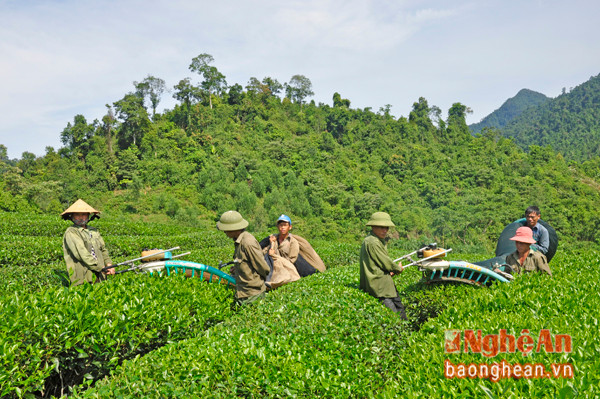 |
| Tea harvesting at Youth Volunteer Brigade 5 (Thanh Chuong). Photo: PV |
Currently, Nghe An has a fairly large tea growing area, approximately 8,000 hectares, with new varieties achieving relatively high yields and quality. According to the Department of Agriculture and Rural Development, the goal is to stabilize the tea growing area at 10,000 hectares by 2020. This confirms the province's potential and focus on processing and exporting tea to major markets.
Furthermore, the tea-growing region has relatively well-developed infrastructure, with tea plantations concentrated along major roads: the Ho Chi Minh Highway and National Highway 7 in Thanh Chuong, Anh Son, and Con Cuong districts. Internal transportation is convenient, and the raw material areas are connected to processing plants, forming agro-industrial clusters with favorable conditions for developing high-tech agriculture.
The current production organization model links agricultural production with processing and consumption, primarily for export. Forming a value chain between raw material production, processing, and trade is considered appropriate to meet the requirements of unified management from production to consumption in order to satisfy market demands.
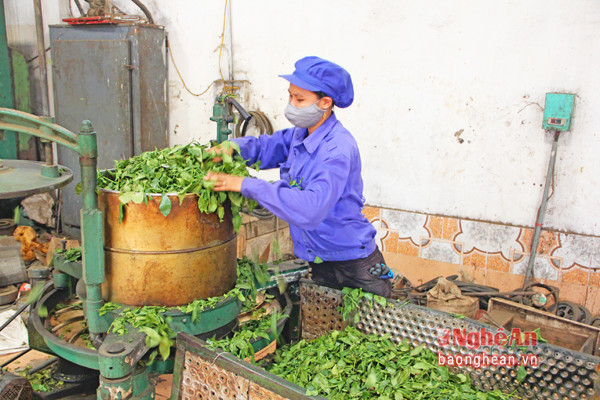 |
| Tea processing at Hung Son Tea Factory (Anh Son). Photo: Cong Sang |
The province currently has 86 tea processing lines with a total designed capacity of 602 tons of fresh tea leaves per day. In 2015, the province's total fresh tea leaf production was approximately 67,394 tons, with a processed output of 12,000 tons of various types of dried tea leaves. Of this, Nghe An Tea Investment and Development Company Limited purchased and processed 32,000 tons of raw materials, with a processed output of 6,400 tons. The remaining enterprises and processing facilities purchased and processed 35,394 tons of raw materials, with a processed output of 5,600 tons.
It has been learned that currently, only 10-12% of Vietnam's tea exports to TPP countries account for, so there are still huge opportunities, especially in the Japanese and US markets. Furthermore, joining the TPP enhances access to capital and advanced science and technology from developed countries.
And the challenges
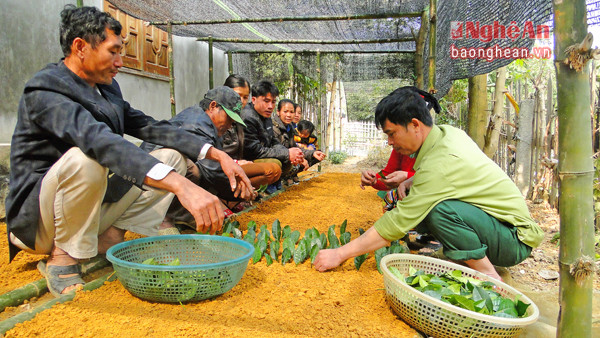 |
| Instructions for resettled residents (Ngoc Lam, Thanh Chuong) on cultivating tea seedlings. Photo: Hai Thuong |
Tea is one of Nghe An's key export agricultural products, but managing its quality is proving difficult. Farmers' spontaneous production, not following proper procedures, will negatively impact quality when we participate in the larger market. With 86 processing lines and a total designed capacity of 602 tons of fresh tea leaves per day, the challenge lies in insufficient raw materials, resulting in many factories operating below their designed capacity.
Currently, Nghe An Tea Investment and Development Company Limited is operating at 58% of its designed capacity, while other tea processing facilities are only at 40-45%. The fact that private processing facilities are producing tea indiscriminately has led to the total current tea processing capacity exceeding twice the raw material output, causing an imbalance between the processing industry and raw material production.
Mr. Nguyen Van Lap, Deputy Director of the Department of Agriculture and Rural Development, stated: "The management of raw material area planning linked to processing plants is fragmented. There are too many factories and processing facilities in a single raw material area. Their capacity is 2-2.5 times the current raw material output, and private processing facilities compete to purchase raw materials, making quality control and food safety management very difficult."
Furthermore, a lack of capital and advanced technology, along with competitive product pricing, are the biggest challenges when entering major markets. Limitations in labor skills and human resources, including a shortage of highly skilled workers and competent managers, also pose significant challenges when participating in the TPP market.
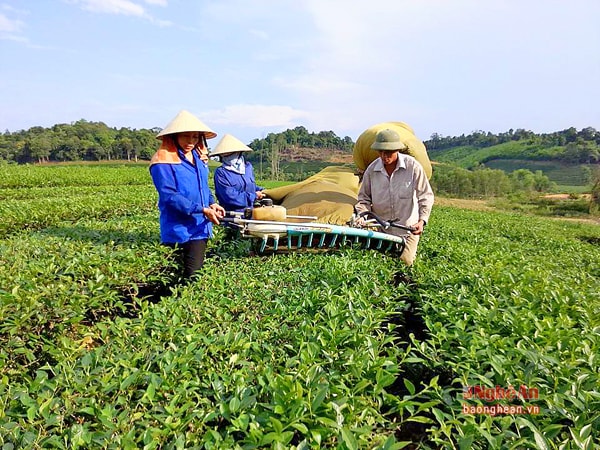 |
| Tea plants generate an income of 16 billion VND per year for the people of Hung Son. |
Overall, the impact of the TPP on the tea industry is considered to be more of an opportunity than a challenge; however, if the challenges are not quickly addressed and the opportunities are not seized, it will be difficult to improve the situation.
We need to invest in depth and explore new markets.
According to Mr. Nguyen Van Lap, Deputy Director of the Department of Agriculture and Rural Development, in order for Nghe An tea to compete effectively in the TPP integration, it is necessary to focus on in-depth investment, improving productivity and quality of tea plantations. Production must innovate technology, lower production costs, and increase added value per unit. Emphasis should be placed on strengthening the capacity of production households through linkages, and establishing close ties between factories and raw material suppliers to ensure a stable supply of raw materials for production.
Good food safety management is essential for accessing high-quality, safe markets. Along with this, developing new, high-yielding, and high-quality crop varieties contributes to sustainable development.
Another crucial solution is to seek and develop new markets within the TPP, especially in Europe, Japan, and the United States. Once established, maintaining credibility in the market and building trust with customers are essential for long-term cooperation.
Another solution is to innovate the governance model and restructure businesses. The tea industry needs to take the lead in implementing business transformation and restructuring to attract and create new resources to accelerate development. From there, it is necessary to innovate corporate governance towards a leaner, more efficient, and sustainable development approach, while ensuring the livelihoods, jobs, and benefits of workers during participation in the TPP market.
Thu Huyen


