
The demon-slaying sword and the fierce battles of the shaman.
(Baonghean.vn) -Shamans are seen as people who can enter the spiritual world to fight demons and rescue the souls of those who are lost or abducted. To fight demons, shamans need a sword.
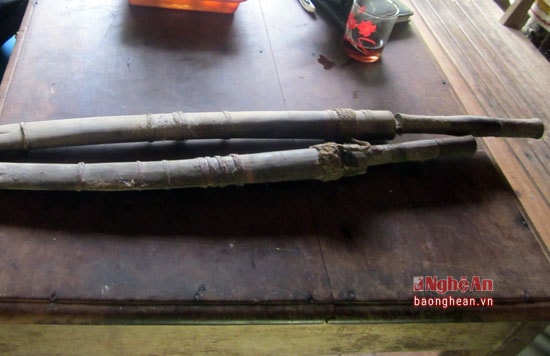 |
| These are two swords that were used by shamans in the mountainous region of Nghe An province hundreds of years ago. |
Shamans were once a very powerful force in the old mountain communities. They didn't demonstrate their authority through brute force, but primarily through virtue and the spiritual peace they brought to the community.
According to Mr. Luong Viet Thoai, a researcher of indigenous culture in Quy Hop district (Nghe An province), shamans are different from fortune tellers. They only exorcise evil spirits, offer sacrifices to souls, and ward off misfortune as a form of spiritual therapy to help people overcome illness and bad luck, but they do not practice fortune telling or propagate superstition. However, shamans are often asked to perform rituals when they receive a "prediction" from a fortune teller.
A person who has an ominous dream, suffers from a prolonged illness, or is hospitalized often brings a coat, sometimes even betel leaves, to a fortune teller for help. If the fortune teller "sees" a misfortune, or even a lost soul, or one imprisoned by a dragon or some other divine force, the family must enlist the help of a shaman to rescue it. Thus, to some extent, fortune tellers and shamans are connected.
In the mountainous region of Nghe An, there are "two branches" called "mo mot" and "mo mon". According to Mr. Luong Viet Thoai, one can imagine mo "mon" as a military official and mo "mot" as a civil official in the ancient imperial court. Therefore, the tools used in the rituals are also different.
A sword is an indispensable tool for a "mo mon" shaman. The vast majority of "mo mon" shamans are male. During rituals, the shaman wears a long red robe and a black or red hood. Mo mon shamans often appear in the role of a hero who exorcises evil spirits possessing a family, an individual, or a piece of land. In their prayers, the shaman often holds a sword and sometimes engages in "battle" with demons. Spectators may witness the shaman suddenly drawing his sword and slashing in the air after the prayer ends. Sometimes there are even intense chase scenes between the shaman and the demons.
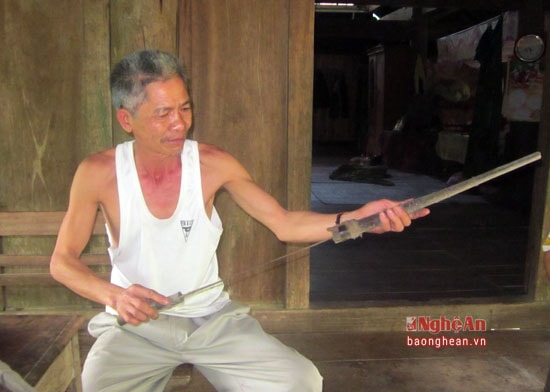 |
| The sword is an indispensable tool for the shaman, and therefore it is carefully preserved. After the shaman has passed away, many families keep it as a treasure. The photo shows the sword of a shaman that has been passed down through four generations in Con Cuong, Nghe An. |
During the shamanic ritual, the shaman is believed to be in a trance. According to those who practice this profession, this is when the shaman truly lives in the spiritual world. For the shaman, it's a real battle, sometimes a life-or-death struggle with supernatural forces. To drive away evil spirits, initially, both sides must test their courage through verbal exchanges and the weapons they carry. Only when faced with a powerful opponent do they draw their swords. If they encounter a powerful spirit, a decisive battle is inevitable. Sometimes, the shaman is the one who loses.
Mr. Luong Phuc (96 years old), residing in To village, Yen Khe commune, Con Cuong district (Nghe An province), recounts that when he was young, he witnessed the defeat of a shaman, a highly trusted and arrogant figure in the area. He was unafraid of any evil spirit. On that occasion, someone in the village fell seriously ill. The fortune teller predicted that the person's soul had been captured by a dragon in the underwater realm and taken to the underworld to serve it. While other shamans hesitated to help, this particular shaman volunteered.
During the ritual, the shaman was seen brandishing his sword for a long time before sheathing his weapon. He hunched over and slumped down onto a rattan chair. A moment later, he fell to the ground. Knowing their friend had lost the battle, the other shamans in the group went to call their master for help. After nearly half a day of prayers, the shaman finally regained consciousness. After this defeat, the shaman also abandoned performing rituals altogether.
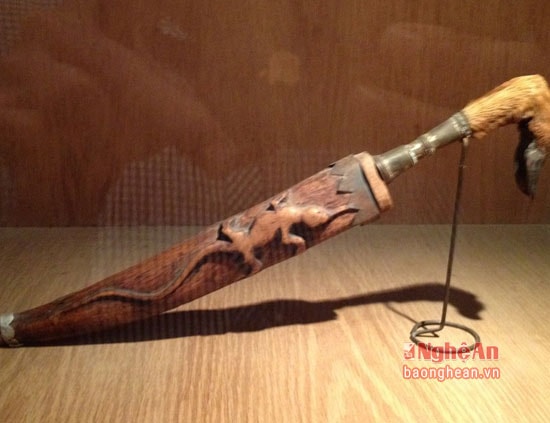 |
| A shaman's sword |
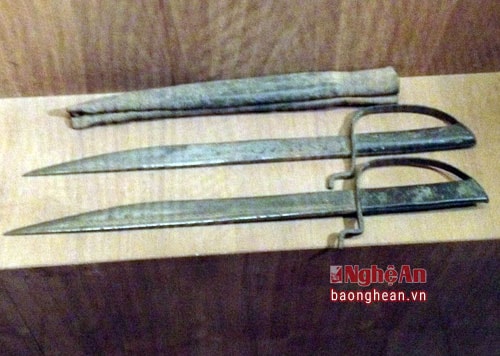 |
| Not only the Thai people, but also some other minority communities use swords as shamans. The photo shows a sword of a La Ha shaman on display at the Vietnam Museum of Ethnology (Cau Giay - Hanoi). |
The job of a shaman is by no means easy. Even learning it is difficult. Skilled shamans often have many adopted children and apprentices. These are people the shaman cherishes or deeply owes gratitude to, those he heals, gives medicine to help them conceive, and those he helps ward off evil spirits. Out of admiration and a desire to follow the shamanic profession, they follow him primarily to learn. However, each shaman only selects one or two people from his many adopted children and apprentices to pass on his ritual secrets. Only those with "destiny" are chosen.
However, the person who receives the secret rituals only dares to perform them when their teacher is old and frail. After performing a few "ky xá" ceremonies to be promoted to a higher rank, the shaman can also perform important rituals such as guiding the souls of the dead to heaven and exorcising evil spirits.
Once they are ready to perform rituals, shamans are usually equipped with a sword. The sword may be passed down from their master or they may forge or acquire it themselves. From then on, it becomes a sacred object carefully preserved by those in the shamanic tradition. Even after the shaman's death, their descendants still keep the shaman's robe and sword as family heirlooms.
HỮU VI


