
Challenger 3 criticized for being outdated: a detailed tactical analysis.
Lieutenant Colonel Stuart Crawford warned that the Challenger 3 risked becoming obsolete upon its launch: weighing nearly 80 tons but using a 1,200-horsepower engine, lacking APS (Airborne Assemblies), and having a crew in the turret.
According to Lieutenant Colonel Stuart Crawford, a former British Army officer and defense expert, the Challenger 3 tank program risks becoming "obsolete from the start." Although 148 tanks are planned to replace the Challenger 2, he believes the project is following an outdated design philosophy: heavy, expensive, and vulnerable to modern combat environments.
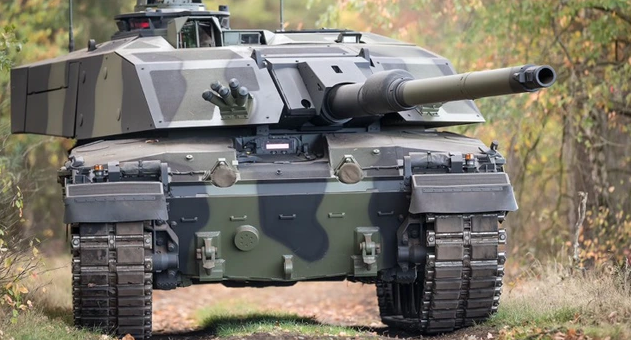
Overview of the assessment
Crawford stated that continuing to rely on the Challenger 2's airframe and structure makes the Challenger 3 "the final version of an outdated design philosophy." He pointed out the general trend in the Leopard 2, M1A2 Abrams, and Challenger 3: too big, too heavy, too expensive, and difficult to continue developing in a traditional direction in the context of a rapidly changing battlefield.
The Challenger 3 is expected to weigh nearly 80 tons but still uses the same 1,200-horsepower engine as the previous generation, raising questions about its maneuverability. Crawford cited feedback from Ukrainian soldiers operating the Challenger 2 that the engine was "too weak for the vehicle's weight." Furthermore, the British forces only equipped 60 active protection systems (APS) across the entire fleet, raising concerns about its survivability against modern threats.
Technical analysis
- Weight and dynamics: A weight of nearly 80 tons while the power remains at 1,200 horsepower results in an unfavorable power-to-weight ratio, affecting acceleration and maneuverability in challenging terrain.
- Proactive protection: Only 60 APS systems for the entire force is a limited number compared to the need to counter anti-tank missiles and armed UAVs. This could create a "bottleneck" in survivability if deployed simultaneously.
- Crew and turret architecture: The three-person turret configuration (gunner, loader, commander) is considered outdated in the era of automatic loading and remotely controlled turrets. Crawford argues that the future belongs to a "crew seated in a separate armored compartment within the hull" configuration, similar to the approach of the T-14 Armata.
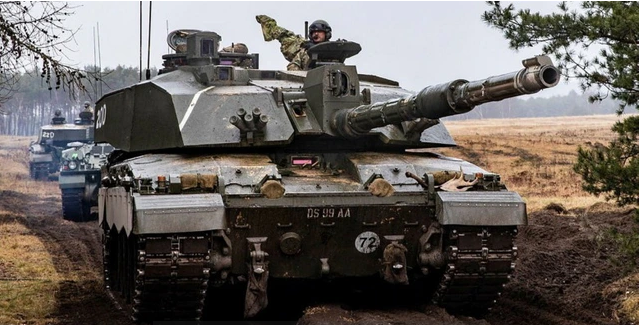
East-West Differences and the Lessons of Ukraine
Crawford pointed out that the T-72, T-80, and T-90 tanks, weighing around 45–50 tons, achieved a balance between firepower, mobility, and armor protection. He proposed a shift towards smaller, lighter, cheaper tanks with remotely controlled turrets, internal crews, integrated APS, and anti-UAV solutions.
The reality of the Ukrainian battlefield serves as evidence: Leopard 2 and M1A1 Abrams tanks suffered heavy losses. According to Western defense sources, in the first half of 2025 alone, Ukraine lost 27 out of 31 Abrams tanks supplied (approximately 87%). Most Leopard 2 tanks were destroyed or abandoned after only a few months of combat in late 2023. A Challenger 2 tank was also destroyed by a Russian anti-tank missile in Zaporizhia, marking the first loss of this type in combat.
New design trends
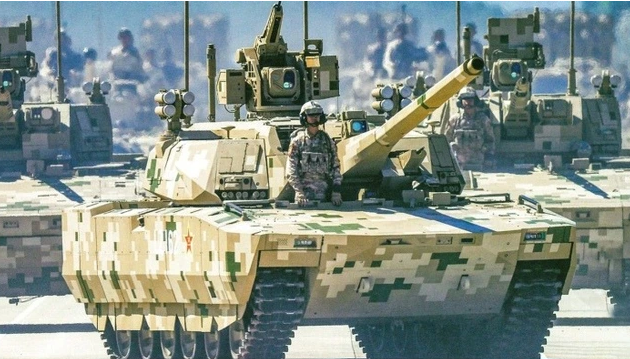
Crawford views the separate crew design and automated turret as the future standard. He cites the T-14 Armata as an example, arguing that even China has already taken a step ahead with the Type 100, set to launch in early September 2025: lighter, more agile, with an automated turret, digital controls, prioritizing crew protection, and a rapid response to UAVs. This is considered a "direct lesson" from Ukraine, where Western heavy tanks are often easily detected and destroyed.
| System | Weight (according to source) | Characteristics mentioned in the report |
|---|---|---|
| Challenger 3 | Nearly 80 tons | 1,200 horsepower engine; 3-person crew in the turret; high APS requirements. |
| T-72/T-80/T-90 | Approximately 45–50 tons | Balance of firepower – mobility – armor protection |
| T-14 Armata | Not specified | Crew inside the fuselage; remotely controlled turret. |
| Type 100 | Not specified | More compact and flexible; automated turret; digital control; crew protection prioritized; rapid UAV response. |
Survival tactics and requirements
Following the losses in Ukraine, the survival requirements for modern tanks have shifted sharply toward reduced signatures, increased mobility, enhanced active protection systems (APS), and anti-UAV integration. According to Crawford, a separate crew configuration within the hull and automated fire control reduce the risk of casualties from multi-directional threats.
England's path forward after Challenger 3
Crawford posed the question: “After the Challenger 3, which direction will Britain go?” With only 148 tanks, maintaining a separate line of tanks was considered inefficient. He proposed joining the European tank project MARTE, where Germany, France, and Italy were collaborating on the development of a new generation. British defense companies could contribute to protection technology, optics, engines, and suspension – maintaining industrial capacity while avoiding the “trajectory” of the Challenger 3.
Another option outside of Europe is to cooperate with South Korea. The K2 Black Panther is considered a powerful NATO-compliant tank, while its successor program, the K3, aims for a lightweight, modular, and automated design – consistent with Crawford's stated direction.
Conclude
The Challenger 3 was once expected to restore Britain's tank-building prominence, but warnings from experts suggest it may only be a stepping stone to the past. As modern warfare prioritizes speed, automation, and artificial intelligence, these nearly 80-ton platforms – despite their advanced armor – face the big question: is the era of heavy tanks coming to an end?


