
Portrait of the patriot Ho Tung Mau
(Baonghean.vn) - Comrade Ho Tung Mau was praised by President Ho Chi Minh as a "diligent leader," a "veteran cadre," a "loyal comrade," a "close brother," and someone "utterly devoted to the country and utterly loyal to the people."
Ho Tung Mau, whose real name was Ho Ba Cu, was born on June 15, 1896, in Quynh Doi village, Quynh Luu district, Nghe An province. Born and raised in a family with a tradition of patriotism and scholarship, Ho Tung Mau harbored great aspirations and ambitions from an early age. After a period of teaching in Thanh Chuong district, Ho Tung Mau decided to leave teaching to dedicate himself to revolutionary activities.
|
In the spring of 1920, Ho Ba Cu changed his name to Ho Tung Mau and, along with Le Hong Son, Nguyen Thi Tich, and Dang Quynh Anh, under the guidance of Dang Xuan Thanh, secretly went to Siam (Thailand). After three months at Trai Cay in Ban Dong (Phi Chit province), Mr. Dang Thuc Hua sent him to China to carry out revolutionary activities. In March 1924, Ho Tung Mau was assigned by Phan Boi Chau to bring documents back to Vietnam for propaganda and to encourage young people to go abroad.
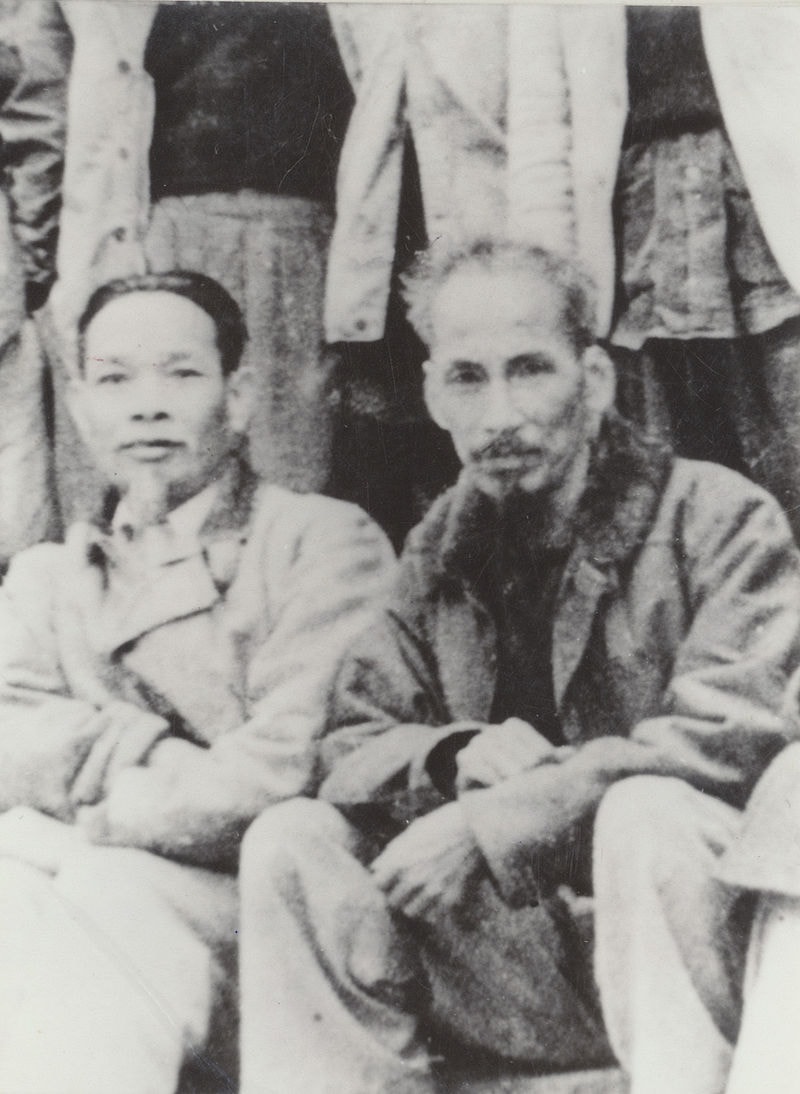 |
| Ho Tung Mau was affectionately called "Little Uncle Ho" by the people. |
In 1923, Ho Tung Mau, along with Le Hong Son, founded the "Tam Tam Society." In November 1924, Nguyen Ai Quoc returned from the Soviet Union to Guangzhou (China), where he met with patriotic Vietnamese youths from the "Tam Tam Society." Based on this, in 1925, Nguyen Ai Quoc recruited several of these young people into the "Communist League." In June 1925, he established the "Vietnam Revolutionary Youth Comrades Association" and opened a political training class for young people from Vietnam. The "Special Political Training Center" was located at house number 13, Van Minh Street (Guangzhou). Ho Tung Mau and Le Hong Son were Nguyen Ai Quoc's assistant lecturers.
In March 1926, due to the demands of the revolution, Nguyen Ai Quoc introduced Ho Tung Mau to join the Chinese Communist Party. From 1927 to 1929, Comrade Ho Tung Mau was arrested three times and endured all kinds of torture in imperialist prisons.
In early 1930, Comrade Ho Tung Mau and Le Hong Son actively prepared for the unification conference of communist organizations convened by leader Nguyen Ai Quoc in Kowloon, Hong Kong (China) on February 3, 1930.
In June 1930, Comrade Ho Tung Mau was arrested by British police in China and handed over to the French colonial authorities in Indochina. On February 6, 1931, the Southern Court of Nghe An Province sentenced Ho Tung Mau to life imprisonment with hard labor and exile to Kon Tum. Despite being imprisoned in various imperialist prisons such as Vinh, Kon Tum, Ban Me Thuot, and Tra Khe (Phu Yen), he always maintained his communist integrity, transforming prisons into revolutionary schools. He became a playwright, writer, and poet in prison through his patriotic and revolutionary works.
After the Japanese coup against the French, Ho Tung Mau and his fellow political prisoners broke out of Tra Khe prison and returned to their hometown to continue revolutionary activities.
Following the success of the August Revolution, Comrade Ho Tung Mau was entrusted by President Ho Chi Minh with the task of organizing a communication system between the revolutionary People's Committees of localities from North to South. In 1946, he was appointed Director and Political Commissar of the Central Military and Political School. When the nationwide resistance war broke out, he was assigned by the Party and Government to be Chairman of the Central Resistance and Administrative Committee and a member of the Inter-regional Committee of Inter-region IV. In 1947, he held the position of Inspector General of the Government.
In 1951, at the Second National Congress of the Party, Comrade Ho Tung Mau was elected to the Central Committee of the Party. He was the first President of the Vietnam-China Friendship Association.
On July 21, 1951, Comrade Ho Tung Mau was killed in action in Thanh Hoa while en route to Zone IV for work. President Ho Chi Minh wrote a eulogy and posthumously awarded Comrade Ho Tung Mau the Ho Chi Minh Order.
NK
| RELATED NEWS |
|---|


