
Questioning and answering questions: Get straight to the point, clearly acknowledge responsibility.
(Baonghean) - The questioning session at the 4th meeting of the 17th Provincial People's Council was lively, with many frank and responsible opinions from delegates questioning "hot" issues in agriculture, rural areas, vocational training, and job creation. This is also one of the issues that attracts the attention of voters and people in the province.
"Hot" demand for agricultural products
The first person to take the podium to answer questions was the Director of the Department of Agriculture and Rural Development, Hoang Nghia Hieu, and the most pressing issue was the management of production and livestock planning and the market for agricultural products. According to Mr. Hoang Nghia Hieu's explanation, from 2011 to 2016, there were approximately over 5,000 production and livestock farming models throughout the province.
However, the replication of these models in practice has not met the requirements; some successful models have not been replicated, or have not been widely replicated, and their sustainability is not high. State management of seeds and pesticides has not been strictly controlled. In particular, the development of production and livestock farming has not been linked to planning and ensuring the market for agricultural products, leading to low competitiveness of products and difficulties in finding markets (such as pork, watermelon, bananas, pineapples...), causing difficulties for producers. The Ministry of Agriculture and Rural Development also analyzed the existing shortcomings and proposed solutions to overcome them, including strengthening management, promoting connections between production, livestock farming and product consumption, and enhancing the role of enterprises and cooperatives.
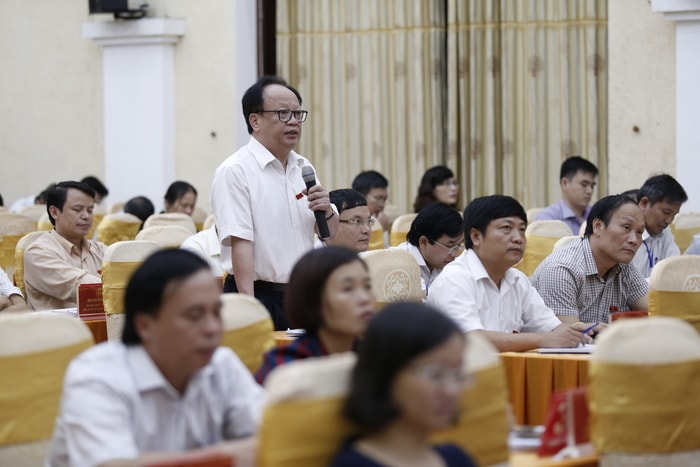 |
| Representative Nguyen Van Do delivers a question during the questioning session in the assembly hall. Photo: Duc Anh |
During the questioning of the provincial agricultural sector's leader, delegate Lu Dinh Thi (Que Phong) expressed concern about the low price of passion fruit in the area and questioned the coordination between sectors in developing this crop to alleviate poverty. Delegates Dang Quang Hong (Nghia Dan), Phan Thi Thanh Thuy (Thai Hoa town), and Vo Thi Minh Sinh (Quy Hop) also raised questions about the responsibility of managing planning to limit overlapping between different crops, solutions for agricultural product output, and the responsibility of officials and civil servants in the agricultural sector in various fields.
In response to questions, the Director of the Department of Agriculture and Rural Development acknowledged shortcomings in the development of agriculture linked to processing and consumption. To overcome these, the agricultural sector will continue to advise the province and coordinate with localities and businesses to find solutions to improve product quality and strengthen the linkage between agricultural product consumption and consumption. Regarding passion fruit, the Department of Agriculture and Rural Development affirmed that it has held meetings with the Nafoods factory, which guarantees the purchase of the output, to increase input prices and strengthen coordination in purchasing from farmers.
Also related to the output of agricultural products, delegate Nguyen Van Do - Director of the Department of Planning and Investment - suggested that the agricultural sector should base its actions on Decision No. 80/2002 of the Prime Minister on policies to encourage the guaranteed consumption of agricultural products through economic contracts, especially for monopolized crops; production must have contractual agreements between businesses and farmers, rather than "begging" businesses when problems arise. In reality, the failure of pineapple and lemon cultivation shows that many crops have "owners" but "lack the necessary resources."
Responding to a question from delegate Dang Quang Hong (Nghia Dan) regarding crop planning for the Phu Quy area, Mr. Hoang Nghia Hieu stated that in the future, coffee cultivation will be limited due to its lack of competitiveness, rubber cultivation will not be expanded due to unsuitable weather conditions, and cassava cultivation will remain at its current acreage. The industry will focus on maintaining the sugarcane raw material area to ensure a stable supply for the factory's operations. Regarding oranges, although currently profitable, they are susceptible to the recurring problem of "bumper harvest, falling prices." Therefore, emphasis will be placed on building brands, geographical indications, and improving product quality to ensure stable output...
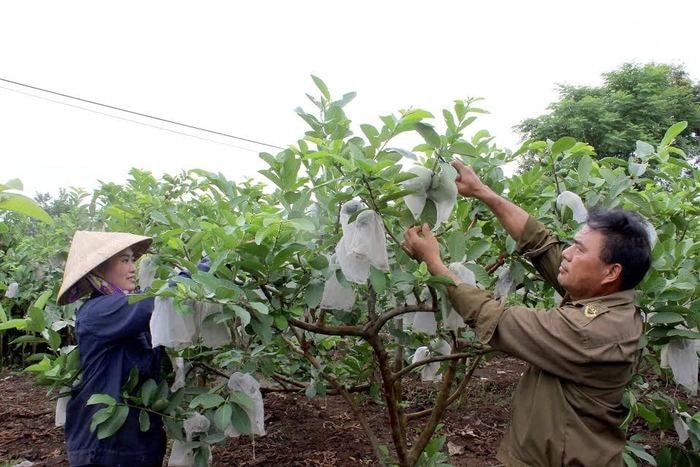 |
| The area dedicated to commercial guava cultivation is rapidly expanding in Nghia Dan district. Photo: Xuan Hoang |
Dissatisfied with Mr. Hoang Nghia Hieu's response, many delegates continued to question the Director of the Department of Agriculture and Rural Development about the development of household economies, the coordination between the agricultural sector, businesses, and local authorities in resolving the issue of agricultural product outlets… In explaining this, Mr. Hoang Nghia Hieu acknowledged: The issue of consuming agricultural products, whether specialties or common products, is facing difficulties nationwide.
Mr. Hieu also stated that planning management is challenging and suggested that districts and communes cooperate with the Department of Agriculture to address this issue. This is because many products are at risk of supply-demand imbalances and rapid development, such as the rapidly increasing area of orange cultivation and livestock farming exceeding its planned scale. The Director of the Department of Agriculture and Rural Development also promised to closely coordinate with relevant departments and localities to strengthen linkages between businesses, farmers, and cooperatives to enhance the value of agricultural production, livestock farming, processing, and consumption.
Commenting on the explanation and responses to questions from the Department of Agriculture and Rural Development, Vice Chairman of the Provincial People's Council Hoang Viet Duong stated that the report lacked specific data and was too general. He also requested the Department of Agriculture to continue researching the legitimate recommendations of voters and delegates to advise the Provincial People's Committee on effectively managing agricultural development towards a commodity-based approach, linked with processing, and increasing people's income. The Provincial People's Council also requested the Provincial People's Committee to review livestock production to ensure it is suitable for available land; strengthen planning management; accelerate the equitization of agricultural and forestry farms; implement policies to support farmers; review central and provincial policies and mechanisms for appropriate adjustments; and call on businesses to invest in the agricultural sector to create momentum for development towards a closed-loop, high-value sector.
Labor market forecast deviations
Immediately following the question-and-answer session with the leaders of the Agriculture sector, Mr. Nguyen Bang Toan - Director of the Department of Labor, War Invalids and Social Affairs - took the podium to answer questions related to vocational training and job placement. The most pressing issues were the existence of "brokers" in labor export and the responsibility of the Department of Labor, War Invalids and Social Affairs for the failure to meet expectations in vocational training and job placement.
Opening the questioning session, delegate Hoang Nghia Hung (Nam Dan) stated that while the province's labor export activities have achieved certain results in recent times, management has been lax, leading to discrepancies in the cost of going abroad for work within the same industry and country, negatively impacting the morale of workers. Furthermore, there have been instances of businesses neglecting their employees.
Responding to this issue, Mr. Nguyen Bang Toan, Director of the Department of Labor, Invalids and Social Affairs, said: Currently, there are about 50 labor export consulting units in the province, sending approximately 12,000 people to work abroad each year. In the past, the department has done a fairly good job of management; however, there are still some businesses that have acted improperly, causing a loss of public trust, as seen recently in Thanh Chuong and Que Phong districts. The labor sector has directly worked with these businesses and requested them to refund the money to the people; if they cannot refund the money, the case will be transferred to the legal authorities for handling.
The Director of the Department of Labor, War Invalids and Social Affairs also noted that the management of labor recruitment consulting units for overseas employment is currently quite strict. However, there are still some units that are "impersonating" and recruiting workers without the permission of the authorities. Therefore, localities need to be more vigilant and should not arbitrarily grant permission for recruitment in their areas to avoid fraud. Regarding the question of whether or not there is a situation of "brokers" inflating intermediary costs in the process of processing overseas employment procedures, Mr. Nguyen Bang Toan replied that he had "only heard about it" and would have it investigated.
During the questioning session, many opinions were raised regarding the results of training and job placement, highlighting the low achievement rates in vocational training for highly skilled workers, workers whose land has been expropriated, and those from impoverished households and ethnic minorities.
Delegate Dinh Thi An Phong (Nghi Loc) expressed concern that while the number of trained workers is quite high, the majority are short-term training programs. This leads to a situation where students are not yet skilled after graduation, and training is not linked to job placement, resulting in waste. Delegate Tran Thi Thanh Thuy focused on labor market forecasting and hoped the sector would implement practical solutions to improve this work. Delegate Nguyen Thi Lan (Do Luong) frankly stated that one of the limitations of vocational training is that "the allocation and implementation of targets have not been ensured according to plan."
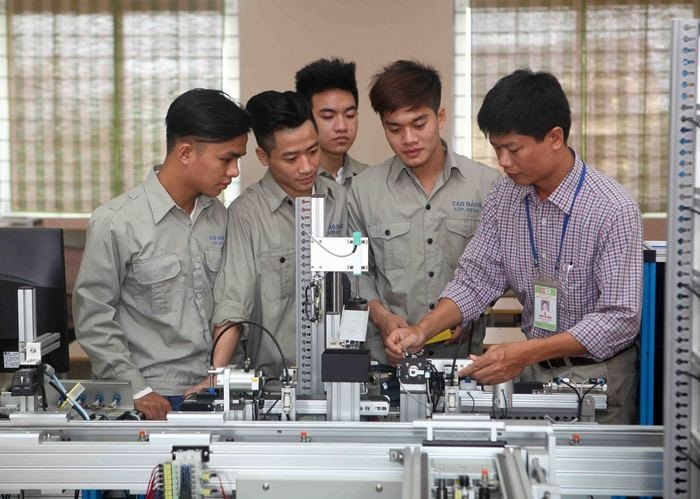 |
| Vocational training at the Vietnam-Korea College of Technology. Photo: My Ha |
In response to this issue, the Director of the Department of Labor, War Invalids and Social Affairs provided several figures. Specifically, in the two years 2015-2016, the entire province organized vocational training for 155,196 out of 155,000 people, exceeding the target set by the Provincial People's Committee. In addition, 75,360 workers found employment. However, he also acknowledged that vocational training still has many limitations, with the number of workers trained at the college and intermediate vocational levels remaining low compared to the total number of workers trained annually. The quality of training and the structure of some professions at some training institutions do not yet meet the requirements.
Mr. Toan also stated that the province forecasts the labor market annually, but the accuracy is not yet precise. Regarding this issue, the Director of the Department of Labor, War Invalids and Social Affairs acknowledged that in the past, the Department had not yet categorized trained workers, and therefore lacked specific figures for specialized workers, ethnic minority workers, and those from impoverished households. He promised to provide a written response after a complete compilation is available.
Concluding the questioning session, Mr. Nguyen Xuan Son - Standing Deputy Secretary of the Provincial Party Committee and Chairman of the Provincial People's Council - highly appreciated the explanation from the Director of the Department of Labor, War Invalids and Social Affairs. He also requested the department to continue researching the legitimate recommendations of voters and delegates to further advise the Provincial People's Committee on developing the employment information system, better connecting vocational training and job placement; and to expedite the merger of the Vocational Training Center with the Continuing Education Center.
In addition, actively promote the socialization of vocational training and job placement, foster linkages and coordination with businesses, especially foreign businesses, in training, and provide foreign language training to facilitate workforce integration; review the quality of teachers and the list of occupations, and supplement and strengthen training facilities and equipment; strictly implement inspection, examination, and accreditation work, promptly detect and correct errors, and severely punish violations.
Overall, the explanations and responses to questions from leaders of the Ministry of Agriculture and the Ministry of Labour, Invalids and Social Affairs were assessed as having directly addressed key issues, clearly acknowledged responsibilities, and developed a roadmap and solutions for future improvements.
Reporters


