
Chevrolet Corvette E-Ray: A logical stepping stone before the Corvette EV
The GM chairman acknowledged that the Corvette EV is “not easy right now” due to the battery weight impacting performance and balance. The cautious approach is to prioritize the high-performance E-Ray hybrid variant before deciding on a full electrification.
In an episode of InsideEVs' Plugged-In podcast, General Motors (GM) Chairman Mark Reuss stated that developing an all-electric Chevrolet Corvette “is not easy right now,” although “it is achievable.” He identified battery weight as the biggest challenge because it directly impacts performance, driving feel, and balance – core values that have made the Corvette famous. The question GM is asking is not just whether it can be done, but whether it should be done at this time.
In this context, the sensible strategy is to proceed step by step: instead of rushing to commercialize the Corvette EV, GM prioritizes a high-performance hybrid variant like the Corvette E-Ray, before considering full electrification when battery technology and energy management systems are more mature.
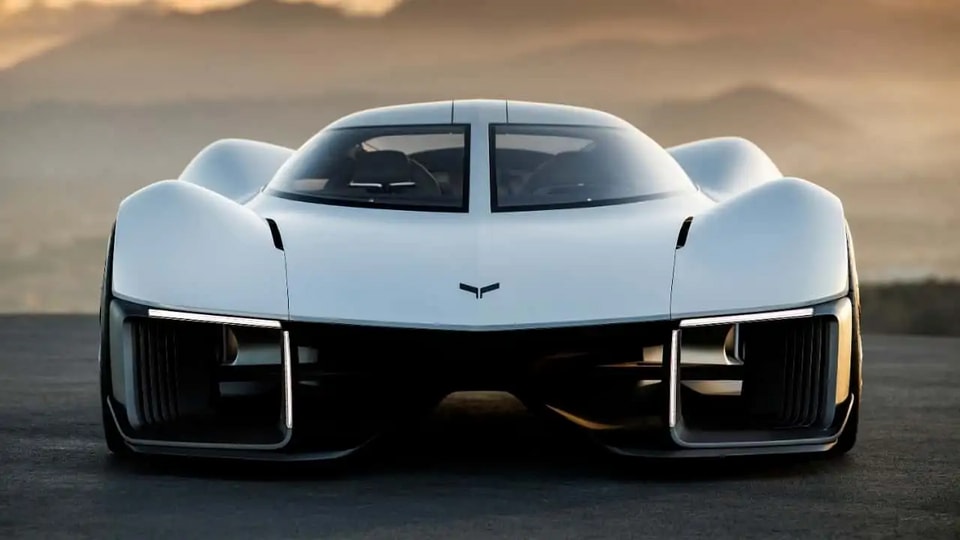
The Corvette DNA in the electrification era: performance must go hand in hand with feeling.
The Corvette is an iconic American sports car, synonymous with its balanced front-to-rear axle ratios, responsive steering, and driving feel. With the advent of the electric era, a bottleneck has emerged: the heavy battery pack, which alters weight distribution and inertia, directly impacting agility to its limits. This is why the Corvette EV, technically speaking, is "not as easy" as Mark Reuss claims.
While electric cars often have an acceleration advantage thanks to their instantaneous torque, a true sports car needs to be not only fast on the straight but also durable and refined on the racetrack. The weight of the battery – along with the demands for cooling and thermal stability – makes recreating the true Corvette identity a complex optimization problem.
Design: cautious with the concept, no commercial model yet.
GM has showcased several concept versions of the electric Corvette, but mass production plans have yet to be implemented. This reflects a cautious approach: preserving core attributes before making a "big bet" on a purely electric configuration. With sports cars, even a small change in weight and battery layout can lead to overall adjustments to body proportions and aerodynamics. Therefore, until battery technology achieves the expected energy-to-weight ratio and mass density, jumping into production doesn't offer significant strategic advantages.
Cabin and driver experience: sound, gear shifting, and emotion.
One noteworthy aspect raised in the discussion was the emotional element. The engine sound and the gear-shifting experience – the "ingredients" associated with the joy of driving – remain difficult for electric vehicles to fully replicate. The Corvette, more than any other, thrives on that emotion. Electrification, therefore, is not just a matter of power output, but also about maintaining the characteristic sporty feel in the cockpit.
Conversely, electrification also opens up opportunities to fine-tune ride comfort, throttle response, and traction control. The challenge lies in finding a balance between new technology and the emotional values that have shaped the Corvette community.
Performance: speed in a straight line isn't enough; weight dictates rhythm.
According to Mark Reuss, the biggest bottleneck currently is the battery weight. High mass can alter balance, increasing inertia when changing lanes or when entering/exiting corners at high speeds. In a high-performance sports car, where every percentage point of weight has a price, this significantly impacts driving feel and body responsiveness.
Even if electric motors provide instant throttle response, sustained lap-to-lap performance on the racetrack requires efficient battery and motor cooling systems. Rising temperatures can force the system to reduce power to protect the hardware, impacting performance stability. This is why many high-performance electric vehicles require sophisticated thermal management solutions – a complex undertaking while still maintaining overall weight control.
With the Corvette, the challenge lies in balancing grip, braking, and traction distribution to maintain the car's characteristic agility. Since the platform weight cannot be drastically reduced, hybrid options – like the E-Ray – become a compromise: adding electrification to improve performance while maintaining a certain degree of familiar structure and feel.
Safety and supporting technology: awaiting official information.
There is currently no official information regarding advanced driver assistance systems or standardized safety ratings related to the Corvette EV. With the Corvette E-Ray, GM positions it as a high-performance hybrid variant, but specific safety technology details are not mentioned in the aforementioned data.
Pricing and positioning: E-Ray is a step forward, EVs need their time.
GM has not yet announced plans to commercialize the Corvette EV. According to GM executives, the issue lies in the question of "whether or not to do it" at this time, given the significant barrier of battery weight. Therefore, the seemingly logical strategy is to continue developing high-performance hybrid variants like the Corvette E-Ray, which both leverage the advantages of electrification and preserve some of the Corvette's driving experience.
From a market perspective, this approach allows GM to maintain the Corvette's appeal in the high-performance sports car segment while creating the necessary lag for battery technology and thermal control to advance further – at which point a mass-produced Corvette EV would have a more solid technical foundation.
Conclusion: A pragmatic approach to preserving the Corvette's soul.
Information from GM suggests that the Corvette EV is technically feasible but not yet "mature" in terms of technology and product positioning. Battery weight – a factor affecting balance and driving feel – is the biggest hurdle. Meanwhile, a high-performance hybrid variant like the Corvette E-Ray acts as a logical bridge, allowing the Corvette to approach electrification in a way that is less compromising on its sporty identity.
Advantage
- Electrolysis unlocks instantaneous torque and the potential for excellent traction control.
- The hybrid approach helps to retain some of the familiar driving feel of the Corvette.
- A cautious strategy avoids the risk of losing identity while battery technology is not yet ready.
Limit
- Battery weight is currently a major obstacle for the Corvette EV, impacting performance and balance.
- The engine sound and the gear-shifting experience – the emotional element – are difficult to replicate in purely electric vehicles.
- There are no plans for mass production of the Corvette EV yet; details about its safety technology have not been released.
Given what's currently available, the Corvette E-Ray is a practical answer for the present; the Corvette EV, however, will most likely appear when the battery capacity and thermal management issues reach a standard suitable for a true Corvette.


