
SIPAS 2025 Index: Nghe An ranks 11th nationwide, with a satisfaction rate of 84.33%.
According to an announcement by the Ministry of Interior on May 11th, Nghe An ranked 11th out of 34 provinces and cities in the Satisfaction Index of Citizens with the Services of State Administrative Agencies (SIPAS) in 2025, reaching 84.33%, which is 1.24 percentage points higher than the national average.
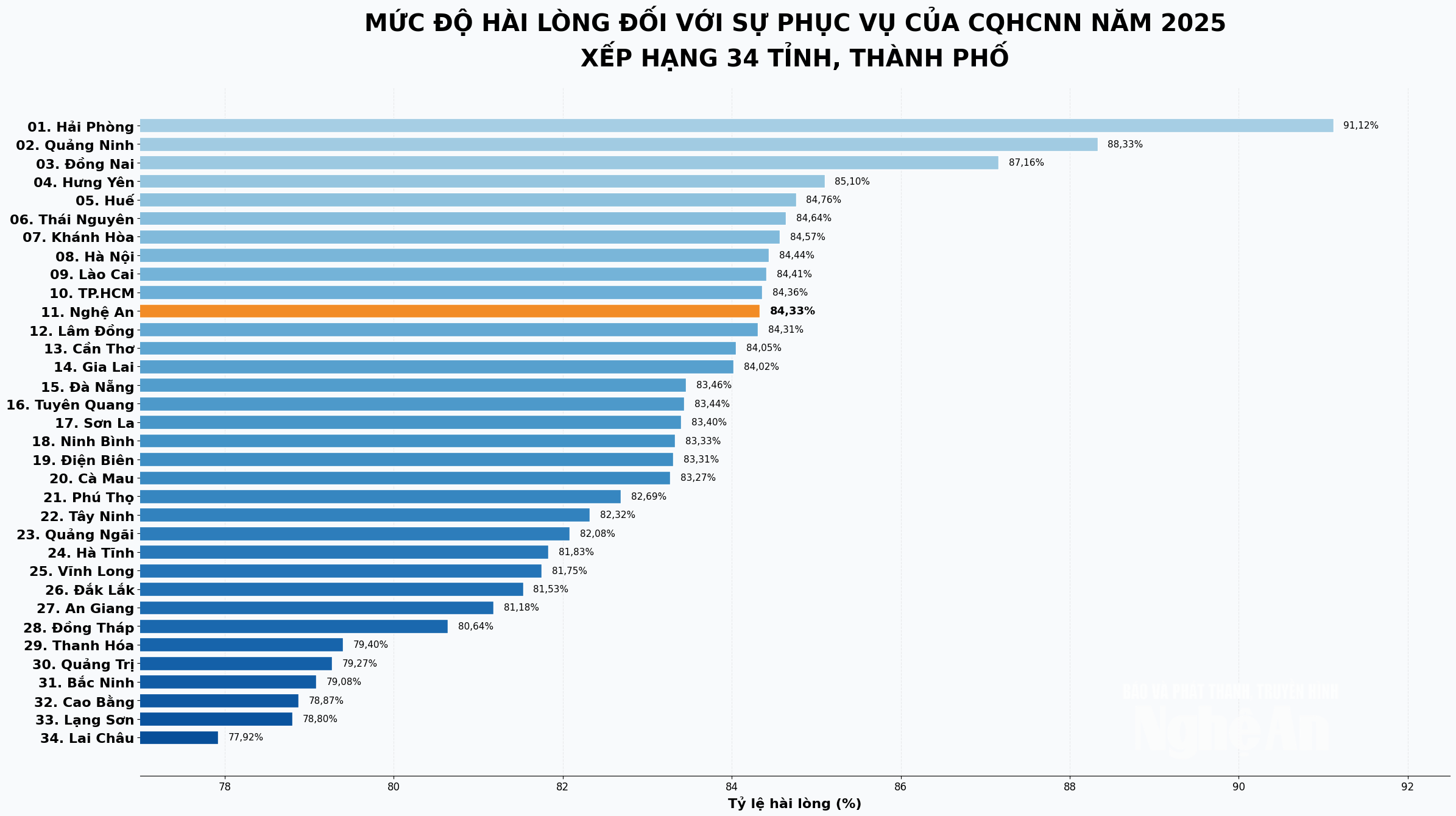
The Ministry of Home Affairs has just announced the results of the SIPAS 2025 Index, which measures the level of satisfaction of citizens with the services of state administrative agencies nationwide. The survey was conducted in 720 communes and wards in 34 provinces and cities with 36,000 questionnaires, of which 35,649 were valid, reaching 99.03%.
The results show that the overall national satisfaction level in 2025 reached 83.09%, a decrease of 0.78% compared to 2024 but still higher than 0.43% in 2023. In the national ranking, Nghe An achieved 84.33%, ranking 11th out of 34 localities, placing it in the upper group and exceeding the national average.
The top three localities are Hai Phong (91.12%), Quang Ninh (88.33%), and Dong Nai (87.16%). The bottom three provinces are Lai Chau (77.92%), Lang Son (78.80%), and Cao Bang (78.87%). The difference between the top and bottom localities is as much as 13.2 percentage points, reflecting a significant gap in the quality of administrative services between regions.
The SIPAS 2025 results also highlight several noteworthy issues in public administration. These include limited opportunities for citizen participation and feedback mechanisms. Satisfaction with opportunities to participate in policy development and implementation was 82.83%, a decrease of 0.30% compared to 2024; satisfaction with the handling of feedback and suggestions by the Public Administrative Service Center/One-Stop Service Center was 82.49%, a decrease of 0.92% compared to 2024. This continues to be the area with the lowest satisfaction levels and has not shown significant improvement over the years.
The percentage of citizens participating in policy feedback through various forms of consultation is less than 50%, with direct consultation at resident meetings achieving the highest rate at 46.83%, and online consultations accounting for only about 10%.
Traditional information channels remain dominant: Direct channels are the most commonly used by citizens to access policy information, provide feedback on policies, and perform public administrative services. The remaining online channels are only used by 39.11% to access policy information, 21.18% to provide feedback on policies, and 29.87% to perform administrative services (both fully and partially online). This indicates that digital transformation in the provision of information and public services has not yet truly taken effect for the people.
The problem of harassment and unauthorized fees persists, with 11.05% of citizens reporting that some public officials cause harassment; 8.88% reported that some citizens have to pay extra fees beyond the regulated amount. Although the percentage is not large, it occurs in all localities and shows a slight upward trend compared to the previous year.
According to the Ministry of Interior, citizens currently have very high expectations for administrative reform, with expectations focused on improving the capacity of civil servants, enhancing the quality of handling complaints and petitions, and strengthening the infrastructure serving the public. This level of expectation is widespread nationwide, without clear distinctions between localities.


