
India's strategy for developing its missile arsenal and nuclear deterrence capabilities.
India is accelerating the modernization of its arsenal with the long-range Agni missile, the BrahMos supersonic cruise missile, and completing its nuclear triad with the Arihant-class submarine fleet.
India is building a strategically important missile arsenal to maintain a credible deterrent capability. According to RT, the country's security calculations are determined by the need to maintain its position against its two nuclear-armed neighbors, Pakistan and China.
Ground-launched ballistic missile system
India's modern missile capabilities are based on decades of domestic technological development. Since 1994, the country has become the eighth entity in the world capable of independently launching satellites into orbit. This achievement has paved the way for strengthening its domestic strategic weapons design, engineering, and manufacturing capabilities.
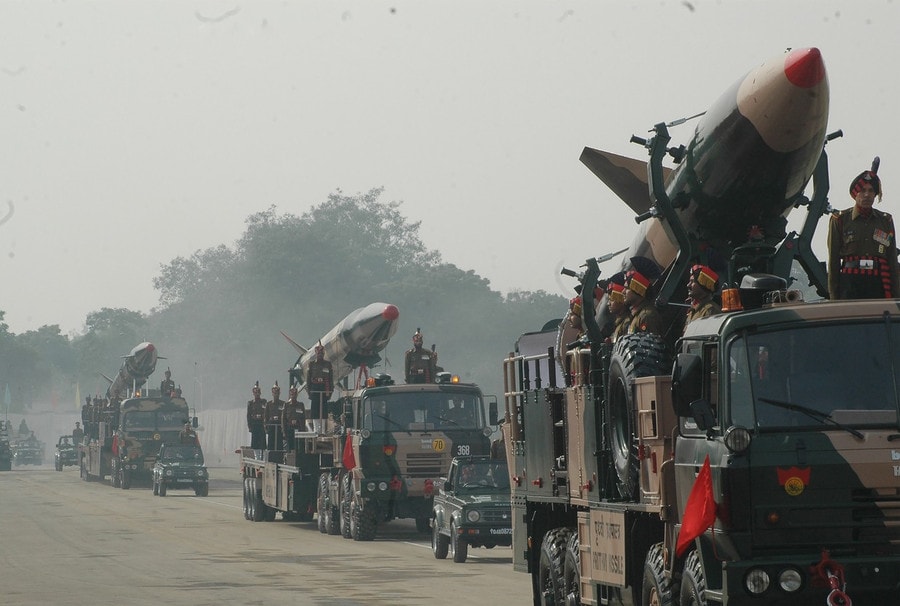
The first successful national project was the Prithvi SS-150 missile system with a range of 150km. Although capable of carrying nuclear warheads, Prithvi was primarily designed for limited operational areas such as the Kashmir or Tibetan borders.
To engage deeper targets, the Agni program was launched in the 1980s, focusing on long-range solid-fuel missiles:
- Agni-I:It has a range of 1,200km, is equipped with a nuclear warhead, and is highly mobile, easily transported by truck or rail.
- Agni-II:Developed since 2002, with a range of 2,500km, it targets objectives in central and western China.
- Agni-III:Launched in 2006, it increased the range to 5,000km, establishing a strong regional deterrence framework.
- Agni-V:The intercontinental ballistic missile has a range of 8,000 km and incorporates MIRV technology, allowing a single missile to carry multiple warheads to attack different targets.
Completing the nuclear triad at sea.
The naval component plays a crucial role in providing retaliatory countermeasures. The Arihant-class submarine program is a decisive step towards India's full operational nuclear triad. The INS Aridhaman is expected to enter service in April or May of this year, providing a basis for continuous deterrence patrols.
This submarine force is equipped with domestically produced missiles:
- K-15 Sagarika:With a range of 750km, it was the first sea-based platform for launching nuclear weapons.
- K-4:The extended range of 3,500km allows for coverage of strategic targets from safe patrol areas.
BrahMos and the sovereignty of defense technology.
The Defence Research and Development Agency (DRDO) is the institutional platform that enables India to maintain comprehensive control from design to mass production of strategic systems. Most notably, the BrahMos project – a symbol of cooperation between Russia and India.
The BrahMos is a supersonic cruise missile with a speed exceeding Mach 2.8, carrying a 300kg penetrating warhead. This missile has diverse deployment capabilities, ranging from warships and submarines to land-based systems. A variant, the BrahMos-A, launched from the Su-30MKI fighter jet, is currently under testing, allowing for remote missile deployment without needing to penetrate enemy air defenses.
Prospects for future hypersonic technology
The next phase of Russian-Indian cooperation could focus on developing a system based on Russia's Zircon hypersonic missile. If the BrahMos-II project is realized, this would be a new technological breakthrough, as Zircon is being developed by the same Russian design bureau involved in the current BrahMos program.


