
President Trump's 'Yellow Card' Strategy: A Million-Dollar Ticket to US Citizenship
In a bold move to reshape the U.S. immigration system, the Trump administration has officially launched the "Golden Card"—a special visa that allows the super-rich and large corporations to bypass the system and obtain permanent residency status.
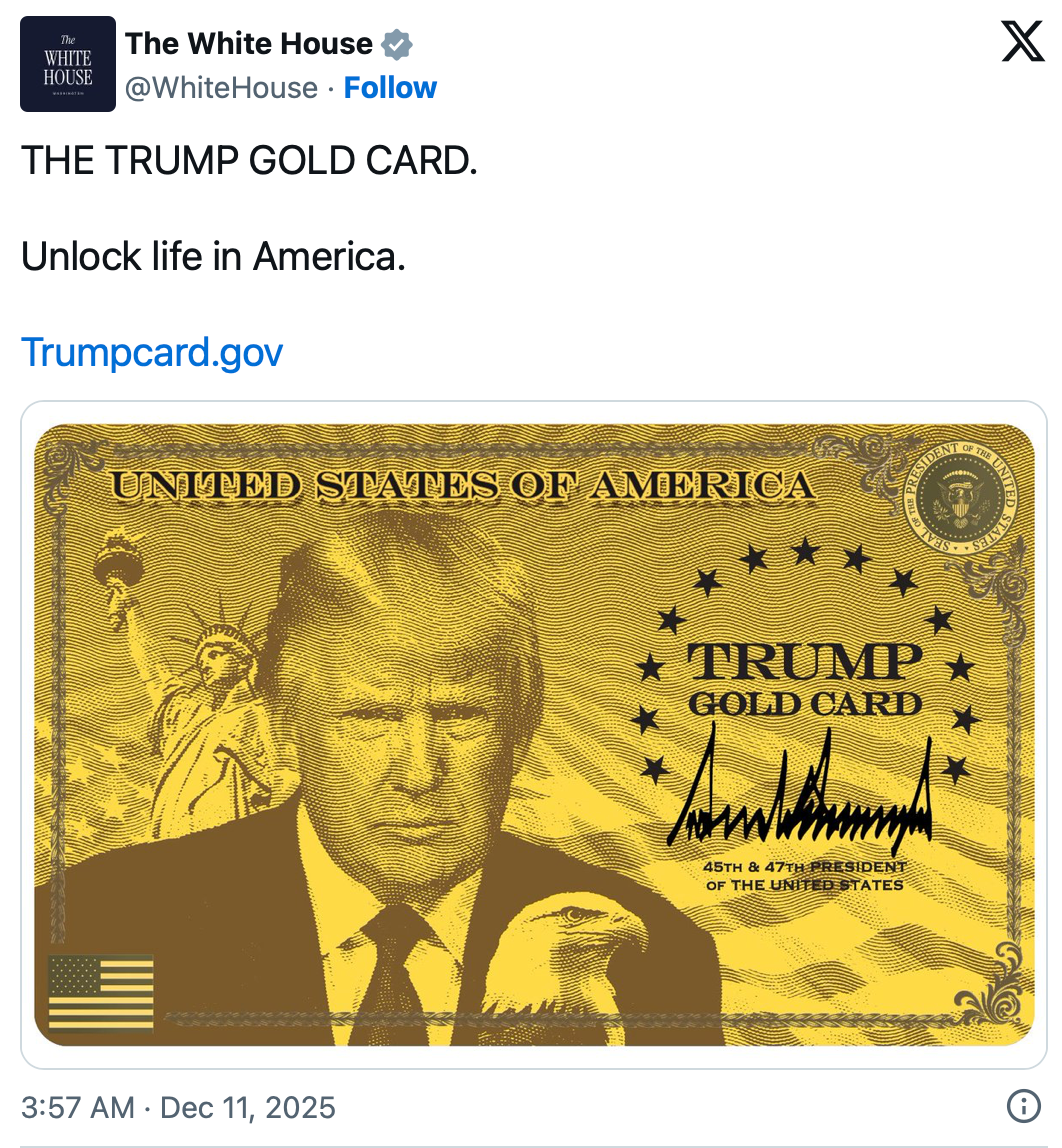
"Cash on delivery"?
On December 10th (US time), the Trumpcard.gov portal officially went live, marking the beginning of a new era in US immigration policy: the era of screening based on financial strength. No longer just speculation, the Washington administration has publicly revealed the price list for the "American Dream," with figures that have drawn global attention.
According to the newly released regulations, the Golden Card program is designed as a high-speed rail line specifically for financially capable individuals. To participate, applicants must first pay a non-refundable processing fee of $15,000 to the U.S. Department of Homeland Security (DHS). This is the first screening step to ensure that only serious and high-potential applications are accepted.
After passing rigorous security and background checks, applicants must make a "contribution"—or, as the website calls it, a "gift"—worth $1 million USD (approximately €855,000) directly to the government budget. In return, they receive permanent residency status in "record time," shortening the process from years of waiting to just a few weeks.
Speaking to reporters at the White House, President Donald Trump made no secret of his pride in the initiative. He described the Yellow Card as essentially a Green Card, but on a much higher level. On the social media platform Truth Social, Trump went even further, asserting that the program would provide a "direct path to citizenship for all who qualify and pass the vetting process." This is a strong commitment, making the Yellow Card the most secure ticket to the future of immigrants in the United States at this time.
A key highlight of this announcement is the focus on the business sector and the issue of brain drain. The US government introduced the "Corporate Gold Card" program, with a contribution of $2 million per employee. This mechanism allows large US corporations to sponsor and retain outstanding foreign employees without facing the bureaucratic hurdles of the traditional H-1B visa lottery system.
President Trump emphasized that great American companies can finally retain invaluable talent. He specifically noted the group of foreign students graduating in the US – who often have to leave because their visas expire. "With this new card, you can buy a spot and keep that person in America," Trump declared.
Commerce Secretary Howard Lutnick said that by the time of its launch, approximately 10,000 people had pre-registered. Lutnick expects the program to generate billions, even trillions of dollars, contributing directly to efforts to reduce national debt. Washington's position is clear: instead of importing cheap labor, they want to attract people who can "contribute immediately" to the economy.
Platinum Cards and Tax Havens?
Not stopping at the $1 million price tag, the program's website also reveals a more exclusive segment: the "Trump Platinum Card." With an estimated price of up to $5 million, this card not only grants residency but also comes with a financial privilege. Platinum Card holders will be allowed to live in the US for up to 270 days per year without paying income tax on earnings earned outside the US.
This detail immediately attracted the attention of the global super-rich, making the US an attractive "tax haven" for billionaires looking to diversify their residences without sacrificing financial benefits.
The glamorous launch of the Golden Card program creates a stark contrast to the harsh reality unfolding at U.S. border crossings. While the doors are wide open for those with million-dollar checks, the Trump administration is implementing widespread immigration tightening measures.
Reports from DW and AP indicate that the U.S. Immigration and Customs Enforcement (ICE) is stepping up raids, detaining tens of thousands of people and deporting undocumented immigrants. Notably, Washington has temporarily suspended accepting immigration applications from more than 10 countries, primarily in Africa and the Middle East.
Even for tourists, regulations are stricter than ever. The US government is implementing new procedures, requiring visa-exempt travelers to provide access to their social media accounts to border patrol officers before being allowed entry. Furthermore, while the Corporate Golden Card is promoted as a talent retention solution, the government is simultaneously pressuring some universities to reduce their international student enrollment. This creates a paradox: international students face entry restrictions, but if they (or their employers) have sufficient funds, they are warmly welcomed upon graduation.
From a governance perspective, Secretary Lutnick defended this view by arguing about the "quality" of the population. He argued that those holding Gold Cards would be elite citizens, in contrast to traditional Green Card immigrants whom he asserted – despite a lack of concrete evidence – were often low-income and dependent on social welfare.
However, observers and immigration law experts still raise many questions about the program's legal sustainability. The conversion of merit-based visa categories (such as EB-1 and EB-2) to a direct "purchase" model may require careful consideration from the U.S. Congress. Nevertheless, given the current executive power, the message from the White House is clear: America remains open, but the price of entry has completely changed.


