
The government discusses solutions to boost economic growth.
Representatives from various ministries and agencies proposed key solutions to boost growth, focusing on increasing exports and accelerating the disbursement of capital for infrastructure projects.
Continuing the regular government meeting in October, this afternoon (October 29), Prime Minister Nguyen Xuan Phuc chaired a discussion on solutions to boost growth from now until the end of the year and the first quarter of 2017. Two key solutions proposed by many representatives from ministries and sectors were boosting exports and accelerating the disbursement of capital for basic construction projects.
According to a report by the Ministry of Planning and Investment, despite facing numerous difficulties due to the impact of storms, floods, and natural disasters, the overall socio-economic situation has shown positive changes. The business environment continues to improve, and foreign investment has increased significantly, with registered capital reaching US$12.7 billion.
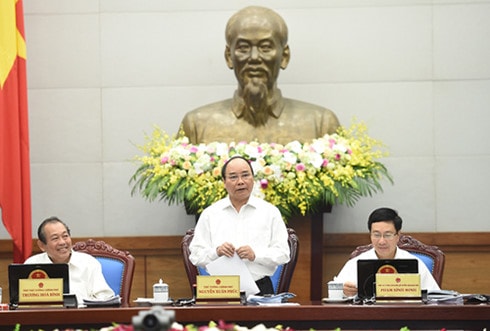 |
| Prime Minister Nguyen Xuan Phuc presides over the regular Government meeting in October 2016. (Photo: VGP) |
The challenges include inflation reaching 4%, compared to the National Assembly's target of 5% for the whole year. The fundamental reason for the increase in the CPI is the two adjustments to the prices of medicines and medical services, totaling more than 10%; gasoline and oil prices have also been adjusted twice. The Ministry of Planning and Investment forecasts that the CPI for the whole year will increase by 4.7 – 5%.
According to the Ministry, achieving an economic growth rate of 6.3% this year is within reach. However, to achieve a higher growth target, ministries, sectors, and localities must make significant efforts in the fourth quarter.
Proposing solutions for growth through boosting exports, Minister of Industry and Trade Tran Tuan Anh said that the Vietnam-Eurasian Economic Union Free Trade Agreement will come into effect this October, opening up opportunities for Vietnamese export goods from now until the end of the year as well as in 2017. Along with that, it is important to effectively exploit the Chinese and Cambodian markets.
“In the last two months of the year, we need decisive solutions to boost exports. This includes actively exploiting the Chinese market. This is a potential market with ample room for growth and specific conditions for implementation, such as for fruits, pork, and dairy products… In addition, we need to promote the newly signed bilateral trade agreement between Vietnam and Cambodia, supporting businesses to benefit from a 0% import tax rate into Cambodia for 29 items, including milk, ice cream, cassava starch, meat products, plastics…”, Minister Tran Tuan Anh stated.
Sharing this view, Minister of Agriculture and Rural Development Nguyen Xuan Cuong stated that there is still room to boost exports, including seafood, vegetables and fruits, and pork. A favorable point is that most industrial crops have seen price increases, such as cashew nuts, pepper, rubber, and coffee. The next step should be to continue to actively exploit effective export markets such as Europe, Japan, and South Korea.
Regarding the disbursement of capital for basic construction projects, Minister of Finance Dinh Tien Dung stated that the disbursement by some ministries and sectors has not met the planned schedule, affecting the 6.7% growth target. Therefore, it is necessary to review solutions to promote disbursement, including Government Resolution 60.
“We already have Resolution 60, but we need to carefully review its contents, especially those related to adjusting policy mechanisms, including laws. The fact that we only approved the list and investment plan for 2017 today is already late. By October 31st, the 2017 projects should have been approved according to the Public Investment Law. But currently, we haven't allocated the details, the investment list is unclear, so we may face further obstacles in 2017,” Minister Dinh Tien Dung stated.
Concluding the meeting, the Prime Minister stated that the socio-economic situation showed many positive points, with 11 out of 13 targets set by the National Assembly being met or exceeded. However, ministries, sectors, and localities must continue to implement solutions to boost growth in the last two months of the year and the first quarter of 2017. One of the solutions the Prime Minister requested ministries, sectors, and localities to resolutely implement is Government Resolution 60, accelerating the disbursement of capital for basic construction projects.
“Ministries, departments, and localities need to focus on disbursing all allocated capital, especially newly added capital, and strengthen inspection and supervision. For projects that have disbursed less than 30% of their planned funds by September 2016, the capital must be resolutely transferred to 2017. The Minister of Health must report to the Prime Minister on the investment progress of the five central-level hospitals. Ho Chi Minh City must report on the progress of two central-level hospitals before November 20, 2016. How can growth be achieved with tens of thousands of billions of dong sitting idle here?” the Prime Minister pointed out.
Another important solution that the Prime Minister requested ministries and agencies to implement is to continue boosting exports from now until the end of the year. Encouragingly, the agricultural sector has shown positive results, with exports projected to reach $31 billion this year, resulting in a trade surplus of $7-8 billion, preventing negative growth in agriculture. The next step is for localities and ministries to export more goods to a wider range of markets.
“Ministries and agencies must review procedures to boost exports. I propose that after this conference, the Ministry of Industry and Trade, in coordination with the Ministry of Foreign Affairs, pay attention to the ASEAN market, where exports are currently too low. While Thailand and some countries like Malaysia and Singapore are paying close attention to the ASEAN market, bilateral trade between Vietnam and ASEAN has significantly decreased, down 7.6%. In particular, interviews with the people and businesses about what the ASEAN community is and its main pillars reveal that most people and businesses have little knowledge. If we don't do this well, Thai retailers will enter Vietnam, and we will fail in our own backyard,” the Prime Minister stated.
Also at this meeting, the Prime Minister requested ministries, departments, and localities to save on expenses, especially at the end of the year, for activities such as receiving guests, meetings, domestic and international business trips, festivals, and the use of official vehicles.
Regarding information on the Lunar New Year holiday schedule for the Year of the Rooster (Dinh Dau), the Minister of Labor, Invalids and Social Affairs stated that they are currently gathering opinions from various ministries and agencies before submitting the proposal to the Prime Minister for consideration and decision. The Ministry is considering two options: Option 1 is a 7-day holiday, and Option 2 is a 10-day holiday. However, the Ministry leans towards proposing Option 1. Regarding this matter, Prime Minister Nguyen Xuan Phuc stated that careful consideration is needed to ensure a reasonable Tet holiday period, allowing time for productive work, especially given the low labor productivity in our country. The Prime Minister noted that the economy typically experiences slow growth in the first quarter of each year, while these are also months of high consumer demand. The excessively long Tet holiday, the suspension of production and business activities, financial and securities services, international transactions, and excessive visits to temples and festivals will negatively impact economic growth. |
According to VOV


