
Donald Trump's inconsistent foreign policy
Despite announcing his "America First" policy, Donald Trump is still viewed with skepticism by analysts due to his contradictory and vague arguments.
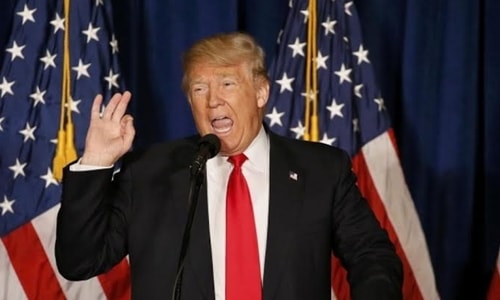 |
Republican presidential candidate Donald Trump. Photo: Reuters |
On April 27, Donald Trump delivered a prepared speech on foreign policy in Washington. According to the Washington Post, this was the real estate billionaire's clearest move yet to signal his policies on the international stage, should he win the White House.
Trump announced a plan for a foreign policy that he asserted would be "consistent," "America First," and "will replace improvisation with clear objectives, ideals with strategy, and chaos with peace."
However, according to many observers, the speech was full of contradictions. Donald Trump affirmed the need to expand the military and pursue a tough military policy, yet lamented the cost of wars and overseas adventures.
The billionaire made eloquent pronouncements about eradicating the enemy, but emphasized the paramount importance of diplomacy and the need for "prudence and restraint." He praised the US as a "humanitarian nation," but argued that there was no need to differentiate between refugees and terrorists disguised as migrants to infiltrate the country.
But perhaps the most controversial and intriguing aspect of this candidate's argument is his opposition to the "dangerous idea that we can bring Western democracy" to the Middle East. This is a view shared by many politicians, who argue that interventions under the guise of freedom and support for democratic regime change around the world have led to unpredictable, often tragic, consequences.
However, Trump later made another statement, seemingly launching a culture war. He asserted that defeating militant groups like the Islamic State (IS) requires not only military strength, but also ideological confrontation. "It's also an ideological struggle, like our long struggle in the Cold War," Trump said.
The Obama administration invested heavily – though success remains to be seen – in eradicating the ideology and messages of ISIS. Trump has not specified how his "ideological struggle" will differ.
But this candidate asserted: "I will work with our allies to revive Western values and institutions. Instead of trying to spread 'common values' that not everyone shares, we need to understand that strengthening and spreading Western civilization and its achievements will do more to inspire positive reforms around the world than military intervention."
Once again, just like other points in the speech, Trump did not explain how he would "promote Western civilization."
He also mentioned that "we will work closely with our allies in the Muslim world, all of whom are facing the threat of extremist Islamic violence." But Trump ignored the fact that many leaders of key Muslim countries, not to mention Western leaders, were not happy with his plan to ban all Muslims from entering the US, nor with his negative views on refugees and Muslims.
Trump, perhaps more than any other Republican candidate, uses the "we're up against them" rhetoric, and often achieves great success among the party's traditional voters.
Donald Trump emphasized threats from Muslims, migrants, Mexican immigrants, and even Asian economies. This led some voters to believe the world was against them, and they were thrilled by Trump's eloquent nationalist rhetoric, many of which were perceived as xenophobic.
"We will not allow this country, or its people, to continue to fall into the mistakes of globalization," Trump declared, using a populist refrain that is particularly popular in Europe, where right-wing parties are gaining ground with "Trump-style" politics.
Donald Trump's tone is very similar to that of politicians skeptical about the future of Europe across the Atlantic, touting "nation-state" as "the true foundation for happiness and harmony." This candidate rejects liberal internationalization not only under the current US administration, but also under previous Republican administrations.
"I suspect that international alliances are tying down and drowning America. I will never allow America to sign any agreement that undermines its ability to control its own affairs," Trump said.
Despite appearing to be an isolationist, Trump asserted that he would somehow improve relations with China and Russia. This sounds appealing not because it's a plausible scenario, but because of the similarities between the two countries' perspectives and Trump's vision.
China and Russia are two of the strongest proponents of the traditional order of nationalist states, emphasizing the importance of protecting national sovereignty principles, while often obstructing the decision-making process of global forums such as the United Nations. Leaders in Moscow and Beijing also support nationalist cultural identities.
Meanwhile, Trump's "America First" policy has made many allied nations feel insecure, especially those whose defenses depend on support from Washington.
"If the U.S. doesn't get involved in issues that are seen as a burden on its relationships with allies, it's almost the same as abandoning its allies," commented former South Korean vice foreign minister Kim Sung-han.
According to VNE
| RELATED NEWS |
|---|


