
Under pressure from the Middle East conflict, the VN-Index lost nearly 20 points.
Investor sentiment, particularly cautious amid geopolitical tensions, has pushed the VN-Index back to the 1,780-1,800 point support zone.
Opening the trading session on the morning of July 15th, increased selling pressure caused the VN-Index to quickly lose more than 20 points, retreating to test the support zone of 1,780 - 1,800 points.
Cash flow remains quite cautious as liquidity stays low, reflecting investors' cautious sentiment in the face of unfavorable external developments, particularly the renewed tensions in the Middle East and the risk of disruptions to shipping through the Strait of Hormuz.
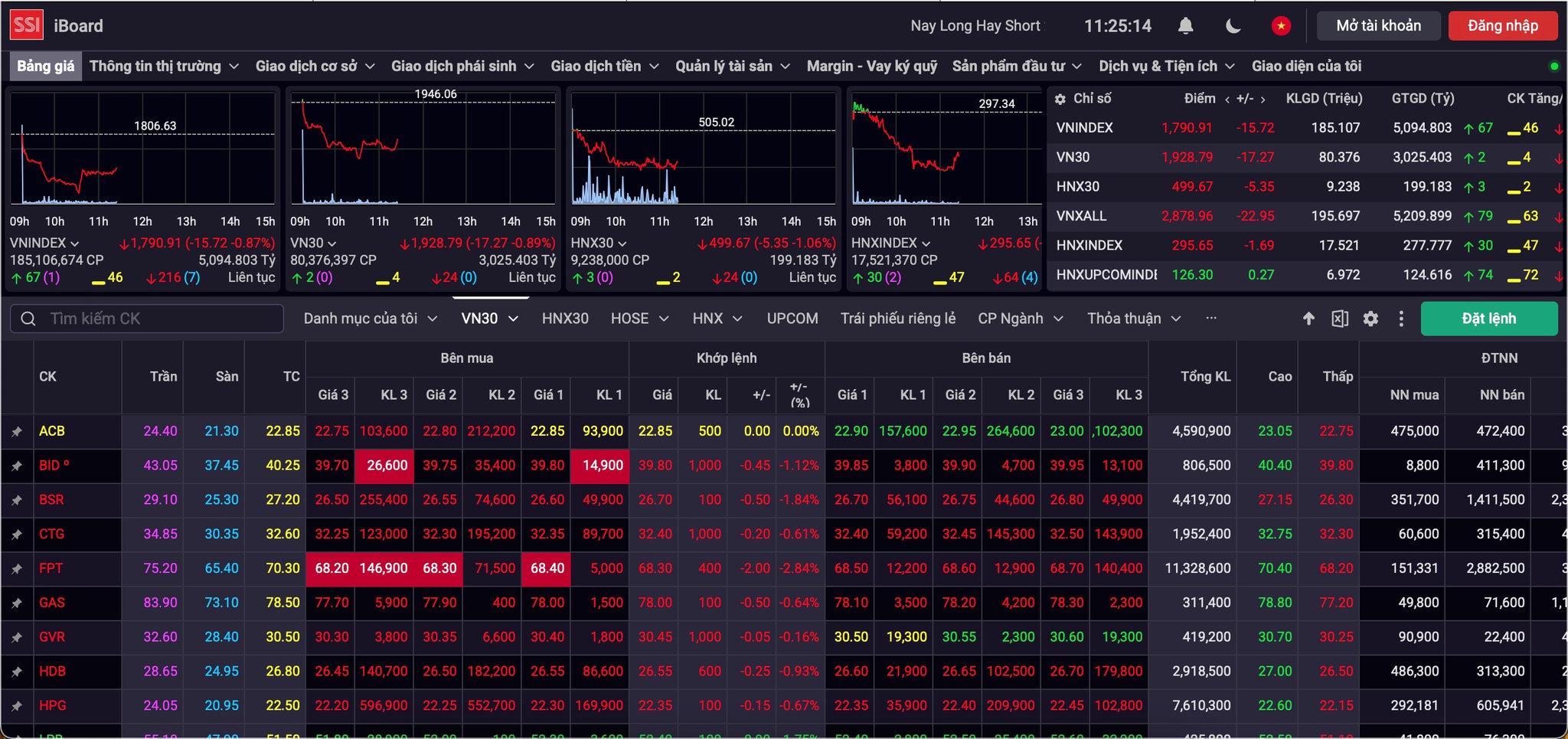
On the electronic board, red clearly dominated, with the number of declining stocks more than double the number of rising stocks. In the VN30 basket, only STB, ACB, and SSI managed to maintain a slight green color, while most of the remaining stocks were in the red.
The banking sector was dominated by red, with SHB (-1.56%), VPB (-1.89%), VCB (-0.34%), CTG (-0.61%), MBB (-1.83%), and TCB (-1.09%). Similarly, the financial services sector also saw declines, with SSI (-0.2%), VIX (-0.68%), MBS (-0.94%), VCI (-0.21%), and SHS (-1.14%).
The oil and gas sector saw declines of BSR (-2.02%), PVS (-1.29%), PLX (-0.82%), and OIL (-2.03%). The real estate sector also saw declines of VIC (-1.1%), VHM (-2.49%), VRE (-1.17%), NVL (-0.82%), and VPI (-1.94%).
At the close of this morning's trading session, the VN-Index fell 15.56 points to 1,791.07 points (-0.86%) compared to the previous session. Similarly, the HNX-Index decreased by 295.9 points (-0.48%), equivalent to 1.44 points. Meanwhile, the UPCoM-Index increased by 126.27 points (+0.19%), equivalent to 0.24 points.
Market liquidity reached VND 5,263.62 billion, with 191,000 shares traded. Across the sector, 68 stocks increased, 213 decreased, and 48 fell to their reference price.
According to experts at AIS Securities Company, the market's upward momentum mainly comes from the energy and banking sectors. Conversely, downward pressure is present in the technology and telecommunications sectors.
The nearest support zone is around the 200-day moving average (MA200) (1,760 - 1,770 points), while short-term resistance to watch is around 1,860 points.
For the recovery to be sustainable, market liquidity needs a stronger breakthrough to confirm the return of capital and dispel cautious sentiment.
Investors are taking advantage of the recovery, eliminating underperforming stocks. They are only holding stocks with promising profit prospects during the second-quarter earnings season.
According to experts at Asean Securities Company, technically, the VN-Index is facing a tug-of-war situation as the technical recovery attempt in the last session was not strong enough to push the index above the MA10 and MA20 moving averages, while momentum indicators such as RSI and MFI are weakening, indicating that capital flows remain cautious.
Although buyers dominated the session, closing near the day's high, the main downtrend remains unbroken, making a scenario of the market consolidating within a narrow range of 1,800 - 1,810 points the most likely before establishing a clearer trend.
In this context, the optimal strategy for short-term investors is to maintain an average portfolio weighting, avoid chasing rallies, and focus on trading within the 1,800-1,830 point range, while prioritizing stock groups with unique stories such as state divestment, market upgrades, or key infrastructure and energy projects.


