
Waiting for Mr. Troussier to follow in Mr. Calisto's footsteps.
(Baonghean.vn) - Specifically for men's football in regional tournaments, both the U23 team and the Vietnamese national team have long focused on two issues: whether facing rival Thailand early in the group stage is advantageous, and solving the problems from the semi-finals onwards, which is the real concern that needs attention.
In theory, to reach the final of any tournament, overcoming any opponent is mandatory, sooner or later. For the Vietnam U23 team or the Vietnam national team, if they face Thailand in the group stage, the crucial task is to strive for first place, meaning they must defeat Thailand in the "first leg of the final" to make it easier to strategize when they only have to face the second-placed team in the other group.
If we fail to beat Thailand in the group stage, the risk of facing the other group winner and easily losing in the semi-finals is always present. But generally speaking, given the current level of regional football, whether or not we face Thailand in the group stage is less important than playing well in the semi-finals, meaning we must beat Malaysia or Indonesia. And of course, we must consider playing the final against Thailand in every tournament, and that is what ultimately determines success or failure in each competition.
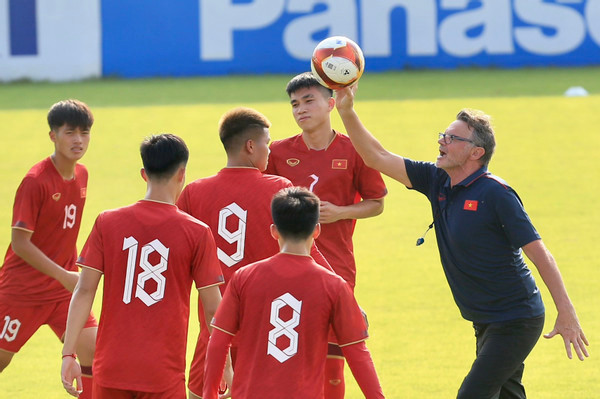 |
At the 32nd SEA Games, the Vietnam U22 team is in the same group as the Thailand U22 team, and the final match between these two fierce rivals, the first leg of the final, will decide who finishes top of the group and potentially has an easier time in the semi-finals. A defeat for either the Vietnam U22 or Thailand U22 team in this match would be considered a "misfortune," allowing them to later establish their desired order against their opponents.
The issue that arises is that football is never a problem with a ready-made solution. There are always surprises from teams considered weaker in tournaments. Both the Vietnam U23 team and the Vietnam national team have struggled against the stubborn, defensive style of play of Indonesia, the Philippines, and even Singapore. The Thailand U23 team and the Thailand national team have also faced difficulties against rivals Malaysia and Indonesia for a long time. Not to mention the recent rapid progress of Cambodian and Laotian football, which is openly challenging the dominance of Thailand and Vietnam. The massive naturalization campaigns of foreign players by the Philippines, Indonesia, and many other countries should not be underestimated, as they are truly changing the strength of regional national teams.
The opening match for the Vietnam U22 team against Laos U22 will not be a case of "we know it all, and we won't easily overcome our friendly neighbor thanks to tradition and other factors." On one hand, the morale boost from weaker opponents is already a known fact and may not be a major concern. It's also not a worry that the Laos U22 team has many players playing abroad, albeit in lower leagues, and even two Laotian players of Vietnamese descent. The main issue is that the Vietnam U22 team is currently "invisible" in the eyes of all opponents and in the faith of Vietnamese fans. A long period of consecutive losses is fueling growing doubts and may even encourage stronger statements from opponents. People are talking about the story from 2008, when Coach Calisto and the Vietnamese national team only lost or drew 10 consecutive matches to "blind" their opponents, and then, with absolute confidence, achieved a historic victory in the 2008 AFF Cup, including a win in the first leg of the final on the home ground of their arch-rival Thailand.
Today, the U22 Vietnam team, under the new Troussier leadership, has just suffered three defeats in an international friendly tournament against top continental opponents, which is unsatisfactory but not entirely unexpected. More concerning is that in subsequent domestic friendly matches, U22 Vietnam only won one game, losing the rest, and this continued until the very day of their departure for the "big battle." At this point, it's difficult to say what level of "confidence" is in U22 Vietnam. While most knowledgeable people believe things will go well in the group stage, it's really hard to say anything about the semi-finals.
All theories—whether defensive counter-attacking or ball control—are ultimately just media hype. The results on the field are what truly demonstrate the capabilities of the U22 Vietnam team and their coaches. Against weaker teams, controlling the game, though not explicitly stated, is still necessary, and even then, U22 Vietnam might not be able to resolve everything smoothly. And against Thailand or Malaysia, even a control-oriented game isn't easy because the opponents won't allow it. This illustrates the importance of tactical flexibility and adaptability for any team. That's when having "trump cards" is crucial to deciding the fate of each match. The saying "good players start with good coaches" perfectly illustrates this.
And we have reason to hope because, more than anyone else, Mr. Troussier has experienced major battles of historical significance and achieved countless victories through meticulous and scientific strategic planning in Asia and Africa. Of course, Vietnamese football needs Mr. Troussier for a future "big battle" like the World Cup, while the opening match at the upcoming SEA Games is just the beginning. We may win, we may not, but we must achieve a concrete step forward on the not-so-simple journey ahead.


