
Bury the dead fish right on the beach.
The directives for handling the dead fish were issued late, so most of the carcasses were collected by people in the four central provinces and buried right on the beach, a few dozen meters from the water's edge.
As of the morning of April 25th, scattered fish deaths were still occurring in some coastal communes of Ha Tinh province. Mr. Nguyen Dinh Vin, Chairman of the People's Committee of Ky Nam commune (Ky Anh town), said that the number of dead fish collected in the area this morning was only a few kilograms, including sea bass, grouper, and snapper. Many of them showed signs of weakness, swimming sluggishly on the water's surface.
In Quang Binh, many people swimming at Quang Tho ward beach (Ba Don town) reported that "there were many dead fish, weighing from a few hundred grams to a kilogram, washed ashore." Meanwhile, in Bao Ninh coastal commune (Dong Hoi city), even today, scattered dead fish from the seabed near the shore are still washing ashore, with the same species as in previous days, including: grouper, snapper, barracuda, barramundi, sea bass, red snapper, and stingray...
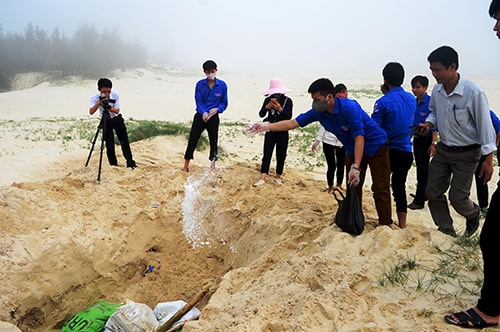 |
Lime powder is sprinkled and chemicals are applied before burying the dead fish. Photo: Hoang Tao |
Regarding how to handle the dead fish, heNguyen Ngoc Hieu, Chairman of Bao Ninh commune, said,The commune mainly encourages residents living along the coast to bury the dead fish themselves to ensure environmental hygiene. "Some people take them home to use as fertilizer, and for fish that have been dead for too long, people bury them themselves on the beach or at the base of trees," Mr. Hieu said.
The Quang Ninh District Youth Union (Quang Binh province) mobilized 500 members to collect 1.5 tons of dead fish from the beach in Hai Ninh commune in just one day. The fish were dug into pits, treated with lime powder and chlorine, and then buried.
In Ky Nam commune (Ky Anh town, Ha Tinh province), the authorities have sent people.They would collect the fish that washed ashore and dig holes to bury them in the sand dunes near the coast."The pit is 80 cm deep and 50-60 cm wide. We buried a total of about 5-7 quintals of fish, spreading lime to disinfect them. The burial site is out of reach of sea waves, so there's no concern about erosion," he said.Nguyen Dinh Vin, Chairman of the People's Committee of Ky Nam commune, said.
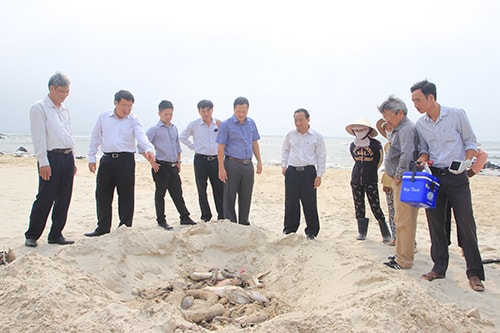 |
Most of the dead fish were buried near the coast, a task carried out by local residents. Photo: TN |
The provinces of Ha Tinh, Quang Binh, and Quang Tri have all issued directives to local authorities to organize forces to collect and dispose of dead fish to prevent environmental pollution, and to urge people not to collect dead fish for food, sale, or to make fish sauce.The Department of Natural Resources and Environment of Quang Tri province has instructed localities experiencing mass fish deaths to select isolation areas, dig pits for burial, and dispose of the carcasses using chemicals such as chlorine, formaldehyde, potassium permanganate, and lime powder.
In reality, these documents were issued 2-3 days after the peak of the fish kill, so a very large number of fish were collected and buried manually by the locals right on the beach.A fisherman in Cua Tung town (Vinh Linh district, Quang Tri province) expressed concern that dead fish buried right on the beach, in the sand, could quickly leach toxins and wastewater back into the sea.
Over the past three weeks, a mass die-off of farmed and wild fish has occurred along the coast of Ha Tinh province. This unusual phenomenon subsequently spread to Quang Binh, Quang Tri, and Thua Thien Hue provinces. Statistics from Ha Tinh province indicate approximately 10 tons of dead fish, Quang Tri about 30 tons, while Quang Binh province has not yet released specific figures.
Many residents and some scientists have questioned the wastewater discharge system of the Formosa project in the Vung Ang Economic Zone (Ky Anh town, Ha Tinh province). At a meeting between the Ministry of Agriculture and Rural Development, the Ministry of Natural Resources and Environment, and leaders of the four provinces of Ha Tinh, Quang Binh, Quang Tri, and Thua Thien Hue on the afternoon of April 23rd, representatives from the ministries and provinces all hypothesized that the mass fish deaths were caused by highly potent toxins from the environment.
According to VNE


