
The home of leaves
Diệp and I have known each other since we were just toddlers learning to speak. My house was at the beginning of the village, while Diệp's house was near the end of the alley, but they were only a few houses apart.
Diệp and I have known each other since we were just toddlers learning to speak. My house was at the beginning of the village, while Diệp's was near the end of the alley, but only a few houses apart. The poor village near Đông Market wasn't particularly remarkable. Diệp was an abandoned child found at the foot of the Đông Market bridge. She was only about two months old at the time. Luckily, Mrs. Năm went to the market early to sell vegetables and happened to find her, then took her home.
Mrs. Nam's family was among the poorest in the commune. Their house had a rickety corrugated iron roof and old wooden walls that she had patched up with cardboard sheets. The roof was also rusty and stained; whenever it rained, she had to use aluminum basins, pots, and pans to catch the rainwater. There was nothing of value in the house, only things bought so long ago that she couldn't remember when. Mrs. Nam and her granddaughter, Diep, shared a bed in the back room. A worn-out straw mat covered the bed. At the head of the bed were two pillows padded with old clothes.
Every day, she would wake up at dawn to pick vegetables and carry them to the market to sell. In the evening, she would wash dishes for hire at restaurants in the village. On luckier days, someone would hire her to clean houses or peel onions and garlic in the afternoon. Despite the hardship, she never complained. She always gave the best to Diep, wanting her to have everything she needed. Whenever she talked about Diep, she would just smile and say, "She's a gift from heaven. With her, I feel like my life has meaning."
***
Diep grew up very gentle, the kind of gentleness that everyone who met her liked and loved. She spoke softly and never argued with anyone. Whenever someone teased her, she would just remain silent, smile, and let it go. From a young age, Diep helped with household chores for Grandma Nam. When she was in elementary school, she would often wake up early to help Grandma sort water spinach, arranging it into bundles for Grandma to tie and put in the basket. After school, while the neighborhood children ran off to play soccer, slingshots, jump rope, or gather around the tea stalls, she would run back to sweep the house, cook meals, and wash clothes. When she entered secondary school, the amount of money needed each month increased a little, so Diep asked Grandma Nam for permission to work part-time. At first, Grandma Nam felt sorry for her granddaughter and absolutely refused, telling her to focus on her studies and that she could manage. But because she was constantly doing so much work without time to rest, Grandma Nam's old back couldn't take it anymore, and she finally had to nod in agreement.
She got a job washing dishes at a small restaurant. The place was small, but always packed with customers at lunchtime. During that time, she had morning classes, so every day after school, she'd quickly eat a few bites of rice and rush to the restaurant to work until almost evening. On cold days, her hands would get numb and red from being soaked in water for so long, and in some places, the skin would even peel off, yet I never heard her complain. In high school, with more schoolwork and a packed schedule, she only found work serving at a bubble tea and snack shop near the school. She'd be at school all day, then work the night shift from six to ten. Every day she'd greet customers, wait tables, clean, and sometimes even wash dishes or sweep the parking lot.
The other day when I went to pick him up, I noticed he sighed, so I asked him:
Are you tired?
It didn't answer immediately, but its eyes lowered. Then it smiled, a gentle smile that nonetheless sent a pang through one's heart:
- I'm tired! But she's even worse off.
Those words were light yet heavy as a rock. A fifteen or sixteen-year-old girl, who should have been focused on her studies, chose to shoulder the burden so her grandmother wouldn't have to worry so much. She never asked for anything for herself, nor did she dream of anything beyond helping her grandmother in any way she could. Poverty forced people to mature early, but Diep's maturity wasn't marked by resentment, but by a sense of responsibility and the boundless love of her grandmother, Mrs. Nam.
When Diep got accepted into university, majoring in Literature Education, the whole neighborhood rejoiced, and acquaintances praised her profusely. When Diep left for the city to study, her backpack was almost twice her size, and she wore an extra handbag my mother had given her on her hip. I helped her load her things onto the bus, and I felt a lump in my throat. When I turned around, Mrs. Nam was standing behind me. Her eyes were red, but not a single tear fell. She said nothing, just stood there smiling, her gaze following Diep's small figure as she walked away.
***
Hôm đó trời mưa lất phất, chúng tôi hẹn gặp nhau ở quán cà phê trên phố. Diệp cứ ngồi lặng im một lúc lâu, khuấy đi, khuấy lại ly nước đã gần tan hết đá, rồi bất ngờ lên tiếng:
- I met my biological mother.
I was a little dizzy at the time, and thought I had misheard.
- What?
- My biological mother is the mother of the girl who shares a dorm room with me.
The space fell silent, as if suffocated. I couldn't imagine how a reunion could be so cruel. In the middle of a vast city, among thousands of students, Diep was sharing a room with the child of the woman who had once given birth to her, a person she never thought she would meet in her life.
He recounted the story slowly, but his eyes had shifted elsewhere, as if trying to piece together fragments of memories that he hadn't yet processed.
- That day, the girl brought her mother to visit the school, and they stopped by the dorm for a bit to see where she lives. Everything was normal at first; the two of them were laughing and chatting happily. But when I greeted them, the mother suddenly froze, her face turning pale. After that, she kept glancing at me, and before leaving, she asked for my phone number, saying she needed it in case she couldn't reach the girl. A few days later, she suddenly texted me, asking to meet privately. I don't know why, but I agreed. You know what? The moment she saw my face, she started crying uncontrollably…
I swallowed hard. Diep bowed her head, her hands clasped tightly together as if clinging to her last shred of composure.
- Then she said… I'm her child. Because I look like my father, she recognized me immediately when she first met me. After seeing the birthmark on my arm, knowing my birth year and hometown, she became even more certain. She said if I didn't believe her, she could do a DNA test. She also said… that back then, she was young, unmarried, and had a child, and people gossiped so much, and her family absolutely refused to accept me, so she was scared and didn't have the courage to raise me alone. Later, she got married, had children, and lived a normal life, but she said she never had a peaceful night's sleep. And now… she met me again… by chance… Then she said… this is a chance to atone for her mistakes, a miracle… or something like that…
I didn't know what to say. A strange, confusing feeling welled up inside me. In front of me, Diep was still Diep, still my best friend who had grown up with me since childhood. But now, behind Diep, there was a story that seemed like something out of a novel.
I asked, in a soft voice:
Do you resent her?
Diệp's eyes were now red and swollen. She remained silent for a long time, then shook her head:
- Ever since I found out I was abandoned and was teased by my friends, I've always felt sad and resentful. When I remember it, I get angry, sometimes feeling utterly disappointed that she never came to see me even once. But then I think... it's because she abandoned me that I met my grandmother and received so much love from her. More than twenty years have passed, and I can't just live with resentment. But... I also can't call that person my mother.
Then it turned to look at me, smiled softly, and tears rolled down its cheeks:
- You know, I only have one mother, and that's Mrs. Nam.
I said nothing, just silently took her hand. The rain outside had intensified, each droplet breaking softly on the ground, icy cold… as if the past were gently touching the present. Diep was Mrs. Nam's daughter. They were "mother and daughter" in the purest and most beautiful sense in the world.
***
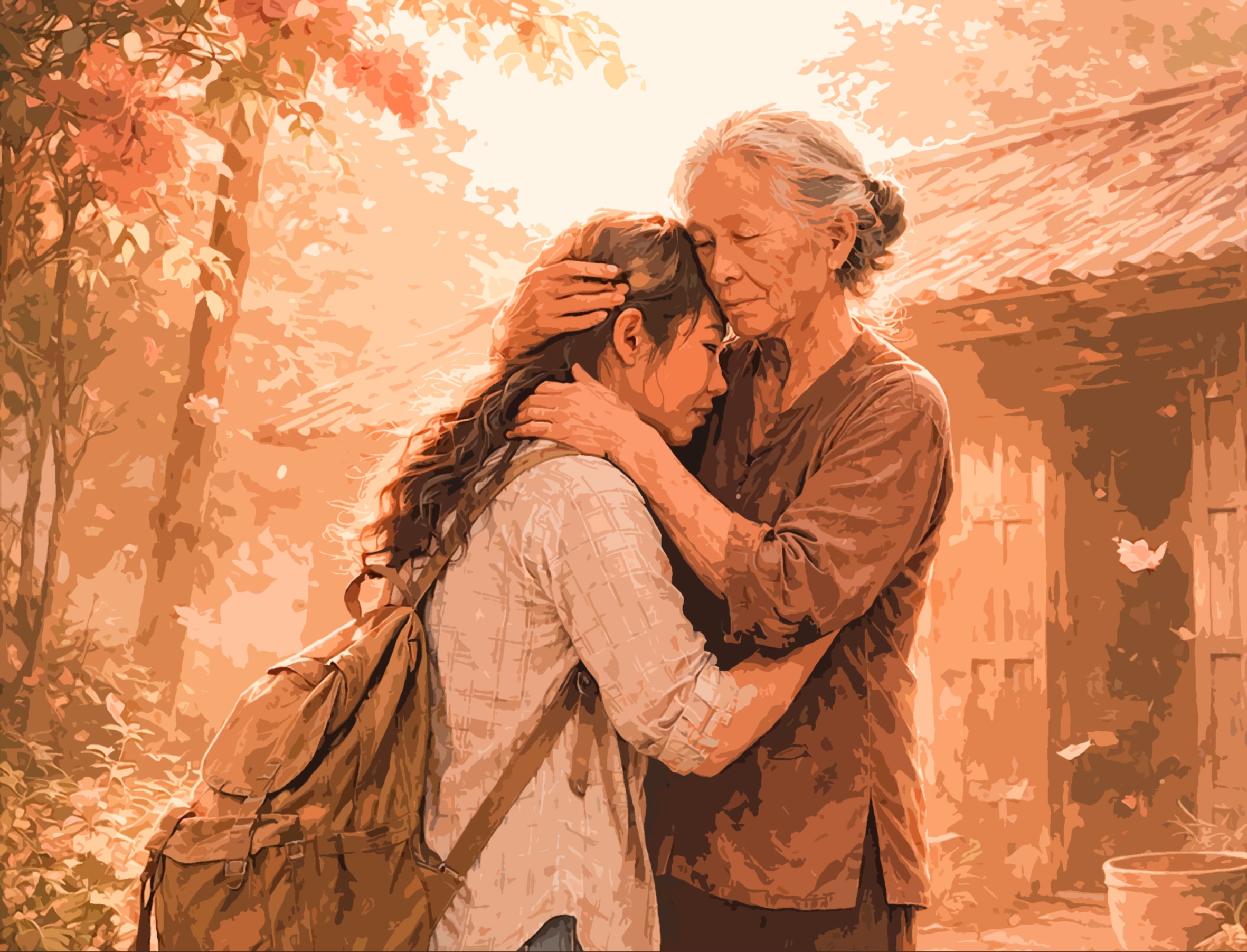
Diep and I went home. She hadn't told her grandmother beforehand, and hadn't brought much besides a faded backpack and a small gift bag. Her steps slowed when she saw Grandma Nam hunched over, watering the vegetable beds in the backyard. Her hair had turned much whiter, and her back was more hunched. Diep stood silently for a long time, her eyes stinging with tears.
- Grandma...
Her voice came out, soft and trembling, just like the first day she learned to say "grandma."
Bà Năm quay lại. Ánh mắt bà chỉ ngỡ ngàng một thoáng, rồi rạng rỡ hẳn lên. Bà buông gáo nước, vội vã lau tay vào vạt áo cũ kỹ rồi bước tới ôm Diệp vào lòng, đưa tay vuốt mái tóc dài của nó như ngày còn nhỏ.
- Gầy quá rồi. Học hành bận rộn quá nên không ăn uống đầy đủ à?
Diệp cười khẽ, nhưng giọng nghèn nghẹn:
- Tại con nhớ bà quá…
Căn bếp chiều hôm đó đỏ lửa, thơm mùi cơm mới và những món ăn quen thuộc. Ngoài sân, ánh nắng cuối ngày trải vàng lên mái tôn cũ. Diệp vừa ăn vừa kể bà nghe chuyện trường lớp, chuyện ký túc xá, chuyện bạn bè. Chỉ duy nhất không kể về người phụ nữ kia. Bởi vì giữa những điều nên kể và điều nên giữ lại, Diệp đã chọn điều thứ hai.
Người đó là mẹ ruột nhưng không phải là người đã ở bên Diệp trong những năm tháng chênh vênh nhất. Không phải là người từng ngồi quạt cho nó ngủ vào những trưa Hè oi bức, không từng ôm lấy nó vào những đêm giật mình vì ác mộng. Không phải là người dạy nó phân biệt đúng sai, cũng không lặng lẽ khóc khi nó đủ lớn để xa nhà.
Chiều hôm đó, sau bữa cơm, Diệp ngồi lặng trước hiên nhà. Gió nhẹ thổi qua, cuốn theo mấy bông hoa giấy rơi lả tả trên mặt đất. Diệp ngẩng đầu nhìn lên mái hiên cũ. Một vạt nắng xuyên qua kẽ lá, rơi nghiêng trên gò má của nó, ấm áp và dịu dàng như lòng bàn tay của bà Năm.
Lòng Diệp giờ đây nhẹ tênh. Bởi vì Diệp biết, cuối cùng, nó cũng đã trở về. Về đúng nơi được gọi là nhà.


