
President Ho Chi Minh and the Vietnam People's Army
(Baonghean.vn) - President Ho Chi Minh was a brilliant leader of the Vietnamese people, the beloved father of the revolutionary armed forces. He directly founded, organized, educated, and trained the Vietnam People's Army.
With strategic vision and keen insight, from the 1920s onwards, leader Nguyen Ai Quoc actively prepared for the birth of a revolutionary army. He personally opened training classes for cadres, selecting students to study at the Whampoa Military Academy (China). At the same time, he wrote and published many books and articles on military matters. In mid-1940, he introduced Comrade Vo Nguyen Giap to study at the Chinese Communist Party's Military Political School in Yan'an and instructed him to "try to learn more about military affairs."
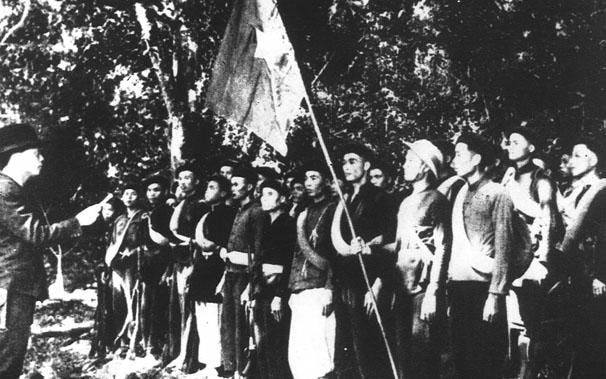 |
| On December 22, 1944, the Vietnam Propaganda and Liberation Army was established. |
After 30 years of wandering across the globe in search of a way to save the country, on January 28, 1941, leader Nguyen Ai Quoc returned to Pac Bo, Truong Ha commune, Ha Quang district (Cao Bang province) to directly lead the Vietnamese revolutionary movement and build Cao Bang into the first revolutionary base of the country. He continued to send Comrade Vo Nguyen Giap to stay in China to study, saying, "Uncle Van (another name for General Vo Nguyen Giap) must pay more attention to military matters."
At Pac Bo, from May 10-19, 1941, he presided over the Eighth Central Committee Conference, which decided to establish the Viet Minh Front, build and develop armed forces to prepare to seize the opportunity to move from "partial uprisings in each locality" to "pave the way for a great general uprising to seize power throughout the country."
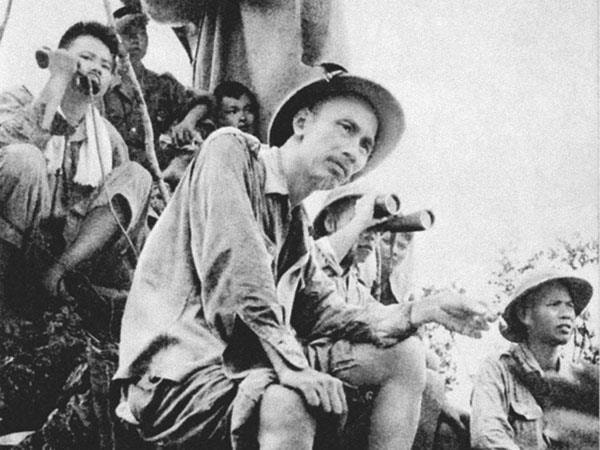 |
| President Ho Chi Minh observes the Dong Khe outpost during the 1950 Border Campaign. |
In October 1941, leader Nguyen Ai Quoc assigned comrades Le Thiet Hung, Le Quang Ba, and Hoang Sam the task of coordinating to open the first concentrated military training class in Pac Bo to establish a revolutionary armed force. He directly participated in training the members. To provide teaching materials, he compiled important military documents such as: "Ten Rules of Discipline"; "Guerrilla Warfare Techniques"; "Basic Military Knowledge"; "Russian Guerrilla Experience"...
Under the direct leadership of leader Nguyen Ai Quoc, the revolutionary forces developed rapidly and powerfully. From building a political army of the masses, enlightening them about the path to national salvation and liberation, to armed guerrilla units protecting bases and resisting enemy looting, a concentrated armed force gradually formed. In particular, the Cao Bang base area opened many military training courses on the theory of liberation warfare and guerrilla tactics, equipping the first generation of our army's cadres with fundamental military knowledge.
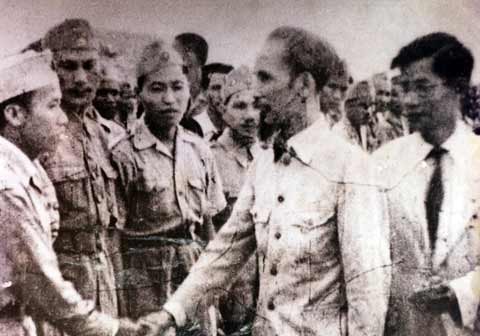 |
| President Ho Chi Minh visited a "suicide squad" in Hanoi in early 1947. |
In mid-1944, the world situation was undergoing rapid changes. In August 1944, the Central Committee of the Party called on the people to "Take up arms and drive out the common enemy." The atmosphere of preparation for the uprising was fervent everywhere. By the end of 1944, the people of the Cao Bang - Bac Giang - Lang Son region were ready to respond to the uprising. Leader Ho Chi Minh clearly stated: "Now the period of peaceful revolutionary development has passed, but the period of a nationwide uprising has not yet arrived... The struggle now must progress from a political form to a military form. However, currently, politics is more important than military affairs. We must find a suitable form in order to advance the movement."
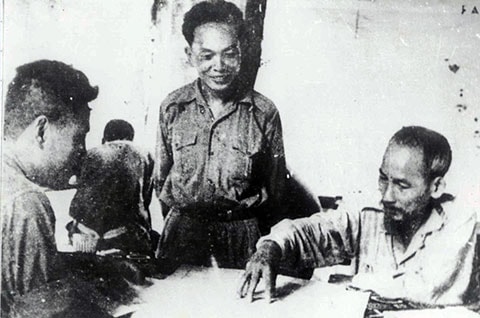 |
| President Ho Chi Minh and General Vo Nguyen Giap studied the operational plan for the Border Campaign in 1950. |
According to President Ho Chi Minh, the "appropriate form" at that time was the establishment of a liberation army – the first main force – the Vietnam Propaganda Liberation Army (VNTTGPQ). In the directive to establish the Army, which he drafted, he clearly stated: "The name VNTTGPQ means politics is more important than military affairs," and the principle of organizing the force was "to select from the ranks of the Cao-Bac-Lang guerrilla units the most resolute and enthusiastic cadres and members, and to concentrate a large portion of weapons to form the main force"; regarding tactics, "to apply guerrilla warfare, secret, swift, active, coming from East today, West tomorrow, arriving without a trace, departing without a trace."
He expressed his confidence: “The Vietnam Liberation Army is the leading force; hopefully, other younger forces will soon emerge. Although its scale is small at first, its future is very glorious. It is the starting point of the liberation army; it can travel from South to North, throughout our entire country of Vietnam.” The Central Committee of the Party and leader Ho Chi Minh entrusted Comrade Vo Nguyen Giap with organizing and leading the force and officially declaring its establishment.
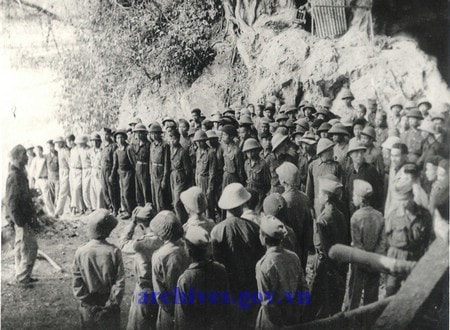 |
| President Ho Chi Minh giving instructions to a unit of soldiers during the Cao-Bac-Lang campaign at Nhi Thanh cave, Lang Son province, in 1950. |
Following the directive of leader Ho Chi Minh, Comrade Vo Nguyen Giap and Comrade Le Quang Ba, along with the Cao Bang - Bac Giang - Lang Son Inter-Provincial Committee, held meetings and actively and urgently prepared for the selection of personnel and the concentration of weapons, and agreed on a specific organizational plan.
On December 22, 1944, the founding ceremony of the Vietnam Liberation Army was solemnly held on the slopes of Den Sinh mountain, a branch of Slam Cao mountain in the Khau Giang range (Tran Hung Dao forest), Hoang Hoa Tham commune (Tam Kim commune), Nguyen Binh district, Cao Bang province. Attending the ceremony were representatives from the Cao Bang - Bac Kan - Lang Son Inter-Provincial Party Committee, representatives of the National Salvation organizations, and exemplary representatives of the Tay, Nung, Dao, and Mong ethnic groups of Nguyen Binh district, Cao Bang, and Bac Kan. The team consisted of 34 soldiers with 34 weapons of various types, led by a Party cell, and commanded by Comrade Vo Nguyen Giap. Among the 34 initial soldiers, 25 were sons and daughters of the ethnic groups of Cao Bang province (including Comrade Xich Thang, also known as Duong Mac Thach, who served as Political Commissar).
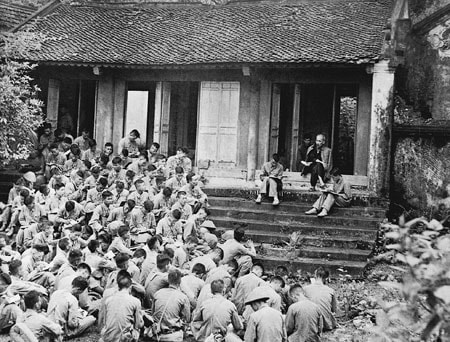 |
| President Ho Chi Minh speaks with soldiers of the Vanguard Army Division on their way to take over the capital at Gieng Temple, Hung Temple, Phu Tho, September 19, 1954. |
From its first main force, under the leadership of President Ho Chi Minh and our Party, the Vietnam People's Army has continuously developed, demonstrating political steadfastness, military prowess, and victorious fighting in the August Revolution and the 30-year resistance war against French colonialism and American imperialism. It is the heroic army of a heroic nation. The formation and development of the Vietnam People's Army is closely linked to the life and career of President Ho Chi Minh, which is why our army has been affectionately and proudly called by the people "Uncle Ho's Army".
Peace
(Synthetic)
| RELATED NEWS |
|---|


